Analysis of Natural Stone Wall Function Index Using Fuzzy Building Service Life (FBSL)
DOI:
https://doi.org/10.56127/ijst.v5i1.2612Keywords:
building service life, fuzzy logic, natural stone, function index, wall claddingAbstract
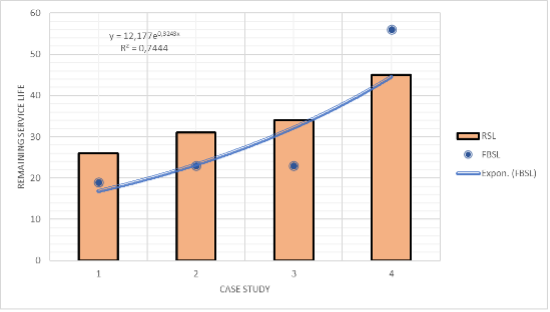
Natural stone wall claddings are widely used in residential buildings, but their functional performance often declines earlier than the building’s structural design life due to environmental exposure and installation-related deterioration. Objective: This study aims to quantify the functional condition of natural stone wall claddings using a Function Index (FI) so that maintenance decisions can be made more consistently and objectively. Methodology: A quantitative case-study approach was applied to five residential buildings in Situbondo Regency. Data were collected through field observations and building-age documentation, assessed using expert judgment, and analyzed using a fuzzy inference-based Fuzzy Building Service Life (FBSL) model to obtain a crisp FI score for each building. Findings: The results indicate that one building was classified as moderate/fair (FI = 56), while four buildings were classified as poor (FI = 0–23), implying higher maintenance urgency. When linked to the estimated Remaining Service Life (RSL) under an assumed 50-year design life and a 2020 observation year, an exploratory exponential relationship between FI and RSL was obtained (y = 12.177e0.3243x; R² = 0.7444). Implications: The FI can serve as a practical decision-support indicator to prioritize immediate repair, scheduled maintenance, or routine monitoring for façade components, even when the building still has considerable remaining design life. Originality: This research contributes by integrating a fuzzy-based functional condition index for natural stone claddings with a remaining service life perspective in a residential case-study context, bridging qualitative inspection outcomes with interpretable maintenance planning.
References
Besiktepe, D., Ozbek, M. E., & Atadero, R. A. (2021). Condition Assessment Framework for Facility Management Based on Fuzzy Sets Theory. Buildings, 11(4), 156. https://doi.org/10.3390/buildings11040156
Dejaco, M. C., Re Cecconi, F., & Maltese, S. (2017). Key Performance Indicators for Building Condition Assessment. Journal of Building Engineering, 9, 17-28. https://doi.org/10.1016/j.jobe.2016.11.004
Mamdani, E. H., & Assilian, S. (1975). An Experiment in Linguistic Synthesis with a Fuzzy Logic Controller. International Journal of Man-Machine Studies, 7(1), 1-13. https://doi.org/10.1016/S0020-7373(75)80002-2
Marzouk, M., & Awad, E. (2016). Establishing Multi-level Performance Condition Indices for Public Schools Maintenance Program Using AHP and Fuzzy Logic. Studies in Informatics and Control, 25(3), 343-352. https://doi.org/10.24846/v25i3y201608
Prieto, A. J., Silva, A., de Brito, J., & Alejandre, F. J. (2016). Functional and physical service life of natural stone claddings. Journal of Materials in Civil Engineering, 28(12). https://doi.org/10.1061/(ASCE)MT.1943-5533.0001663
Re Cecconi, F., Moretti, N., & Dejaco, M. C. (2019). Measuring the performance of assets: a review of the Facility Condition Index. International Journal of Strategic Property Management, 23(3), 187-196. https://doi.org/10.3846/ijspm.2019.7955
Silva, A., de Brito, J., & Gaspar, P. L. (2011). Service life prediction model applied to natural stone wall claddings (directly adhered to the substrate). Construction and Building Materials, 25(9), 3674-3684. https://doi.org/10.1016/j.conbuildmat.2011.03.064
Silva, A., de Brito, J., & Gaspar, P. L. (2013). Probabilistic Analysis of the Degradation Evolution of Stone Wall Cladding Directly Adhered to the Substrate. Journal of Materials in Civil Engineering, 25(2), 227-235. https://doi.org/10.1061/(ASCE)MT.1943-5533.0000588
Vieira, S. M., Silva, A., Sousa, J. M. C., de Brito, J., & Gaspar, P. L. (2015). Modelling the service life of rendered facades using fuzzy systems. Automation in Construction, 54, 1-10. https://doi.org/10.1016/j.autcon.2014.12.011
Wasserman, R., Ciabocco, L., & Shohet, I. M. (2023). Estimating the Service Life of Exterior Stone Claddings Subjected to Regular and Marine Service Conditions. Applied Sciences, 13(8), 4942. https://doi.org/10.3390/app13084942
Zadeh, L. A. (1965). Fuzzy sets. Information and Control, 8, 338-353. https://doi.org/10.1016/S0019-9958(65)90241-X
Downloads
Published
How to Cite
Issue
Section
Citation Check
License
Copyright (c) 2026 Griselda Junianda Velantika, Ayu Fatimah Sari, Karina Meilawati Eka Putri, Elok Dewi Widowati

This work is licensed under a Creative Commons Attribution-ShareAlike 4.0 International License.