Industrial Artificial Intelligence Methods for Fabric Color-Defect Detection in Textile Manufacturing
DOI:
https://doi.org/10.56127/ijst.v5i1.2600Keywords:
Industrial Artificial Intelligence, Fabric Color Defects, Textile Inspection, Illumination Robustness, SLRAbstract
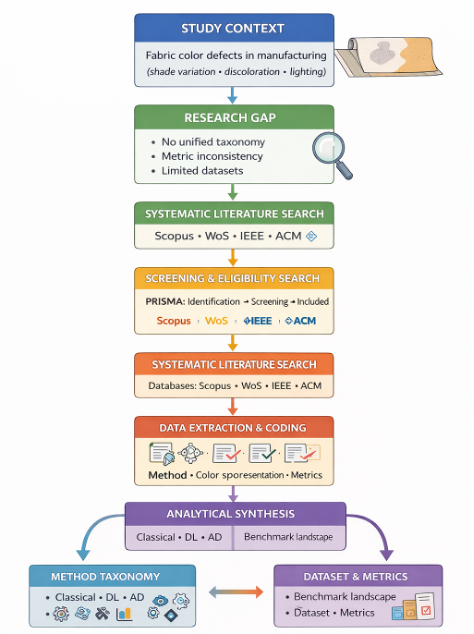
Color-related fabric defects such as shade variation, off-shade, discoloration, and color bleeding remain challenging to detect consistently in textile manufacturing because camera-based inspection is highly influenced by illumination variability, fabric reflectance, and domain shift across production batches. These limitations often reduce the reliability of automated inspection systems and highlight the need for a systematic synthesis of existing Industrial Artificial Intelligence approaches. Objective: This study aims to systematically review and synthesize Industrial Artificial Intelligence methods for fabric color-defect detection to identify methodological trends, evaluation practices, and research gaps, as well as to explain why these approaches are important for improving reliability in industrial quality control. Method: The research employs a Systematic Literature Review design, collecting peer-reviewed studies through structured database searches followed by PRISMA-guided screening and eligibility assessment. The selected studies are analyzed using comparative narrative synthesis and standardized coding of method types, color representation, illumination handling strategies, datasets, and evaluation metrics. Findings: The review reveals four dominant methodological groups: classical computer vision, supervised deep learning, reconstruction-based anomaly detection, and feature-space anomaly or hybrid approaches. Across these approaches, robust performance consistently depends on a triadic design principle consisting of color-consistent representation, illumination robustness, and learning strategies aligned with label availability. The study also identifies a key evaluation gap where conventional vision metrics are rarely complemented by perceptual color-difference measures. Implications: The findings suggest that future research and industrial implementation should focus on developing color-calibrated datasets, adopting dual-axis evaluation frameworks that include perceptual color metrics, and validating models under varying illumination and fabric conditions to enhance real-world reliability. Originality/Value: This study provides an original contribution by proposing a color-defect–focused operational framework that integrates color science principles with Industrial AI method selection and deployment constraints, offering clearer guidance than previous reviews that primarily addressed structural textile defects.
References
Chen, J. (2020). Fabric defect detection using feature fusion. Neural Computing and Applications. https://doi.org/10.1007/s00521-020-04819-5
Cui, Y., Liu, Z., & Lian, S. (2023). A survey on unsupervised anomaly detection algorithms for industrial images. IEEE Access. https://doi.org/10.1109/ACCESS.2023.3282993
Hanbay, K. (2016). A review of defect detection on textile fabrics. Optik. https://doi.org/10.1016/j.ijleo.2016.09.110
Iqbal, E. (2024). Multi-scale feature reconstruction network for industrial anomaly detection. Knowledge-Based Systems. https://doi.org/10.1016/j.knosys.2024.112650
Jing, J. (2020). YOLOv3-based fabric defect detection. Neurocomputing. https://doi.org/10.1016/j.neucom.2019.10.067
Li, P. F., Wang, J., & Jing, J. F. (2015). Application of improved back propagation algorithm in color difference detection of fabric. Color Research & Application. https://doi.org/10.1002/col.21895
Liu, X., & Yang, D. (2021). Color constancy computation for dyed fabrics. Color Research & Application. https://doi.org/10.1002/col.22653
Mei, S. (2018). A defect detection method for fabric based on deep learning. Sensors, 18(4). https://doi.org/10.3390/s18041064
Ng, M. K. P., Wang, W., & Zeng, T. (2011). A total variation model for Retinex. SIAM Journal on Imaging Sciences. https://doi.org/10.1137/100806588
Nguyen, T. A. (2024). A review of image-based fabric color measurement (IBCM) methods for textile fabrics. Color Research & Application. https://doi.org/10.1002/col.70060
Rahaman, M. T. (2024). Color fading and chromatic parameters in denim. Journal of Open Innovation. https://doi.org/10.1016/j.joitmc.2024.100435
Song, S. (2021). EfficientDet for fabric defect detection. Journal of Engineered Fibers and Fabrics. https://doi.org/10.1177/15589250211008346
Wang, J. (2025). Industrial anomaly detection based on improved diffusion model: A review. Cognitive Computation. https://doi.org/10.1007/s12559-025-10517-y
Wu, Z. (2020). Cascaded mixed feature pyramid network for fabric defect detection. Sensors, 20(3). https://doi.org/10.3390/s20030871
Downloads
Published
How to Cite
Issue
Section
Citation Check
License
Copyright (c) 2026 Byung-ho Kim, Hee-Sung Jae

This work is licensed under a Creative Commons Attribution-ShareAlike 4.0 International License.