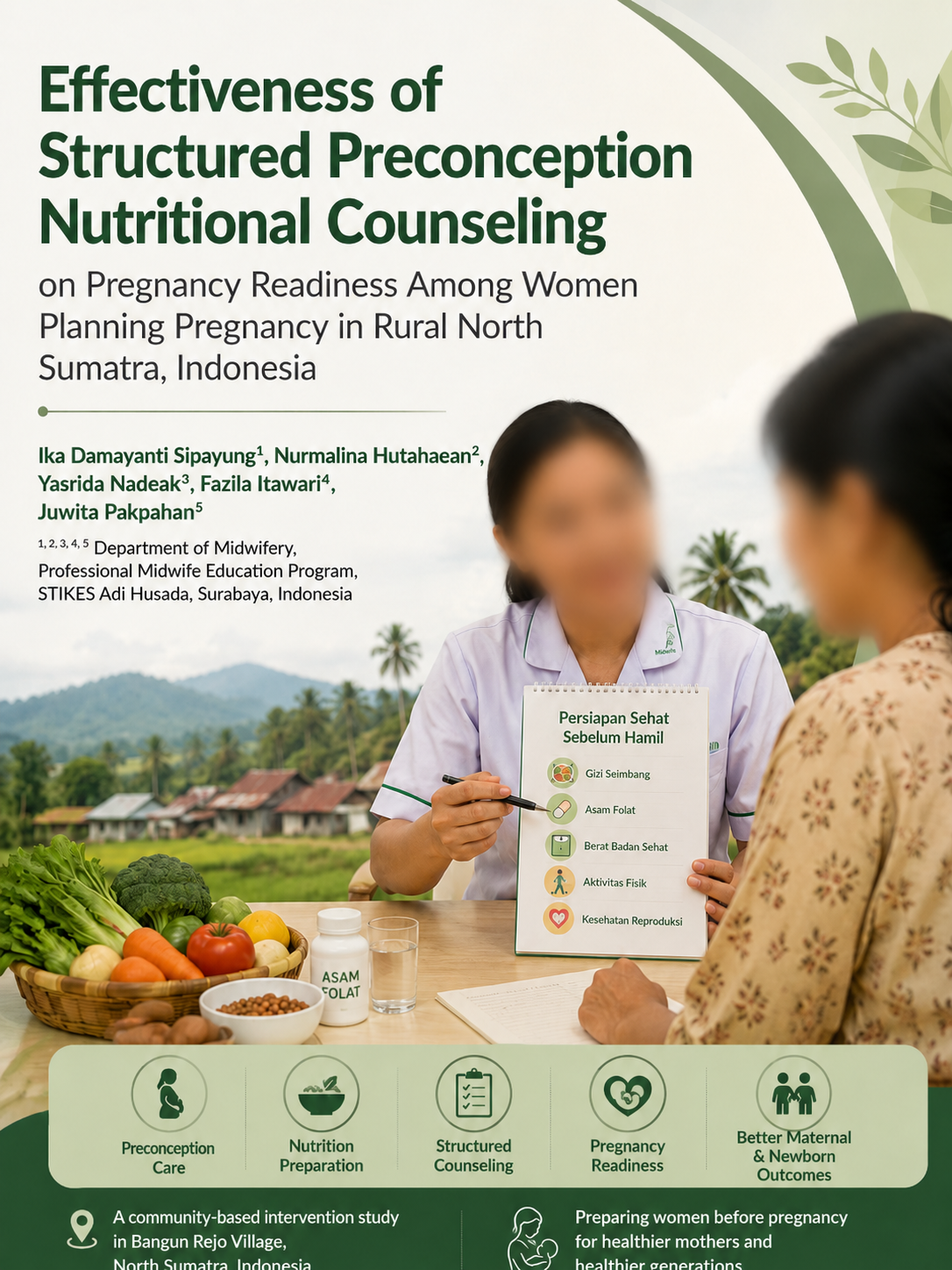
Effectiveness of Structured Preconception Nutritional Counseling on Pregnancy Readiness Among Women Planning Pregnancy in Rural North Sumatra, Indonesia
DOI:
https://doi.org/10.56127/jukeke.v5i2.2488Keywords:
preconception care, nutritional counseling, pregnancy readiness, maternal nutrition, reproductive healthAbstract
Preconception nutritional readiness is an important component of maternal and neonatal health because women’s nutritional status before pregnancy may influence pregnancy outcomes, fetal growth, and newborn health. However, structured preconception nutritional counseling has not been widely implemented in rural community settings, including among women planning pregnancy in Bangun Rejo Village, North Sumatra, Indonesia. Objective: This study aimed to examine the effectiveness of structured preconception nutritional counseling on pregnancy readiness among women planning pregnancy. Methods: This study used a quantitative approach with a quasi-experimental non-equivalent control group design. A total of 80 women of reproductive age who intended to conceive within one year were selected using purposive sampling and divided into an intervention group and a control group, with 40 respondents in each group. The intervention group received structured preconception nutritional counseling for eight weeks, while the control group received routine health education. Data were collected using a pregnancy readiness questionnaire and analyzed using descriptive statistics, paired sample t-tests, and independent sample t-tests. Results: The results showed that the intervention group experienced a significant increase in pregnancy readiness scores from 61.75 ± 8.42 to 84.20 ± 6.11 after the counseling program (p < 0.001). In contrast, the control group showed only a small and statistically insignificant increase from 62.10 ± 7.95 to 65.45 ± 7.38 (p = 0.091). Improvements were also observed in nutritional knowledge, dietary behavior, and folic acid awareness, with the highest improvement found in folic acid awareness. Implications: These findings imply that structured preconception nutritional counseling can be integrated into community-based maternal and reproductive health services to improve women’s readiness before pregnancy. Originality: The originality of this study lies in its focus on structured nutritional counseling for women actively planning pregnancy in a rural Indonesian setting, providing practical evidence for strengthening preconception care at the community level.
References
Barker, M., Dombrowski, S. U., Colbourn, T., Fall, C. H. D., Kriznik, N. M., Lawrence, W. T., Norris, S. A., Ngaiza, G., Patel, D., Skordis-Worrall, J., Sniehotta, F. F., Steegers-Theunissen, R., Vogel, C., Woods-Townsend, K., & Stephenson, J. (2018). Intervention strategies to improve nutrition and health behaviours before conception. The Lancet, 391(10132), 1853-1864. https://doi.org/10.1016/S0140-6736(18)30313-1
Benedetto, C., Borella, F., Divakar, H., O'Riordan, S. L., Kaur, H., & Lal, P. (2024). FIGO Preconception Checklist: Preconception care for mother and baby. International Journal of Gynecology & Obstetrics, 165(1), 1-8. https://doi.org/10.1002/ijgo.15446
Berhane, A., Belachew, T., & Gerbaba, M. (2022). Effect of picture-based health education and counselling on knowledge and adherence to preconception iron-folic acid supplementation among women planning to be pregnant in Eastern Ethiopia: A randomized controlled trial. Journal of Nutritional Science, 11, e58. https://doi.org/10.1017/jns.2022.51
Dean, S. V., Lassi, Z. S., Imam, A. M., & Bhutta, Z. A. (2014). Preconception care: Nutritional risks and interventions. Reproductive Health, 11(Suppl 3), S3. https://doi.org/10.1186/1742-4755-11-S3-S3
Dean, S. V., Mason, E., Howson, C. P., Lassi, Z. S., Imam, A. M., Bhutta, Z. A., & Born Too Soon Preconception Working, G. (2014). Preconception care: Closing the gap in the continuum of care to accelerate improvements in maternal, newborn and child health. Reproductive Health, 11(Suppl 3), S1. https://doi.org/10.1186/1742-4755-11-S3-S1
Dhaded, S. M., Hambidge, K. M., Ali, S. A., Somannavar, M., Saleem, S., Pasha, O., Khan, U., Herekar, V., Vernekar, S., Kumar, S. Y., Westcott, J. E., Thorsten, V. R., Sridhar, A., Das, A., McClure, E. M., Derman, R. J., Goldenberg, R. L., Koso-Thomas, M., Goudar, S. S., & Krebs, N. F. (2020). Preconception nutrition intervention improved birth length and reduced stunting and wasting in newborns in South Asia: The Women First Randomized Controlled Trial. PLOS ONE, 15(1), e0218960. https://doi.org/10.1371/journal.pone.0218960
Fleming, T. P., Watkins, A. J., Velazquez, M. A., Mathers, J. C., Prentice, A. M., Stephenson, J., Barker, M., Saffery, R., Yajnik, C. S., Eckert, J. J., Hanson, M. A., Forrester, T., Gluckman, P. D., & Godfrey, K. M. (2018). Origins of lifetime health around the time of conception: Causes and consequences. The Lancet, 391(10132), 1842-1852. https://doi.org/10.1016/S0140-6736(18)30312-X
King, J. C. (2016). A summary of pathways or mechanisms linking preconception maternal nutrition with birth outcomes. The Journal of Nutrition, 146(7), 1437S-1444S. https://doi.org/10.3945/jn.115.223479
Lassi, Z. S., Kedzior, S. G. E., Tariq, W., Jadoon, Y., Das, J. K., & Bhutta, Z. A. (2020). Effects of preconception care and periconception interventions on maternal nutritional status and birth outcomes in low- and middle-income countries: A systematic review. Nutrients, 12(3), 606. https://doi.org/10.3390/nu12030606
M'Hamdi, H. I., van Voorst, S. F., Pinxten, W., Hilhorst, M. T., & Steegers, E. A. P. (2017). Barriers in the uptake and delivery of preconception care: Exploring the views of care providers. Maternal and Child Health Journal, 21(1), 21-28. https://doi.org/10.1007/s10995-016-2089-7
Ministry of Health of the Republic of, I. (2023). Indonesia Health Profile 2022.
Stephenson, J., Heslehurst, N., Hall, J., Schoenaker, D. A. J. M., Hutchinson, J., Cade, J. E., Poston, L., Barrett, G., Crozier, S. R., Barker, M., Kumaran, K., Yajnik, C. S., Baird, J., & Mishra, G. D. (2018). Before the beginning: Nutrition and lifestyle in the preconception period and its importance for future health. The Lancet, 391(10132), 1830-1841. https://doi.org/10.1016/S0140-6736(18)30311-8
Temel, S., van Voorst, S. F., Jack, B. W., Denktas, S., & Steegers, E. A. P. (2015). Knowledge on preconceptional folic acid supplementation and intention to seek for preconception care among men and women in an urban city: A population-based cross-sectional study. BMC Pregnancy and Childbirth, 15, 340. https://doi.org/10.1186/s12884-015-0774-y
World Health, O. (2013). Preconception care to reduce maternal and childhood mortality and morbidity: Meeting report and packages of interventions.
World Health, O. (2023). Trends in maternal mortality 2000 to 2020: Estimates by WHO, UNICEF, UNFPA, World Bank Group and UNDESA/Population Division.