Tandem Walking Exercise on Muscle Strength in The Elderly in Prunggahan Kulon Village Semanding District, Tuban
DOI:
https://doi.org/10.56127/jukeke.v5i2.2663Keywords:
elderly, muscle strength, tandem walking, balance exercise, fall preventionAbstract
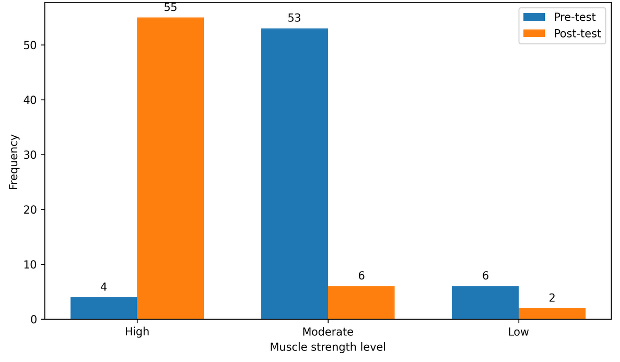
The decline in muscle strength among older adults is a major health concern that contributes to reduced mobility, increased risk of falls, and decreased quality of life. This issue becomes more critical as the elderly population continues to grow, particularly in community-based settings where simple and accessible interventions are needed. Objective: This study aimed to analyze the effect of tandem walking exercise on muscle strength in older adults in Prunggahan Kulon Village, Semanding District, Tuban. Methods: This study employed a quantitative pre-experimental design using a one-group pre-test and post-test approach. A total of 63 elderly participants were selected through purposive sampling. Data were collected using the 30-Second Chair Stand Test (30s-CST) to measure lower limb muscle strength before and after the intervention. The data were analyzed using the Wilcoxon Signed Rank Test. Results: The findings showed a significant improvement in muscle strength after the intervention, where most participants shifted from moderate to high muscle strength categories. Statistical analysis indicated a significant difference between pre-test and post-test results (p < 0.05). Implications: Tandem walking exercise can be applied as a simple, low-cost, and effective intervention to improve muscle strength and reduce fall risk among older adults, particularly in community-based settings. Originality: This study provides new evidence on the effectiveness of tandem walking exercise as a specific balance-based intervention focusing on muscle strength as the primary outcome in a village-based elderly population, which remains limited in previous studies.
References
Ambrose, A. F., Paul, G., & Hausdorff, J. M. (2013). Risk factors for falls among older adults. Maturitas, 75(1), 51-61. https://doi.org/10.1016/j.maturitas.2013.02.009
Beauchet, O., Dubost, V., Allali, G., Gonthier, R., & Kressig, R. W. (2009). Faster counting while walking as a predictor of falls in older adults. Journal of the American Geriatrics Society, 57(1), 128-129. https://doi.org/10.1111/j.1532-5415.2008.02043.x
Cadore, E. L., & Izquierdo, M. (2013). How to simultaneously optimize muscle strength, power, and functional capacity in the elderly. Age, 35(6), 2329-2344. https://doi.org/10.1007/s11357-012-9501-x
Cruz-Jentoft, A. J., Bahat, G., Bauer, J., Boirie, Y., Bruyère, O., Cederholm, T., Cooper, C., Landi, F., Rolland, Y., Sayer, A. A., Schneider, S. M., Sieber, C. C., Topinkova, E., Vandewoude, M., Visser, M., Zamboni, M., Writing Group for the European Working Group on Sarcopenia in Older, P., & the Extended Group for, E. (2019). Sarcopenia: revised European consensus on definition and diagnosis. Age and Ageing, 48(1), 16-31. https://doi.org/10.1093/ageing/afy169
Gao, Q., Hu, K., Yan, C., Zhao, B., Mei, F., Chen, F., & Ma, B. (2021). Factors associated with sarcopenia in community-dwelling older adults: a systematic review and meta-analysis. Nutrients, 13(12), 4291. https://doi.org/10.3390/nu13124291
Gasril, P., Herlinah, L., Zulfitri, R., Yarnita, Y., & Devita, Y. (2022). The Role of Families in Preventing the Risk of Depression in the Elderly with the National Population and Family Planning Board (BKKBN). Journal of Devotion to Your Country, 6(1), 130-134. https://doi.org/10.37859/jpumri.v6i1.3489
Hausdorff, J. M. (2007). Gait dynamics in aging: Are we at the cusp of a new understanding? Journal of Gerontology: Series A, 62(7), 786-792. https://doi.org/10.1093/gerona/62.7.786
Jones, C. J., Rikli, R. E., & Beam, W. C. (1999). The 30-second chair stand test as a measure of lower body strength. Research Quarterly for Exercise and Sport, 70(2), 113-119. https://doi.org/10.1080/02701367.1999.10608028
Liu, C. J., & Latham, N. K. (2009). Progressive resistance strength training for improving physical function in older adults. Cochrane Database of Systematic Reviews. https://doi.org/10.1002/14651858.CD002759.pub2
Mualif, Z. A., & Wirawati, M. K. (2021). Tandem Walking to Reduce the Risk of Falls in the Elderly at Harapan Ibu Nursing Home. Journal of Nursing Care Management, 5(2), 77-80. https://doi.org/10.33655/mak.v5i2.116
Peterson, M. D., Rhea, M. R., Sen, A., & Gordon, P. M. (2010). Resistance exercise for muscular strength in older adults: A meta-analysis. Ageing Research Reviews, 9(3), 226-237. https://doi.org/https://doi.org/10.1016/j.arr.2010.03.004
Sherrington, C., Fairhall, N. J., Wallbank, G. K., Tiedemann, A., Michaleff, Z. A., Howard, K., Clemson, L., Hopewell, S., & Lamb, S. E. (2019). Exercise for preventing falls in older people living in the community. Cochrane Database of Systematic Reviews(1), CD012424. https://doi.org/10.1002/14651858.CD012424.pub2
Statistics, I. (2021). Elderly Population Statistics 2020.
Syah, I., Purnawati, S., & Sugijanto. (2017). The Effect of Elderly Gymnastics Training and Tandem Walking Exercises in Improving the Body Balance of Elderly People at the Tresna Kasih Sayang Ibu Social Home in Batusangkar, West Sumatra. Sport and Fitness Journal, 5(1), 8-16.
Tiedemann, A., Sherrington, C., & Lord, S. R. (2013). The role of exercise for fall prevention in older adults. Current Geriatrics Reports, 2(4), 205-212. https://doi.org/10.1007/s13670-013-0060-6
Valenzuela, P. L., Castillo-García, A., Morales, J. S., Izquierdo, M., Serra-Rexach, J. A., Santos-Lozano, A., & Lucia, A. (2023). Effects of exercise interventions on physical function in older adults. The Lancet Healthy Longevity, 4(6), e354-e376. https://doi.org/10.1016/S2666-7568(23)00072-0
World Health, O. (2021). Falls. https://www.who.int/news-room/fact-sheets/detail/falls