Association Between Stress Levels and Waist Circumference Among Medical and Health Sciences Students at Universitas Muhammadiyah Sumatera Utara
DOI:
https://doi.org/10.56127/jukeke.v5i2.2684Keywords:
Stress Level, Waist Circumference, Central Obesity, Medical Students, DASS-42Abstract
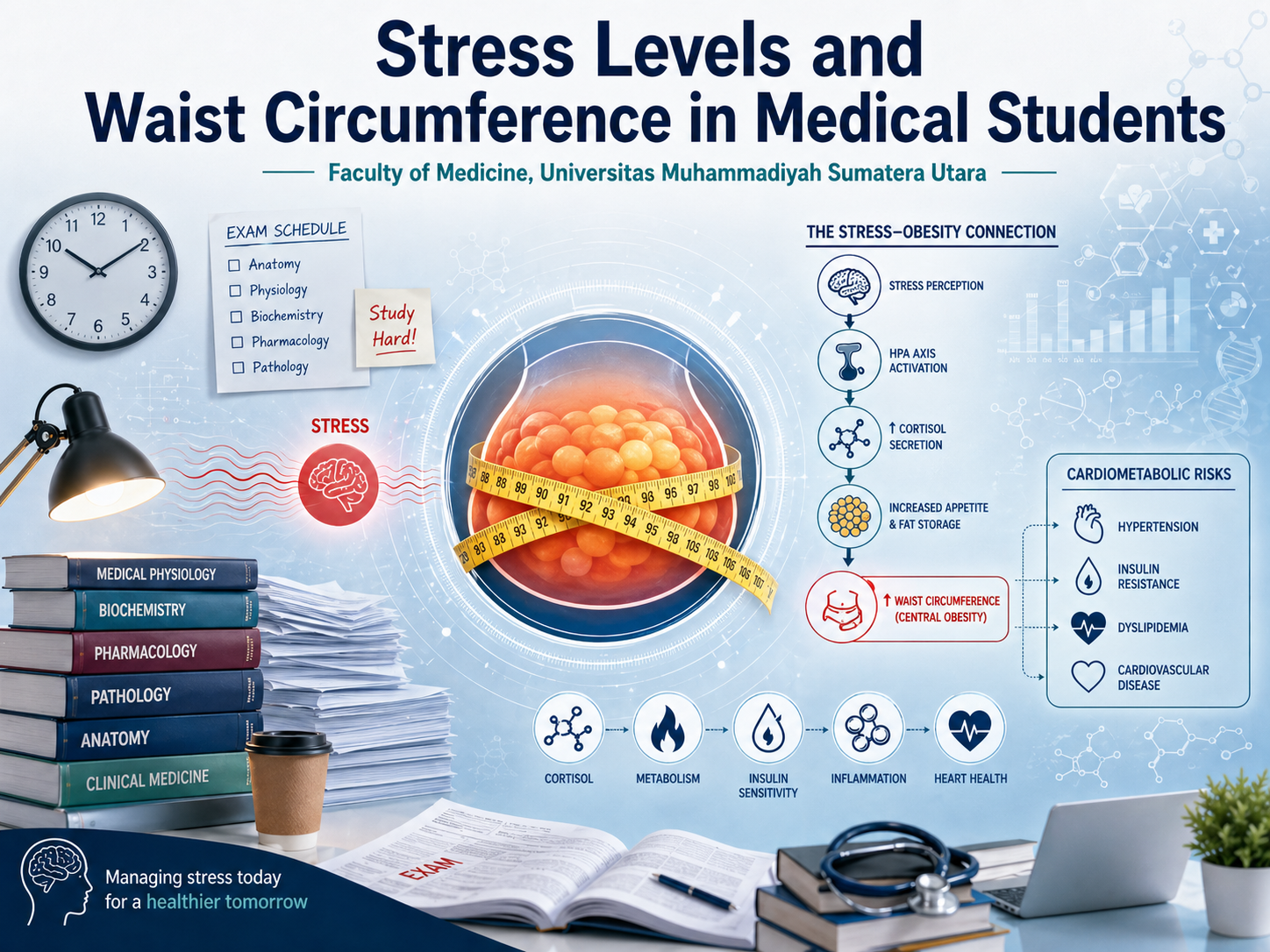
Stress may influence physiological balance through hormonal mechanisms, particularly increased cortisol levels, which are associated with visceral fat accumulation in the abdominal area. Waist circumference is an important anthropometric indicator for assessing central obesity and cardiometabolic risk. Medical students are vulnerable to stress due to high academic demands, which may affect their health status. Objective: This study aimed to determine the association between stress levels and waist circumference among students of the Faculty of Medicine, Universitas Muhammadiyah Sumatera Utara. Methods: This observational analytic study used a cross-sectional design. A total of 89 students from the 2022–2024 cohorts were selected using quota sampling based on the inclusion criteria. Stress levels were measured using the Depression Anxiety Stress Scale-42 (DASS-42), while waist circumference was measured using a flexible measuring tape according to standard anthropometric procedures. Data were analyzed using an exact statistical test with a significance level of 0.05. Findings: The results showed a statistically significant association between stress levels and waist circumference, with a p-value of 0.011. Students with higher stress levels tended to have a greater proportion of central obesity compared to those with normal stress levels. Implication: These findings highlight the importance of stress management and healthy lifestyle promotion in student health programs. Originality: This study provides empirical evidence on the relationship between psychological stress and waist circumference among medical students in the Indonesian university context.
References
Darsini, D., Hamidah, H., Notobroto, H. B., & Cahyono, E. A. (2020). Health risks associated with high waist circumference: A systematic review. Journal of Public Health Research, 9, 1811.
Delker, E., AlYami, B., Gallo, L. C., Ruiz, J. M., Szklo, M., & Allison, M. A. (2021). Chronic stress burden, visceral adipose tissue, and adiposity-related inflammation: The Multi-Ethnic Study of Atherosclerosis. Psychosomatic Medicine, 83(8), 834-842. https://doi.org/10.1097/psy.0000000000000983
Imami, Y. U., Novasyra, A., Utami, N., & Alamsyah Lubis, I. (2022). Stress levels of students Faculty Medicine Islamic University North Sumatra batch 2021 during COVID-19 pandemic. STM, 5(2). https://doi.org/10.30743/stm.v5i2.308
Indraswari, D. A., Al Ahmadi, H. U., Sari, W. A. D., Jordan, T., Puruhito, B., & Basyar, E. (2021). Body mass index and waist circumference are associated with visceral fat measured by bioelectrical impedance analysis in adolescents. Jurnal Kedokteran Diponegoro, 10(5). http://ejournal3.undip.ac.id/index.php/medico
Kemenkes, R. I. (2023a). Menjaga kesehatan mental para penerus bangsa.
Kemenkes, R. I. (2023b). Survei Kesehatan Indonesia (SKI).
Kim, M., & Kim, Y. (2022). Psychosocial stress accompanied by an unhealthy eating behavior is associated with abdominal obesity in Korean adults: A community-based prospective cohort study. Frontiers in Nutrition, 9, 949012. https://doi.org/10.3389/fnut.2022.949012
Li, M., Zhu, P., & Wang, S. X. (2022). Risk for cardiovascular death associated with waist circumference and diabetes: A 9-year prospective study in the Wan Shou Lu cohort. Frontiers in Cardiovascular Medicine, 9. https://doi.org/10.3389/fcvm.2022.856517
National, H., & Nutrition Examination, S. (2021). NHANES anthropometry procedures manual 2021.
Ningtyas, N. S. A., & Isaura, E. R. (2024). Makan secara emosional dan stres psikologis: Mengungkap perjuangan tersembunyi mahasiswa internasional di Surabaya. Amerta Nutrition, 8(4), 582-592.
Nirwan, A. Q., Rahmanisa, S., Daulay, S. A., & Sari, R. D. P. (2025). Faktor-faktor yang mempengaruhi stres akademik pada mahasiswa kedokteran: Tinjauan pustaka. Medula, 14(10), 2019-2024. http://mail.journalofmedula.com/index.php/medula/article/view/1444/1052
Putri, L. R. (2015). Asosiasi stres dengan indeks massa tubuh (IMT) dan lingkar perut pada karyawan Fakultas Kedokteran Universitas X 2015 Universitas Indonesia].
Ross, R., Neeland, I. J., Yamashita, S., Shai, I., Seidell, J., & Magni, P. (2020). Waist circumference as a vital sign in clinical practice: A consensus statement from the IAS and ICCR Working Group on Visceral Obesity. Nature Reviews Endocrinology, 16(3), 177-189. https://doi.org/10.1038/s41574-019-0310-7
Setyaningsih, A., Mulyasari, I., Afiatna, P., & Putri, H. R. (2024). The relationship between ultra-processed food consumption with diet quality and over-nutritional status in young adults. Amerta Nutrition, 8(1), 124-129. https://doi.org/10.20473/amnt.v8i1.2024.124-129
Sherwood, L. (2016). Human physiology: From cells to systems. Penerbit Buku Kedokteran EGC.
Sun, J. Y., Huang, W. J., Hua, Y., Qu, Q., Cheng, C., & Liu, H. L. (2022). Trends in general and abdominal obesity in US adults: Evidence from the National Health and Nutrition Examination Survey (2001–2018). Frontiers in Public Health, 10. https://doi.org/10.3389/fpubh.2022.925293
Tan, T., & Leung, C. W. (2021). Associations between perceived stress and BMI and waist circumference in Chinese adults: Data from the 2015 China Health and Nutrition Survey. Public Health Nutrition, 24(15), 4965-4974. https://doi.org/10.1017/S1368980020005054
Viertiö, S., Kiviruusu, O., Piirtola, M., Kaprio, J., Korhonen, T., & Marttunen, M. (2021). Factors contributing to psychological distress in the working population, with special reference to gender difference. BMC Public Health, 21(1). https://doi.org/10.1186/s12889-021-10560-y
Yimer, W., Asmare, L., Gebeyehu, F. B., Alemu, T., Mehamed, A., & Ayele, F. Y. (2025). Factors influencing waist circumference among urban bank employees in Northeast Ethiopia: A cross-sectional study. Frontiers in Nutrition, 11. https://doi.org/10.3389/fnut.2024.1414930