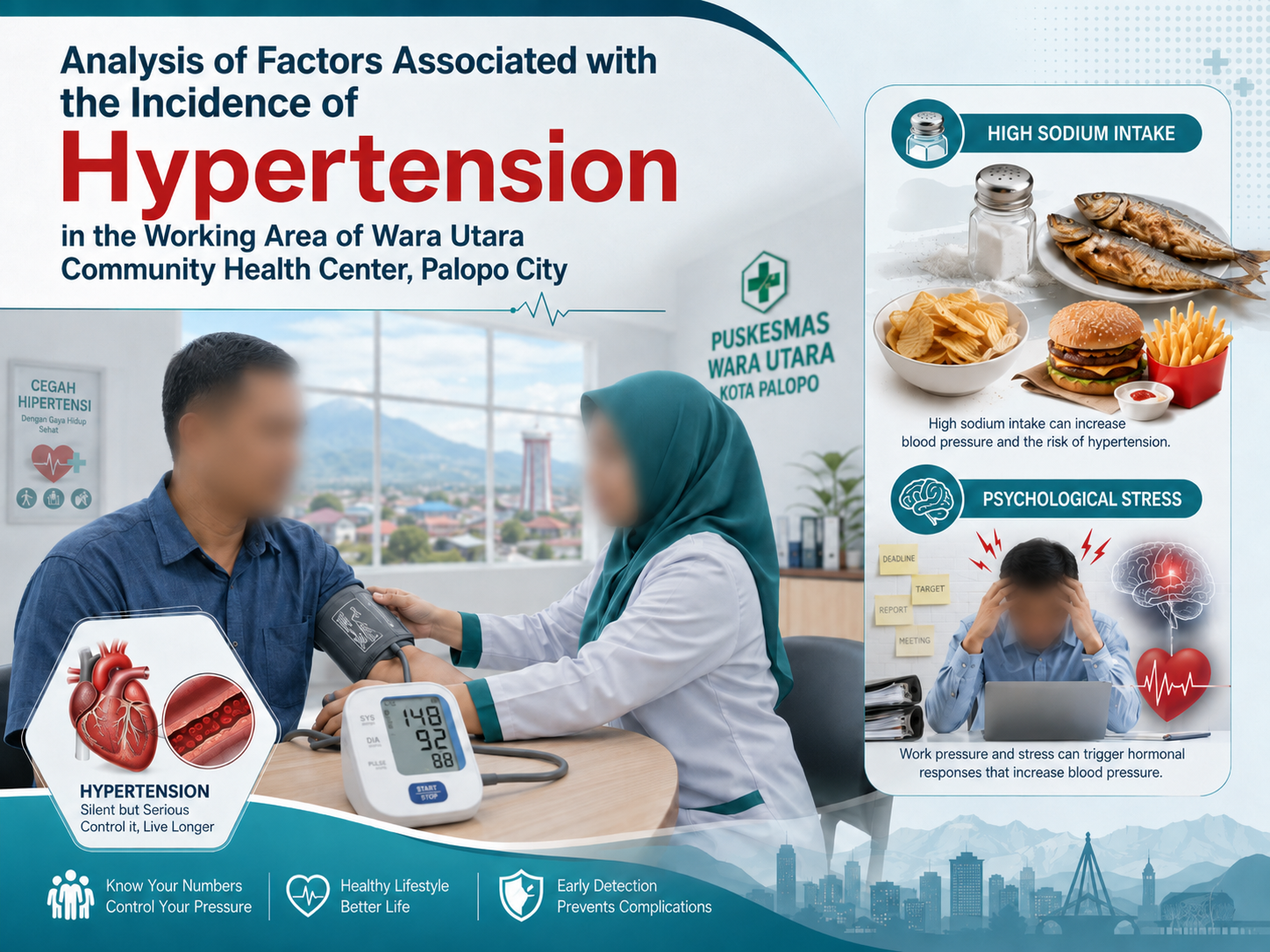
Analysis of Factors Associated with the Incidence of Hypertension in the Working Area of Wara Utara Community Health Center, Palopo City
DOI:
https://doi.org/10.56127/jukeke.v5i2.2701Keywords:
hypertension, sodium intake, stress, dietary behavior, primary health careAbstract
Hypertension is a major public health problem because it often occurs without specific symptoms and may lead to severe complications, including stroke, kidney failure, and cardiovascular disease. Dietary behavior and psychological stress are modifiable factors that may contribute to increased blood pressure, particularly in communities served by primary health care facilities. Objective: This study aimed to analyze the association between sodium dietary intake, stress level, and the incidence of hypertension in the working area of the Wara Utara Community Health Center, Palopo City. Methods: This study used a quantitative analytic observational design with a cross-sectional approach. The sample consisted of 97 respondents aged 35–65 years selected using purposive sampling. Data were collected through blood pressure measurement, sodium intake assessment using a Semi-Quantitative Food Frequency Questionnaire, and stress level measurement using the Depression Anxiety Stress Scales questionnaire. Data were analyzed using univariate analysis, Chi-square test, and binary logistic regression. Findings: The results showed that 70 respondents (72.2%) had hypertension, 37 respondents (38.1%) had excessive sodium intake, and 52 respondents (53.6%) experienced stress. Sodium dietary intake was significantly associated with hypertension (p = 0.007), and stress was also significantly associated with hypertension (p < 0.001). Multivariate analysis showed that stress was the most dominant factor associated with hypertension (OR = 6.71; 95% CI: 2.01–22.38; p = 0.005), followed by excessive sodium intake (OR = 5.13; 95% CI: 1.61–16.32; p = 0.020). Implications: These findings imply that hypertension prevention programs at the primary health care level should integrate sodium intake control, healthy dietary education, routine blood pressure monitoring, and stress management. Originality: The originality of this study lies in its simultaneous analysis of dietary and psychosocial factors associated with hypertension in a local primary health care setting, providing contextual evidence for community-based hypertension prevention strategies.
References
Burnier, M., & Egan, B. M. (2019). Adherence in hypertension. Circulation Research, 124(7), 1124-1140. https://doi.org/10.1161/CIRCRESAHA.118.313220
Cao, C. H., Liao, X. L., Jiang, X. Y., Li, X. D., Chen, I. H., & Lin, C. Y. (2023). Psychometric evaluation of the Depression, Anxiety, and Stress Scale-21 (DASS-21) among Chinese primary and middle school teachers. BMC Psychology, 11, 209. https://doi.org/10.1186/s40359-023-01242-y
Carey, R. M., & Whelton, P. K. (2018). Prevention, detection, evaluation, and management of high blood pressure in adults: Synopsis of the 2017 American College of Cardiology/American Heart Association Hypertension Guideline. Annals of Internal Medicine, 168(5), 351-358. https://doi.org/10.7326/M17-3203
Carnevale, D. (2023). Role of inflammatory processes in the brain-body relationship underlying hypertension. Current Hypertension Reports, 25(12), 455-461. https://doi.org/10.1007/s11906-023-01268-y
Citerawati, & Sukati. (2017). INCOMPLETE REFERENCE: Citerawati & Sukati (2017) is cited in the text, but full bibliographic details were not provided. Complete or replace this citation before publication. In.
Darmawan, A., Suryani, D., & Prasetyo, B. (2023). The relationship between sodium consumption and the incidence of hypertension among older adults at Cimanggis Community Health Center, Depok. Jurnal Kesehatan Masyarakat Indonesia, 18(2), 115-123. https://doi.org/10.52023/ijns.v1i1.2461
Fitria, N. (2022). Factors associated with the incidence of hypertension among adults. Journal of Nursing and Public Health, 10(2), 112-120. https://doi.org/10.32583/keperawatan.v10i2.2154
Fitrianti, E. C., & Simanungkalit, S. F. (2020). Relationship of fiber intake, stress level, physical activity with blood pressure of pre elderly and elderly. Indonesian Journal of Nutritional Science, 1(1).
Frisca. (2019). INCOMPLETE REFERENCE: Frisca et al. (2019) is cited in the text, but full bibliographic details were not provided. Complete or replace this citation before publication. In.
Grillo, A., Salvi, L., Coruzzi, P., Salvi, P., & Parati, G. (2019). Sodium intake and hypertension. Nutrients, 11(9), 1970. https://doi.org/10.3390/nu11091970
He, F. J., & MacGregor, G. A. (2020). Role of salt intake in prevention of cardiovascular disease: Controversies and challenges. Nature Reviews Cardiology, 17(6), 371-377. https://doi.org/10.1038/s41569-019-0243-2
Juliana, R., Wahyuni, S., & Nasution, A. (2024). Epidemiological transition of non-communicable diseases in Indonesia. Indonesian Journal of Public Health, 19(1), 45-53. https://doi.org/10.26714/jkmi.19.1.2024.45-53
Kario. (2024). INCOMPLETE REFERENCE: Kario et al. (2024) is cited in the text, but full bibliographic details were not provided. Complete or replace this citation before publication. In.
Mills, K. T., Stefanescu, A., & He, J. (2020). The global epidemiology of hypertension. Nature Reviews Nephrology, 16(4), 223-237. https://doi.org/10.1038/s41581-019-0244-2
Ministry of Health of the Republic of, I. (2018). National Report of Basic Health Research (Riskesdas) 2018.
Ministry of Health of the Republic of, I. (2023). Indonesia Health Survey (SKI) 2023.
O'Donnell, M., Mente, A., & Yusuf, S. (2020). Sodium intake and cardiovascular health. Circulation Research, 126(9), 1046-1057. https://doi.org/10.1161/CIRCRESAHA.120.315890
Palopo City Health, O. (2023). Palopo City Health Profile 2023.
Situmorang, R. F. (2020). The effect of stress on hypertension complications in adult patients. Holistic Health Journal, 14(3), 155-162. https://doi.org/10.24252/kesehatan.v14i3.14211
Sutarjana, I. M. (2021). The relationship between caffeine consumption frequency and stress levels with the incidence of hypertension among young adults. Medical Journal of Udayana, 10(5), 85-92. https://doi.org/10.24843/MU.2021.V10.i5.P15
Whelton, P. K., Carey, R. M., & Aronow, W. S. (2018). 2017 ACC/AHA guideline for the prevention, detection, evaluation, and management of high blood pressure in adults. Hypertension, 71(6), e13-e115. https://doi.org/10.1161/HYP.0000000000000065
World Health, O. (2023a). Global report on hypertension: The race against a silent killer.
World Health, O. (2023b). Guideline for sodium intake for adults and children.
World Health, O. (2023c). Hypertension.