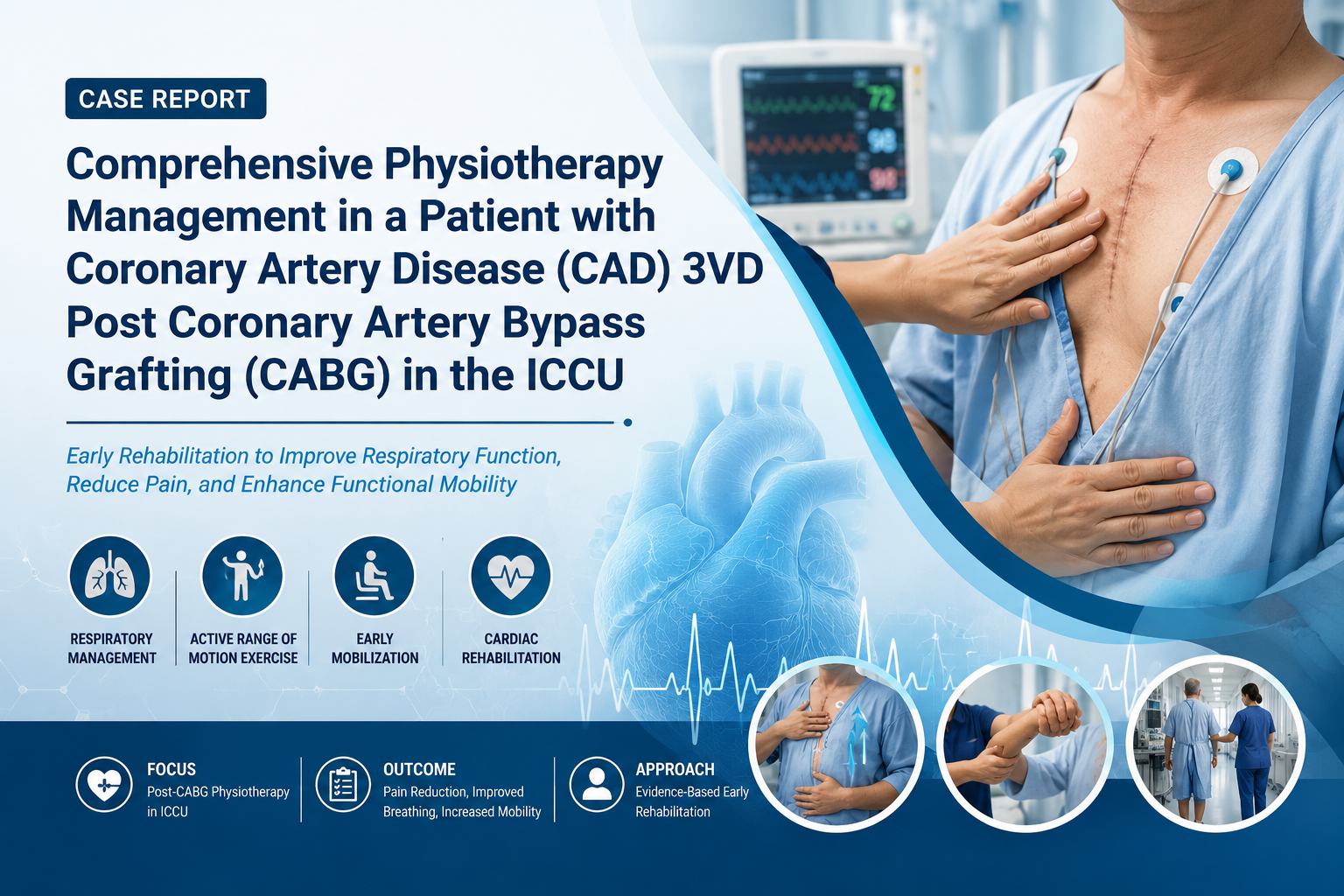
Physiotherapy Management in a Patient with Coronary Artery Disease 3VD Post Coronary Artery Bypass Grafting in ICCU: A Case Study
DOI:
https://doi.org/10.56127/jukeke.v5i2.2702Keywords:
Coronary Artery Bypass Grafting, Coronary Artery Disease, Early Mobilization, Cardiac Rehabilitation, PhysiotherapyAbstract
Post-Coronary Artery Bypass Grafting (CABG) patients are at risk of postoperative complications, including pain, respiratory disorders, decreased thoracic expansion, and functional mobility limitations due to surgical procedures and prolonged bed rest in the Intensive Cardiac Care Unit (ICCU). Therefore, physiotherapy during the acute rehabilitation phase is essential to support recovery and prevent further complications. Objective: This study aims to describe physiotherapy management in a patient with Coronary Artery Disease (CAD) three-vessel disease (3VD) post-CABG in the ICCU and to evaluate changes in pain, shortness of breath, thoracic expansion, and functional mobility after physiotherapy intervention. Method: This study used a case report design involving a 53-year-old male patient with complaints of sternotomy pain, shortness of breath, and postoperative mobility limitations. Data were collected through physiotherapy assessment, including vital signs, Numeric Rating Scale (NRS), Borg Scale, thoracic expansion measurement using a meterline, and functional ability using the ICU Mobility Scale. Data were analyzed descriptively by comparing clinical outcomes before and after three physiotherapy sessions. Findings: The results showed decreased resting pain from 5/10 to 3/10, reduced shortness of breath from 2/10 to 0/10, increased thoracic expansion, and improved functional mobility from score 1 to score 3 based on the ICU Mobility Scale. These findings indicate positive clinical progress during the acute rehabilitation phase. Implication: Early physiotherapy intervention through diaphragmatic breathing exercise, deep breathing exercise, active range of motion exercise, and gradual mobilization may support respiratory function, reduce pain, improve mobility, and assist early recovery in post-CABG patients in the ICCU. Originality/Value: This case report provides specific clinical evidence regarding comprehensive physiotherapy management in a CAD 3VD post-CABG patient during intensive cardiac care, particularly through measurable outcomes in the acute rehabilitation phase.
References
Afxonidis, G., Moysidis, D. V., Papazoglou, A. S., Tsagkaris, C., Loudovikou, A., Tagarakis, G., Karapanagiotidis, G. T., Alexiou, I. A., Foroulis, C., & Anastasiadis, K. (2021). Efficacy of Early and Enhanced Respiratory Physiotherapy and Mobilization after On-Pump Cardiac Surgery: A Prospective Randomized Controlled Trial. 1-11.
Eghbali, T., Rashtabadi, O. R., Ahmadi, A., & Nakhaeizadeh, R. (2025). Effectiveness of deep breathing exercises on anxiety, depression and sleep quality in patients undergoing coronary artery bypass surgery. 1-10.
Emamzadehashemi, K. R., Khanghah, A. G., Azizi, A., & Paryad, E. (2024). Quality of life and activities of daily living one year after Coronary Artery Bypass Graft (CABG) surgery: a cross-sectional study. Journal of Cardiothoracic Surgery, 1-11. https://doi.org/10.1186/s13019-024-02848-y
Han, P., Yu, H., Xie, F., Li, M., Chen, X., Yu, X., Li, J., Liu, X., Shao, B., Liu, J., Liu, Y., Liu, Z., & Liu, X. (2022). Effects of early rehabilitation on functional outcomes in patients after coronary artery bypass graft surgery: a randomized controlled trial. https://doi.org/10.1177/03000605221087031
Jafari, H., Bagheri-nesami, M., Ali, R., & Tohamtan, M. (2023). The Effect of Breathing Exercises on Respiratory Condition After Coronary Artery Bypass Surgery. 10(3).
Jalili, S., Allahbakhshian, A., Khalili, A. F., & Mobasseri, K. (2025). Effects of Early Mobilization on Hemodynamics and Pain after Coronary Artery Bypass Graft Surgery: A Randomized Controlled Trial. Tabriz University of Medical Sciences, 14(1), 14-24. https://doi.org/10.34172/jcs.025.33510
Jannah, U., Sucipto, A., Laksono, E. B., & Barat, K. (2024). The effect of slow deep breathing on reducing pain scale in post-operative patients. 5(2), 791-800.
Li, C., Zhang, P., Zhang, Z., Qi, D., & Li, H. (2025). Effect of breathing exercises to prevent pulmonary complications in patients undergoing coronary artery bypass graft surgery: a prospective randomized controlled trials study protocol. 1-8. https://doi.org/10.3389/fmed.2024.1424291
Pramudiana, N., & Pristianto, A. (2022). Penatalaksanaan Fisioterapi Komprehensif Pada Kasus Pasca Coronary Artery By Pass Grafting Et Causa Coronary Artery Disease Involving 3 Vessels (CAD3VD): Case Report. 3(1), 8-15. https://doi.org/10.23917/fisiomu.v3i1.12960
Putri, A. N. D., Komalasari, D. R., Gani, P., & Dewi, D. Q. (2024). Penatalaksanaan Fisioterapi Pasien dengan Post-Op Coronary Artery Bypass Graft (CABG): A Case Study. Academic Physiotherapy Conferences, 1(1), 471-478.
Reinhart, M., Jonsson, M., Enthoven, P., & Westerdahl, E. (2024). Immediate effects of upper limb exercises with and without deep breathing on lung function after cardiac surgery: a randomized crossover trial.
Singam, A. (2024). Mobilizing Progress: A Comprehensive Review of the Efficacy of Early Mobilization Therapy in the Intensive Care Unit. 16(4). https://doi.org/10.7759/cureus.57595
Yao, Z., Wen, X., Yu, J., & Zhu, X. (2025). Psychometric evaluation of the cardiac rehabilitation adherence scale in patients with coronary heart disease: an observational study. 1-15. https://doi.org/10.3389/fcvm.2025.1641392