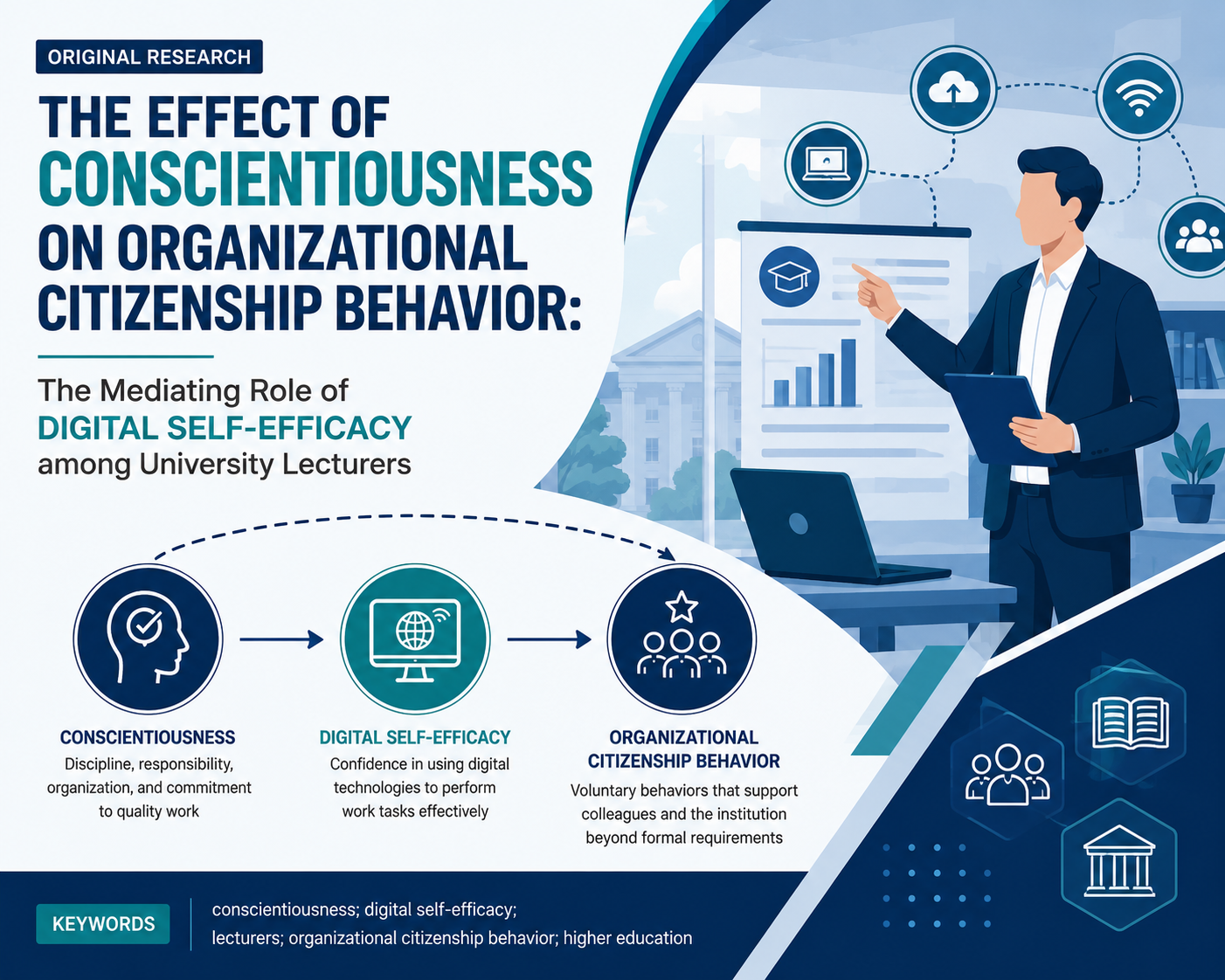
The Effect of Conscientiousness on Organizational Citizenship Behavior: The Mediating Role of Digital Self-Efficacy among University Lecturers
DOI:
https://doi.org/10.56127/jukeke.v5i2.2886Keywords:
conscientiousness, digital self-efficacy, lecturers, organizational citizenship behavior, higher educationAbstract
Organizational citizenship behavior (OCB) is increasingly important in higher education because lecturers are expected to contribute beyond their formal duties while adapting to digital transformation. This study examines whether digital self-efficacy mediates the effect of conscientiousness on organizational citizenship behavior among university lecturers. Methodology: This study employed a quantitative cross-sectional design involving 112 lecturers in Jakarta selected through convenience sampling. Data were collected using an online questionnaire distributed through Google Forms and analyzed using correlation and path analysis with JASP software. Findings: Conscientiousness positively influenced both digital self-efficacy and organizational citizenship behavior. Digital self-efficacy also positively affected organizational citizenship behavior. However, the indirect effect of conscientiousness on organizational citizenship behavior through digital self-efficacy was weaker than its direct effect. Therefore, digital self-efficacy did not significantly mediate the relationship between conscientiousness and organizational citizenship behavior. Implications: The findings indicate that lecturers’ voluntary contributions are more strongly influenced by stable personality traits, professional responsibility, and commitment to academic roles than by confidence in using digital technology. Higher education institutions should therefore strengthen professional values, collaborative culture, and recognition of lecturers’ extra-role contributions while continuing to support digital competency development. Originality: This study integrates conscientiousness, digital self-efficacy, and organizational citizenship behavior within a single empirical model and demonstrates that digital self-efficacy is not the primary psychological mechanism connecting conscientiousness with OCB among lecturers.
References
Bandura, A. (1997). Self-efficacy: The Exercise of Control. W. H. Freeman.
Barrick, M. R., & Mount, M. K. (1991). The Big Five Personality Dimensions and Job Performance: A Meta-Analysis. Personnel Psychology, 44(1), 1-26. https://doi.org/10.1111/j.1744-6570.1991.tb00688.x
Compeau, D. R., & Higgins, C. A. (1995). Computer Self-Efficacy: Development of a Measure and Initial Test. MIS Quarterly, 19(2), 189-211.
Costa, P. T., & McCrae, R. R. (1992). Revised NEO Personality Inventory (NEO PI-R) Professional Manual. Psychological Assessment Resources.
da Silva, C. C., Vieira, K. M., Klein, L. L., Estivalete, F. D. F. B., & de Andrade, T. (2024). Organizational Citizenship Behavior Scale for Knowledge Workers: Empirical Evidence and New Validations. SAGE Open, 1-15. https://doi.org/10.1177/21582440241247399
Devaraj, S., Easley, R. F., & Crant, J. M. (2008). Research Note: How Does Personality Matter? Relating the Five-Factor Model to Technology Acceptance and Use. Information Systems Research, 19(1), 93-105.
Eastin, M. S., & LaRose, R. (2000). Internet Self-Efficacy and the Psychology of the Digital Divide. Journal of Computer-Mediated Communication, 6(1). https://doi.org/10.1111/j.1083-6101.2000.tb00110.x
Fan, Q., Wider, W., & Chan, C. K. (2023). The Brief Introduction to Organizational Citizenship Behaviors and Counterproductive Work Behaviors: A Literature Review. Frontiers in Psychology, 14. https://doi.org/10.3389/fpsyg.2023.1181930
Haleem, A., Javaid, M., Qadri, M. A., & Suman, R. (2022). Understanding the Role of Digital Technologies in Education: A Review. Sustainable Operations and Computers, 3, 275-285. https://doi.org/10.1016/j.susoc.2022.05.004
Hanson, J. L., Niqab, M., & Arif, T. (2022). Organizational Citizenship Behaviour (OCB) in Educational Settings: A Narrative Review. JISR Management and Social Sciences & Economics, 20(1), 21-42.
Hu, X., Xu, W., Wan, Z., Liu, M., & Xu, W. (2025). Bridging Self-Efficacy and Digital Competence: A Comprehensive Scoping Review of Teachers' Readiness for the Digital Age. SAGE Open, 15(3). https://doi.org/10.1177/21582440251363
Ilies, R., Fulmer, I. S., Spitzmuller, M., & Johnson, M. D. (2009). Personality and Citizenship Behavior: The Mediating Role of Job Satisfaction. Journal of Applied Psychology, 94(4), 945-959. https://doi.org/10.1037/a0013329
McCrae, R. R., & Costa, P. T. (1997). Personality Trait Structure as a Human Universal. American Psychologist, 52(5), 509-516. https://doi.org/10.1037/0003-066X.52.5.509
Organ, D. W. (1988). Organizational Citizenship Behavior: The Good Soldier Syndrome. Lexington Books.
Organ, D. W., Podsakoff, P. M., & MacKenzie, S. B. (2006). Organizational Citizenship Behavior: Its Nature, Antecedents, and Consequences. Sage.
Organ, D. W., & Ryan, K. (1995). A Meta-Analytic Review of Attitudinal and Dispositional Predictors of Organizational Citizenship Behavior. Personnel Psychology, 48(4), 775-802. https://doi.org/10.1111/j.1744-6570.1995.tb01781.x
Paredes-Aguirre, M., Aguirre, R. C., Hernandez-Pozas, O., Ayala, Y., & Medina, H. B. (2024). The Digital Self-Efficacy Scale: Adaptation and Validation in Its Spanish Version. Human Behavior and Emerging Technologies. https://doi.org/10.1155/2024/3952946
Paredes-Aguirre, M., Hernandez-Pozas, O., Ayala, Y., & Aguirre, R. C. (2025). The Stress-Busting Power of Digital Self-Efficacy: Does Training Format Matter for Works? Current Research in Behavioral Sciences, 8, 100161. https://doi.org/10.1016/j.crbeha.2024.100161
Podsakoff, N. P., Whiting, S. W., Podsakoff, P. M., & Blume, B. D. (2009). Individual- and Organizational-Level Consequences of Organizational Citizenship Behaviors. Journal of Applied Psychology, 94(1), 122-141. https://doi.org/10.1037/a0013079
Podsakoff, P. M., MacKenzie, S. B., Paine, J. B., & Bachrach, D. G. (2000). Organizational Citizenship Behaviors: A Critical Review of the Theoretical and Empirical Literature. Journal of Management, 26(3), 513-563. https://doi.org/10.1177/014920630002600307
Ramdhani, N. (2012). Adaptasi Bahasa dan Budaya Inventori Big Five. Jurnal Psikologi, 39(2), 189-207. https://doi.org/10.22146/jpsi.6986
Somech, A., & Drach-Zahavy, A. (2004). Exploring Organizational Citizenship Behaviour from an Organizational Perspective. Journal of Occupational and Organizational Psychology, 77(3), 281-298. https://doi.org/10.1348/0963179041752709
Ta, H. H., Layeghi, G., Delladio, S., Nguyen, V. H. A., & Caputo, A. (2025). Examining the Impact of Big Five Personality Traits and Digital Competencies on Digital Entrepreneurial Intention: The Mediating Role of Digital Self-Efficacy. International Entrepreneurship and Management Journal, 21. https://doi.org/10.1007/s11365-025-01143-z
Venkatesh, V., Thong, J. Y. L., & Xu, X. (2012). Consumer Acceptance and Use of Information Technology: Extending the Unified Theory of Acceptance and Use of Technology. MIS Quarterly, 36(1), 157-178.