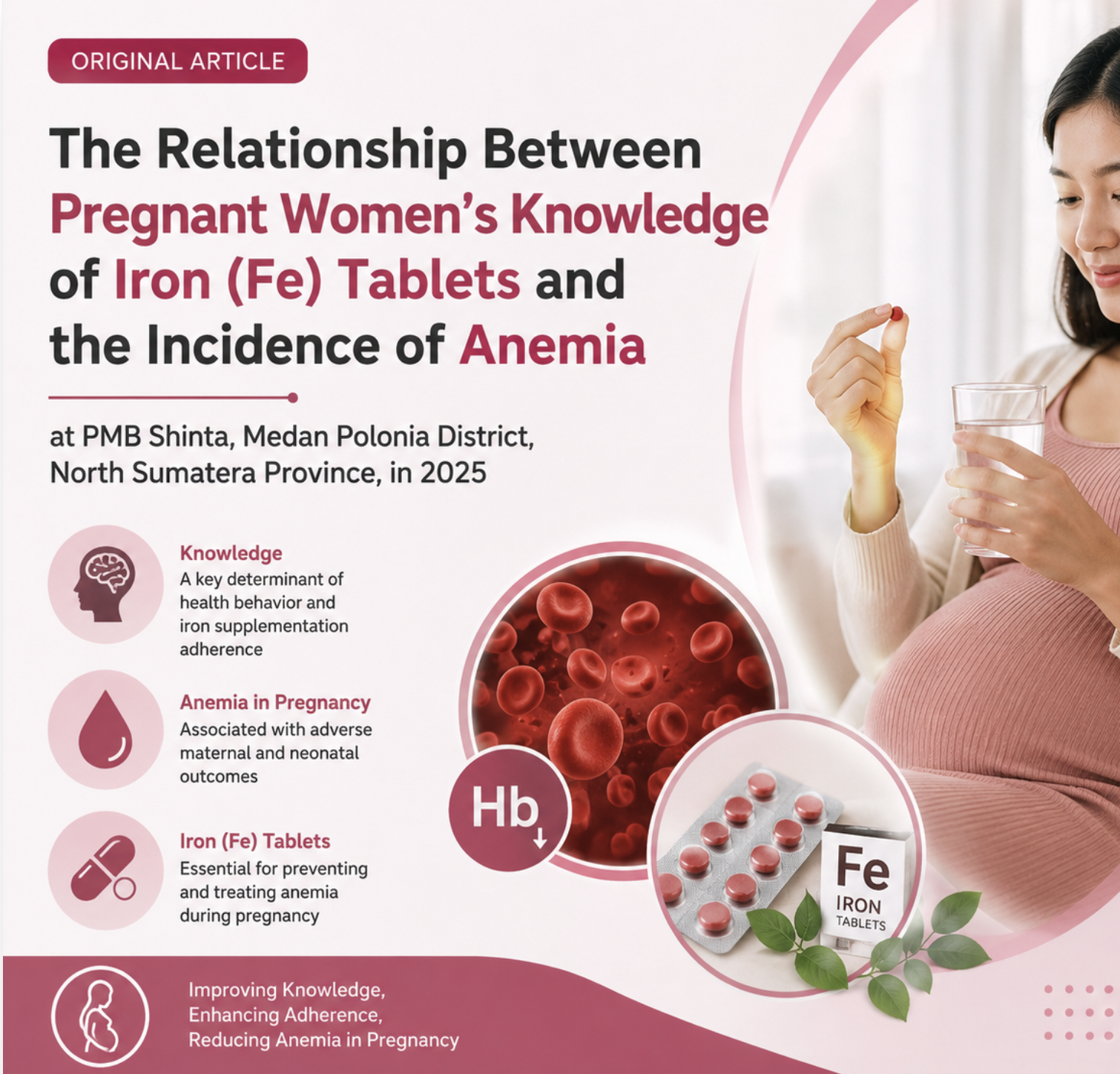
Relationship Between Pregnant Women's Knowledge of Iron (Fe) Tablets and Incidence of Anemia at PMB Shinta, Medan Polonia District, North Sumatera Province
DOI:
https://doi.org/10.56127/jukeke.v5i2.2944Keywords:
Anemia, Hemoglobin, Iron (Fe) Tablets, Knowledge, Pregnant WomenAbstract
Anemia during pregnancy remains a major public health problem in Indonesia. One of the contributing factors is inadequate maternal knowledge regarding iron (Fe) tablets, which may affect adherence to supplementation and increase the risk of anemia. Objective: This study aimed to analyze the relationship between pregnant women's knowledge of iron (Fe) tablets and the incidence of anemia at PMB Shinta, Medan Polonia District, North Sumatera Province, in 2025. Methods: This quantitative study employed a cross-sectional design. The study involved all 30 pregnant women attending antenatal care at PMB Shinta, selected through total sampling. Data were collected using a structured questionnaire and hemoglobin examination. The data were analyzed using descriptive statistics and the Chi-Square test. Findings: The results showed that 56.7% of respondents had poor knowledge and 60.0% experienced anemia. A significant relationship was found between maternal knowledge and the incidence of anemia, with a p-value of 0.013. Pregnant women with poor knowledge had a 10.5-times higher likelihood of experiencing anemia than those with good knowledge (OR = 10.5; 95% CI: 1.889–58.359). Implications: The findings indicate the need to strengthen health education during antenatal care, particularly regarding the benefits, dosage, timing, and proper consumption of iron tablets. Improved maternal knowledge is expected to support adherence to iron supplementation and reduce the incidence of anemia during pregnancy. Originality: This study provides recent empirical evidence from a primary midwifery practice in Medan Polonia by directly examining the relationship between maternal knowledge of iron tablets and anemia incidence. The findings offer practical value for developing targeted, community-based maternal health education strategies.
References
Agnes Kusumasari, R., Putri, N. I., Riansih, C., & Ratnaningsih, D. (2021). Kepatuhan ibu hamil mengkonsumsi tablet Fe dengan kejadian anemia di Puskesmas Sleman Yogyakarta. Jurnal Permata Indonesia, 12(2), 1-8. https://doi.org/10.59737/jpi.v12i2.30
Ameline, A. S., Chandra, D. N., Htet, M. K., Zahra, N. L., & Fahmida, U. (2025). Prevalence and factors associated with anemia among pregnant women during the COVID-19 pandemic in East Lombok district, Indonesia. PLOS ONE, 20(6), e0323942. https://doi.org/10.1371/journal.pone.0323942
Andira, S. B., & Sulastri, S. (2025). Analisis pengetahuan ibu hamil dan kepatuhan mengonsumsi tablet Fe. Holistik Jurnal Kesehatan, 19(10), 3056-3064. https://doi.org/10.33024/hjk.v19i10.1736
Balcha, W. F., Eteffa, T., Arega Tesfu, A., & Abeje Alemayehu, B. (2023). Maternal knowledge of anemia and adherence to its prevention strategies: A health facility-based cross-sectional study design. INQUIRY: The Journal of Health Care Organization, Provision, and Financing, 60, 1-11. https://doi.org/10.1177/00469580231167731
Engidaw, M. T., Lee, P., Fekadu, G., Mondal, P., & Ahmed, F. (2025). Effect of nutrition education during pregnancy on iron–folic acid supplementation compliance and anemia in low- and middle-income countries: A systematic review and meta-analysis. Nutrition Reviews, 83(7), e1472-e1487. https://doi.org/10.1093/nutrit/nuae170
Fauzianty, A., Napitupulu, N. I. M. B., & Wijaya, E. S. (2024). Hubungan pengetahuan dan sikap ibu hamil dengan kepatuhan konsumsi tablet tambah darah di wilayah kerja UPTD Puskesmas Semulajadi Kecamatan Datuk Bandar Timur Kota Tanjung Balai tahun 2023. Termometer: Jurnal Ilmiah Ilmu Kesehatan dan Kedokteran, 2(4), 44-55. https://doi.org/10.55606/termometer.v2i4.4318
Hardido, T. G., Mikamo, A. A., & Legesse, C. T. (2023). Adherence to iron-folic acid among pregnant women attending antenatal care in Southern Ethiopia, 2022. Women's Health Reports, 4(1), 431-437. https://doi.org/10.1089/whr.2023.0020
Kassa, Z. Y., Awraris, T., Daba, A. K., & Tenaw, Z. (2019). Compliance with iron folic acid and associated factors among pregnant women through pill count in Hawassa city, South Ethiopia: A community based cross-sectional study. Reproductive Health, 16(1), 14. https://doi.org/10.1186/s12978-019-0679-8
Kementerian Kesehatan, R. I. (2022). Profil kesehatan Indonesia 2022. Kementerian Kesehatan Republik Indonesia.
Laila, E. F. (2025). Faktor-faktor yang berhubungan dengan kepatuhan ibu hamil dalam mengonsumsi tablet tambah darah. Journal of Midwifery Care, 5(2), 308-317. https://doi.org/10.34305/jmc.v5i02.1617
Niza, H., Putri, C. G., & Azzahra, N. (2022). Analisis hubungan pendidikan, pengetahuan, pekerjaan dengan kepatuhan mengkonsumsi tablet (Fe) pada ibu hamil di Puskesmas Sako Palembang 2021. Jurnal Kesehatan Terapan, 9(2), 1-6. https://doi.org/10.54816/jk.v9i2.519
Notoatmodjo, S. (2017). Ilmu perilaku kesehatan. Rineka Cipta.
Rabiatunnisa, R., & Mujahadatuljannah, M. (2024). Analisis tingkat kepatuhan konsumsi tablet Fe pada ibu hamil trimester III di DAS. Jurnal Surya Medika, 10(2), 236-241. https://doi.org/10.33084/jsm.v10i2.7748
Saeed, M. S., Adam, G. K., Hussein, S. M., AlHabardi, N., & Adam, I. (2024). Prevalence and factors associated with adherence to iron-folic acid supplementation among pregnant women in Eastern Sudan: A cross-sectional study. Patient Preference and Adherence, 18, 1665-1674. https://doi.org/10.2147/PPA.S476738
Saragih, I. D., Dimog, E. F., Saragih, I. S., & Lin, C. J. (2022). Adherence to iron and folic acid supplementation (IFAS) intake among pregnant women: A systematic review meta-analysis. Midwifery, 104, 103185. https://doi.org/10.1016/j.midw.2021.103185
Sendeku, F. W., Azeze, G. G., & Fenta, S. L. (2020). Adherence to iron-folic acid supplementation among pregnant women in Ethiopia: A systematic review and meta-analysis. BMC Pregnancy and Childbirth, 20(1), 138. https://doi.org/10.1186/s12884-020-2835-0
Utari, D., & Al Rahmad, A. H. (2022). Pengetahuan dan sikap ibu hamil dengan pola kepatuhan mengonsumsi tablet tambah darah di Kabupaten Aceh Timur. Jurnal SAGO Gizi dan Kesehatan, 4(1), 8-13. https://doi.org/10.30867/gikes.v4i1.247
World Health, O. (2019). The global prevalence of anaemia. WHO Press.
Yismaw, A. E., Tulu, H. B., Kassie, F. Y., & Araya, B. M. (2022). Iron-folic acid adherence and associated factors among pregnant women attending antenatal care at Metema District, Northwest Ethiopia. Frontiers in Public Health, 10, 978084. https://doi.org/10.3389/fpubh.2022.978084