Quality Characteristics of Fermented Arabica CascaraTea using SCOBY-Kombucha Fermentation in Different Drying Methods
DOI:
https://doi.org/10.56127/ijst.v5i1.2672Keywords:
cascara tea, Arabica coffee husk, drying method, total phenol content, SCOBY-kombucha fermentationAbstract
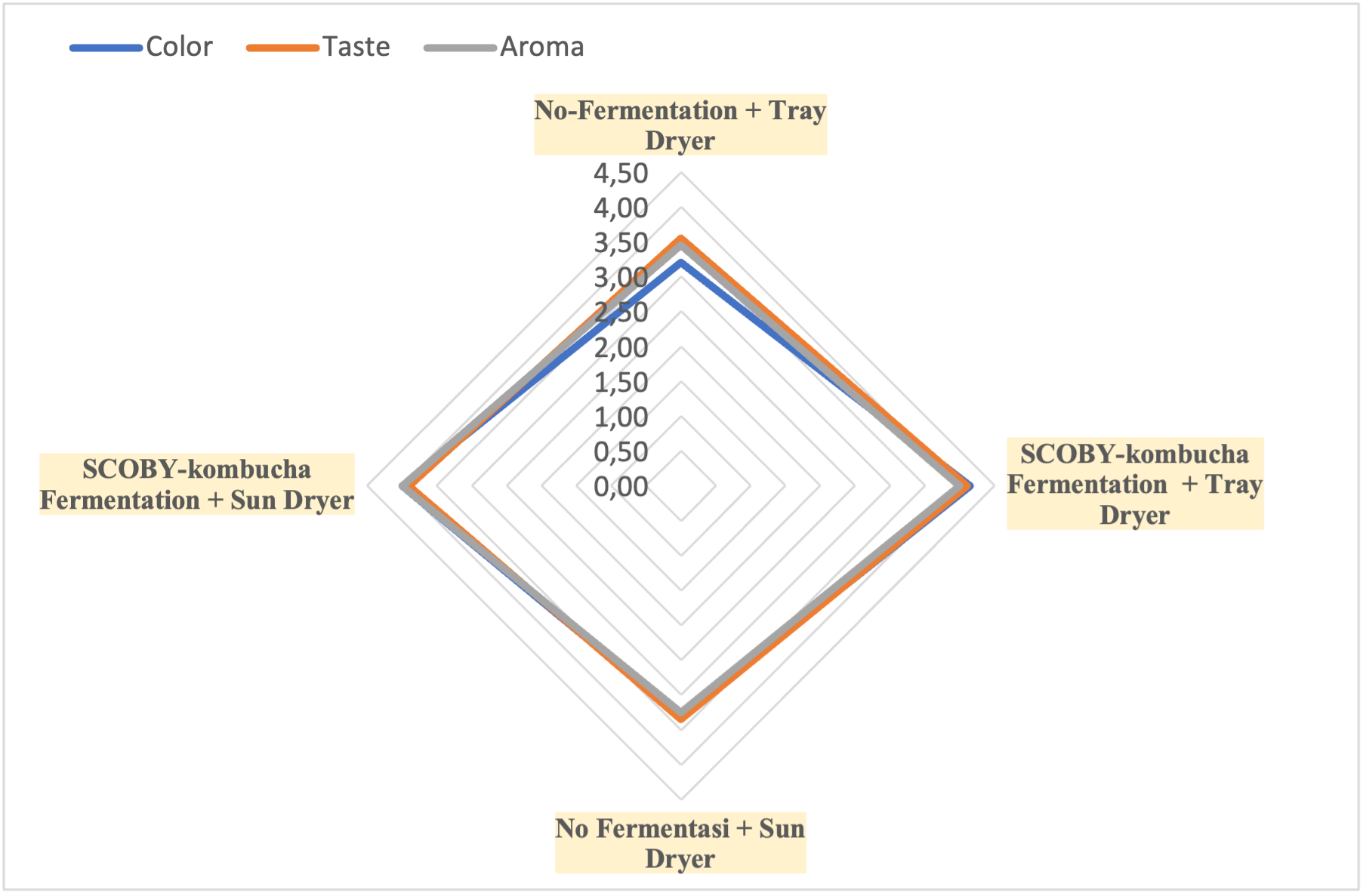
Arabica coffee processing generates coffee cherry skin or husk as a by-product that is often underutilized and treated as waste, despite its potential to be processed into cascara tea as a value-added functional beverage. The application of SCOBY-kombucha fermentation offers an innovative approach to improve the chemical and sensory quality of cascara tea. Objective: This study aimed to analyze the quality characteristics of cascara tea produced from Arabica coffee husks fermented with SCOBY-kombucha under different drying methods. Method: This study employed a quantitative experimental approach using a completely randomized design (CRD). The treatments consisted of fermentation and non-fermentation combined with two drying methods, namely tray-dryer and sun-dryer. Data were collected through laboratory analysis of moisture content, total phenol content, and tannin characteristics, as well as organoleptic testing of color, aroma, and taste. The data were analyzed using analysis of variance (ANOVA). Results: The results showed that drying methods had no significant effect on the quality of cascara tea in terms of moisture content and total phenol content. However, SCOBY-kombucha fermentation reduced tannin content and improved the aroma characteristics of the tea. The best treatment was obtained from SCOBY-kombucha fermentation combined with tray-dryer drying, producing cascara tea with 4.8% moisture content, total phenol content of 1191.6 mg GAE/100 g, lower tannin content, and acceptable sensory characteristics. Implications: The findings indicate that fermentation can enhance the quality and consumer acceptability of cascara tea, while supporting the utilization of coffee-processing by-products into value-added products in the agroindustrial sector. Originality/Value: This study provides a novel contribution by integrating SCOBY-kombucha fermentation and drying methods in cascara tea production, offering a comprehensive evaluation of their combined effects on chemical and sensory quality.
References
Agfarina, T. U. (2021). The Effect of Coffee Husk Fermentation Duration on Cascara Tea Characteristics. Sriwijaya University.
Aswanto, A. A., Muhtarudin, M., Farda, F. T., Liman, L., & Tantalo, S. (2023). The potential of coffee husk waste nutrients for ruminant feed in Sugarcane District plantation, West Lampung Regency. Journal of Animal Husbandry Research and Innovation, 7(3), 306-311.
Badan Pusat, S. (2023). Indonesia Coffee Statistics.
Baihaqi, B., Hakim, S., Nuraida, N., Fridayati, D., & Madani, E. (2023). Organoleptic Properties of Cascara Tea (Coffee Fruit Waste) at Different Drying Levels. Jurnal Agroscience, 16(1), 56-63. https://jurnal.upb.ac.id/index.php/agrosains/article/view/350
Directorate General of, P. (2016). Indonesia Plantation Statistic 2015-2017.
Fajrina, A., Jubahar, J., & Sabirin, S. (2017). Determination of Tannin Levels in Tea Bags Using UV-Vis Spectrophotometry. Higea Pharmacy Journal, 8(2), 133-142. https://doi.org/10.52689/higea.v8i2.145
Garis, P., Romalasari, A., & Purwasih, R. (2019). Utilization of Cascara Coffee Skin Waste into Tea Bags. Proceedings of Industrial Research Workshop and National Seminar,
Isdar, N. (2023). Modification of Cascara Drink from Coffee Husks with the Addition of Mint Leaves (Mentha piperita L.). Pangkep State Polytechnic of Agriculture.
Larassati, D. P., Kustyawati, E., Sartika, D., & Suharyono, A. S. (2021). Effect of Wet Fermentation Using Saccharomyces cerevisiae on Chemical and Sensory Properties of Robusta Coffee. Jurnal Teknik Pertanian Lampung, 10(4), 449-458. https://doi.org/10.23960/jtep-l.v10i4.449-458
Listiana, L., Wahlanto, P., Ramadhani, S. S., & Ismail, R. (2022). Determination of Tannin Content in Mangkokan Leaves Using UV-Vis Spectrophotometer. Pharmacy Genius Journal, 1(1), 62-73. https://doi.org/10.56359/pharmgen.v1i01.152
Nafisah, D., & Widyaningsih, T. D. (2018). Study of Drying Methods and Brewing Ratios in Cascara Production. Journal of Food and Agroindustry, 6(3), 37-47. https://doi.org/10.21776/ub.jpa.2018.006.03.5
National Standardization, A. (2013). SNI 01-3836-2013 Dry Tea Quality Requirements.
Nurhayati, N., Yuwanti, S., & Urbahillah, A. (2020). Physicochemical and sensory characteristics of cascara kombucha. Journal of Food Technology and Industry, 31(1), 38-49. https://doi.org/10.6066/jtip.2020.31.1.38
Puspaningrum, D. H. D., & Sumadewi, N. L. U. (2019). The Effect of Drying Methods on Total Phenol Content of Arabica Cascara. National Scientific Seminar on Technology,
Puspaningrum, D. H. D., & Sumadewi, N. L. U. (2020). Effect of Drying on Total Phenols and Antioxidant Capacity. Journal of Food Technology, 6(2), 89-95. https://doi.org/10.24843/MITP.2019.v06.i02
Puspaningrum, D. H. D., Sumadewi, N. L. U., & Sari, N. K. Y. (2022). Chemical Characteristics and Antioxidant Activity During Fermentation of Cascara. Journal of Science Education, 5(2), 44-51. https://doi.org/10.24246/juses.v5i2p44-51
Rahayu, W. E., Purwasih, R., & Hidayat, D. (2020). Effect of Pineapple Juice Addition on Cascara Tea Characteristics. Food Technology Journal, 11(2), 144-151. https://doi.org/10.35891/tp.v11i2.1900
Subeki, D. D. T. W., Nauli, P., & Rahmawati, S. H. (2019). Polyphenol Content and Quality of Cascara. National Seminar Tektan Polinela,
Sugito, S., Rosidah, U., & Wijaya, A. (2023). Effect of Coffee Husk Fermentation Duration on Cascara Tea Quality. National Seminar on Suboptimal Land,
Tampubolon, S. D. R., Seleleubajak, M. B., & Nurhayati, N. (2024). Effect of Drying Method and Temperature on Cascara Tea Quality. Agro Bali: Agricultural Journal, 7(2), 435-448. https://doi.org/10.37637/ab.v7i2.1637
Downloads
Published
How to Cite
Issue
Section
Citation Check
License
Copyright (c) 2026 Nur Faidah Munir, Muhammad Kadir, Suwandi Suwandi, Reta Reta

This work is licensed under a Creative Commons Attribution-ShareAlike 4.0 International License.