Artificial Intelligence in the Initial Assessment of Acute Burn Wounds:
A Narrative Literature Review
DOI:
https://doi.org/10.56127/jukeke.v5i2.2832Keywords:
artificial intelligence, acute burn wounds, burn depth assessment, clinical decision support, total body surface area.Abstract
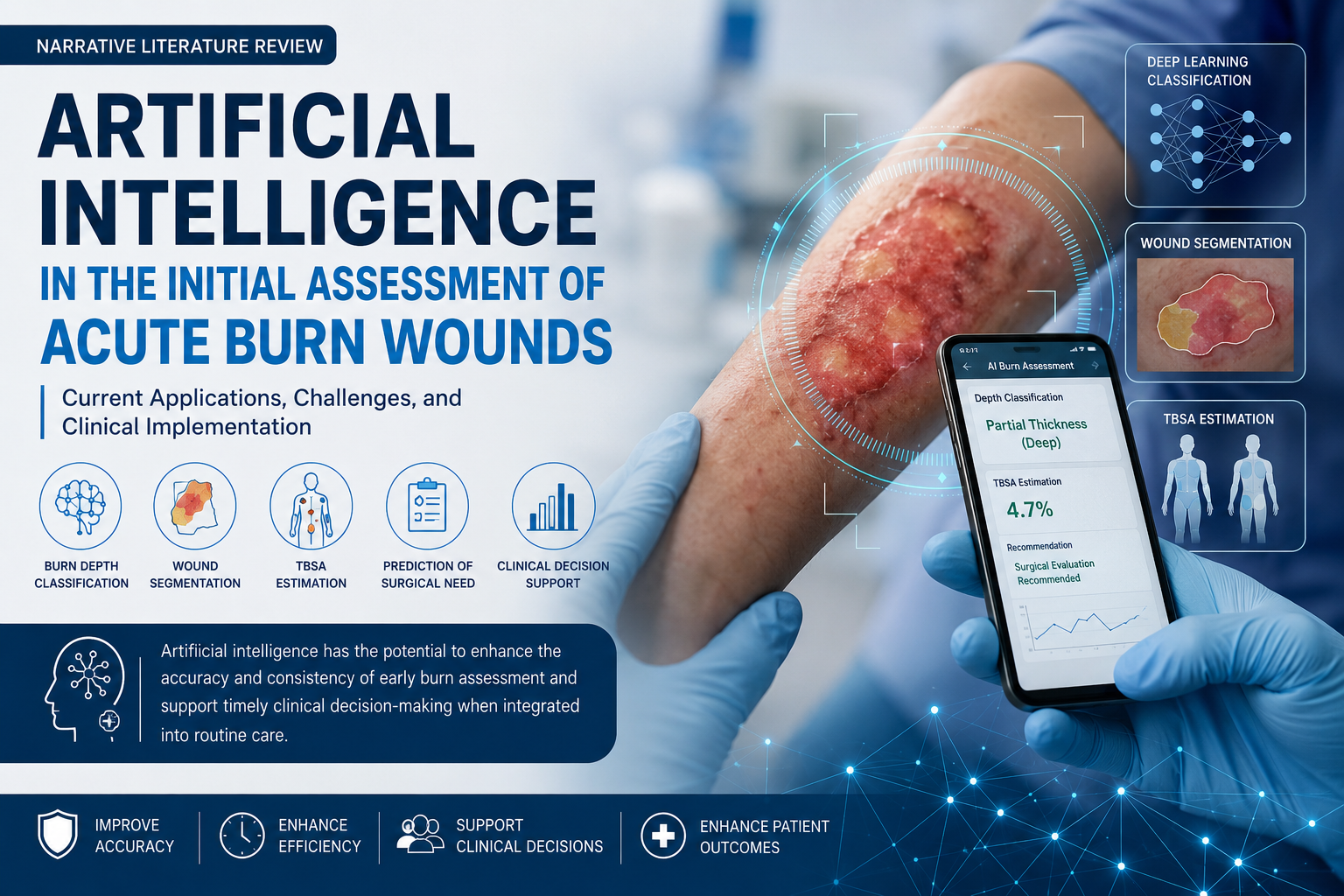
Accurate initial assessment of acute burn wounds is essential for determining severity, healing potential, referral needs, and treatment strategy. However, this assessment remains challenging because burn wounds evolve over time and conventional methods often depend on clinician experience or specialized imaging technologies. Artificial intelligence offers a potential approach to improve the objectivity and efficiency of early burn assessment. Objective: This study aims to analyze current applications of artificial intelligence in the initial assessment of acute burn wounds and evaluate its potential, methodological challenges, and clinical implementation. Methodology: This study employed a narrative literature review. Scientific publications were retrieved from PubMed and Google Scholar from database inception to May 2026. Eligible publications included original research articles, systematic and narrative reviews, clinical practice guidelines, and AI reporting guidelines related to AI-assisted burn assessment. The selected literature was synthesized narratively by comparing evidence on burn detection, burn-depth classification, wound segmentation, total body surface area estimation, prediction of surgical requirements, multimodal AI, and methodological quality. Findings: AI has demonstrated promising performance in burn detection, burn-depth classification, wound segmentation, total body surface area estimation, and prediction of surgical requirements. Recent studies have also expanded AI applications toward multimodal assessment by integrating clinical images with physiological and electronic medical record data. Nevertheless, current evidence is constrained by heterogeneous reference standards, retrospective designs, limited external validation, inconsistent image-acquisition protocols, and inadequate representation of diverse skin tones. Implications: AI should be implemented as a clinical decision-support tool that complements, rather than replaces, serial clinical assessment by burn specialists. Originality: This review integrates technical advances in artificial intelligence with clinically relevant considerations, including burn wound progression, image-acquisition timing, treatment status, reference-standard heterogeneity, external validation, skin-tone diversity, and workflow integration.
References
Abubakar, A., Ugail, H., Smith, K. M., Bukar, A. M., & Elmahmudi, A. A. (2020). Burns depth assessment using deep learning features. Journal of Medical and Biological Engineering, 40, 923-933. https://doi.org/10.1007/s40846-020-00574-z
Bhattachan, P., Ricciuti, Z., Khalaf, F., & Jeschke, M. G. (2026). The role of artificial intelligence in burn assessment, complication diagnosis, and outcome prediction: A narrative review. Burns & Trauma, 14, tkaf071. https://doi.org/10.1093/burnst/tkaf071
Chang, C. W., Lai, F., Christian, M., Chen, Y. C., Hsu, C., Chen, Y. S., Chang, D. H., Roan, T. L., & Yu, Y. C. (2021). Deep learning-assisted burn wound diagnosis: Diagnostic model development study. JMIR Medical Informatics, 9(12), e22798. https://doi.org/10.2196/22798
Cirillo, M. D., Mirdell, R., Sjöberg, F., & Pham, T. D. (2021). Improving burn depth assessment for pediatric scalds by AI based on semantic segmentation of polarized light photography images. Burns, 47(7), 1586-1593. https://doi.org/10.1016/j.burns.2021.01.011
Holm, S., Huss, F., Nayyer, B., & Zdolsek, J. (2026). Use of artificial intelligence in burn assessment: A scoping review with a large language model-generated decision tree. European Burn Journal, 7(1), 4. https://doi.org/10.3390/ebj7010004
Huang, S., Dang, J., Sheckter, C. C., Yenikomshian, H. A., & Gillenwater, J. (2021). A systematic review of machine learning and automation in burn wound evaluation: A promising but developing frontier. Burns, 47(8), 1691-1704. https://doi.org/10.1016/j.burns.2021.07.007
Jaspers, M. E. H., van Haasterecht, L., van Zuijlen, P. P. M., & Mokkink, L. B. (2019). A systematic review on the quality of measurement techniques for the assessment of burn wound depth or healing potential. Burns, 45(2), 261-281. https://doi.org/10.1016/j.burns.2018.05.015
Monstrey, S., Hoeksema, H., Verbelen, J., Pirayesh, A., & Blondeel, P. (2008). Assessment of burn depth and burn wound healing potential. Burns, 34(6), 761-769. https://doi.org/10.1016/j.burns.2008.01.009
Taib, B. G., Karwath, A., Wensley, K., Minku, L., Gkoutos, G. V., & Moiemen, N. (2023). Artificial intelligence in the management and treatment of burns: A systematic review and meta-analyses. Journal of Plastic, Reconstructive & Aesthetic Surgery, 77, 133-161. https://doi.org/10.1016/j.bjps.2022.11.049
Wang, R., Zhao, J., Zhang, Z., Cao, C., Zhang, Y., & Mao, Y. (2020). Diagnostic accuracy of laser Doppler imaging for the assessment of burn depth: A meta-analysis and systematic review. Journal of Burn Care & Research, 41(3), 619-625. https://doi.org/10.1093/jbcr/irz203
Wang, Y., Ke, Z., He, Z., Chen, X., Zhang, Y., Xie, P., Li, T., Zhou, J., Li, F., Yang, C., & Kai, L. (2020). Real-time burn depth assessment using artificial networks: A large-scale, multicentre study. Burns, 46(8), 1829-1838. https://doi.org/10.1016/j.burns.2020.07.010
World Health, O. (2023). Burns. https://www.who.int/news-room/fact-sheets/detail/burns