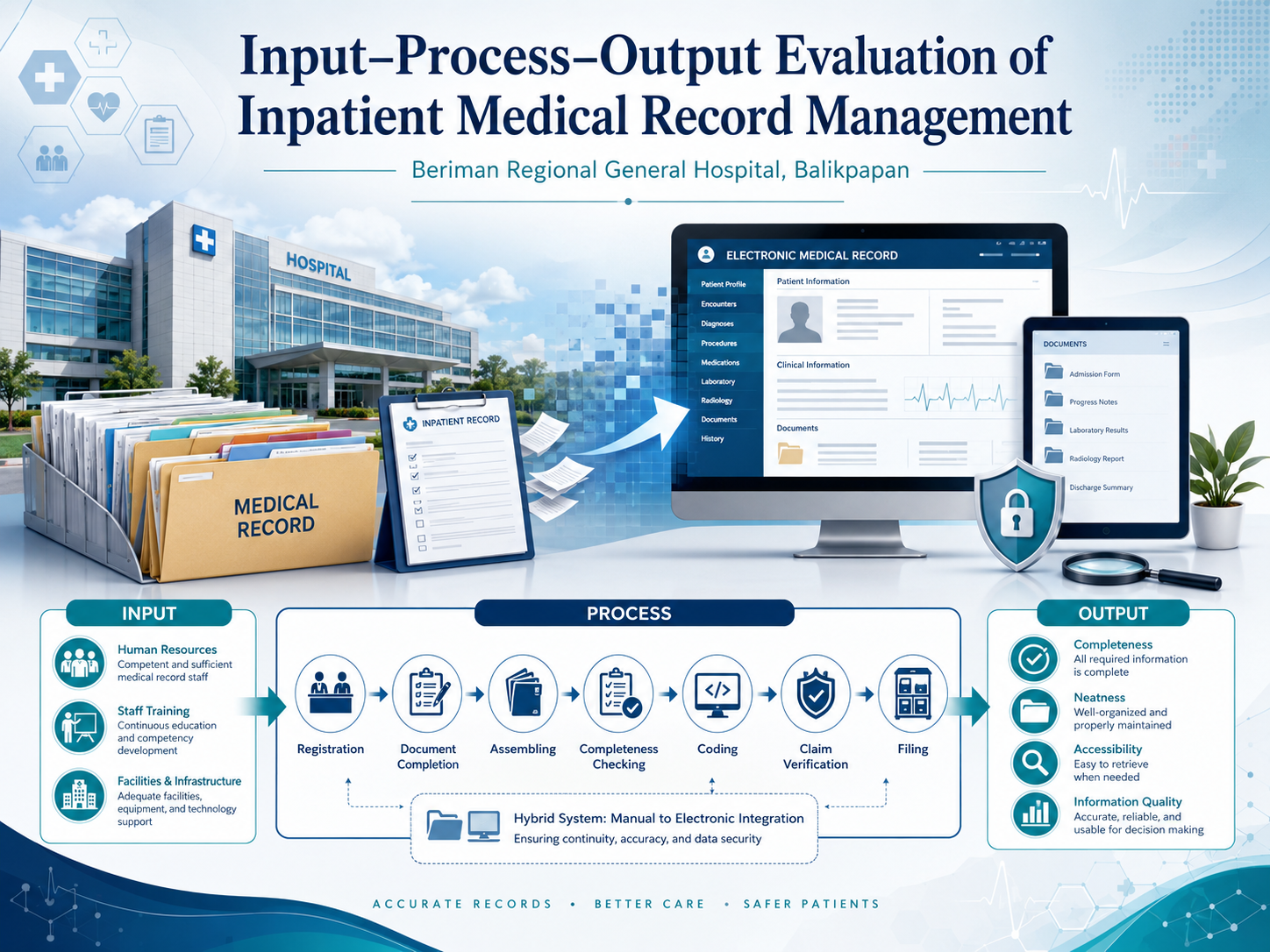
Input–Process–Output Evaluation of Inpatient Medical Record Management at Beriman Regional General Hospital, Balikpapan
DOI:
https://doi.org/10.56127/jukeke.v4i2.592Keywords:
electronic medical record, health information management, inpatient medical record, input–process–output evaluation, medical record managementAbstract
Inpatient medical record management is essential for continuity of care, administrative accountability, claim verification, legal protection, and hospital service quality. However, hospitals still face problems related to incomplete documents, delayed file returns, limited facilities, and the transition from manual to electronic medical record systems. Objective: This study aimed to evaluate inpatient medical record management based on the input, process, and output dimensions at Beriman Regional General Hospital, Balikpapan. Methodology: This study used a descriptive qualitative design. Data were collected through observation, in-depth interviews, and documentation involving five informants from the Medical Record Unit, consisting of the head of the medical record installation, data processing officer, filing officer, coding officer, and registration officer. Data were analyzed using qualitative descriptive analysis through data collection, data reduction, data display, and conclusion drawing. Findings: The results showed that the number of staff was relatively adequate; however, several personnel did not have an educational background in medical records and had not received structured training. The workflow generally followed standard operating procedures, including registration, file distribution, document completion, assembling, completeness analysis, coding, claim verification, and filing. Nevertheless, implementation was constrained by incomplete discharge summaries, blank informed consent forms, missing physician signatures, illegible handwriting, delayed file returns, limited infrastructure, and repeated file movement in the hybrid manual–electronic system. Document access was relatively easy through SIMRS and borrowing logbook procedures, but file completeness and neatness had not been fully achieved. Implication: The findings highlight the need to strengthen staff competence, regular training, infrastructure, SOP compliance, internal audits, and integrated electronic medical record implementation. Originality: This study provides an integrated input–process–output evaluation model for identifying root causes and improvement priorities in inpatient medical record management.
References
Boonstra, A., Versluis, A., & Vos, J. F. J. (2014). Implementing electronic health records in hospitals: A systematic literature review. BMC Health Services Research, 14, 370. https://doi.org/10.1186/1472-6963-14-370
Gesulga, J. M., Berjame, A., Moquiala, K. S., & Galido, A. (2017). Barriers to electronic health record system implementation and information systems resources: A structured review. Procedia Computer Science, 124, 544-551. https://doi.org/10.1016/j.procs.2017.12.188
Kencana, G., Rumengan, G., & Hutapea, F. (2019). Analisa kepatuhan pengisian berkas rekam medis di instalasi rawat inap Rumah Sakit X. Jurnal Manajemen Kesehatan Yayasan RS Dr. Soetomo, 5(1), 27-37. https://doi.org/10.29241/jmk.v5i1.127
Khubone, T., Tlou, B., & Mashamba-Thompson, T. P. (2020). Electronic health information systems to improve disease diagnosis and management at point-of-care in low and middle income countries: A narrative review. Diagnostics, 10(5), 327. https://doi.org/10.3390/diagnostics10050327
Lestari, D. F. A., & Muflihatin, I. (2020). Analisis faktor penyebab ketidaklengkapan rekam medis pasien rawat inap di Puskesmas Kotaanyar. J-REMI: Jurnal Rekam Medik dan Informasi Kesehatan, 2(1), 134-142. https://doi.org/10.25047/j-remi.v2i1.2217
Sharifi, S., Zahiri, M., Dargahi, H., & Faraji-Khiavi, F. (2021). Medical record documentation quality in the hospital accreditation. Journal of Education and Health Promotion, 10, 76. https://doi.org/10.4103/jehp.jehp_852_20
Syukria, O. A., & Wardhani, V. (2021). Completeness of medical record documents: Exploration on causes and solutions. Jurnal Kedokteran Brawijaya, 31(Supplement 2), 52-57. https://doi.org/10.21776/ub.jkb.2021.031.02.11s
Ulfa, H. M. (2018). Analisis unsur manajemen dalam pengolahan rekam medis di Rumah Sakit TNI AU Lanud Roesmin Nurjadin. KESMARS: Jurnal Kesehatan Masyarakat, Manajemen dan Administrasi Rumah Sakit, 1(1), 20-25. https://doi.org/10.31539/kesmars.v1i1.146
Wati, T. G., & Nuraini, N. (2019). Analisis kejadian missfile berkas rekam medis rawat jalan di Puskesmas Bangsalsari. J-REMI: Jurnal Rekam Medik dan Informasi Kesehatan, 1(1), 23-30. https://doi.org/10.25047/j-remi.v1i1.1932
Wirajaya, M. K. M., & Nuraini, N. (2019). Faktor-faktor yang mempengaruhi ketidaklengkapan rekam medis pasien pada rumah sakit di Indonesia. Jurnal Manajemen Informasi Kesehatan Indonesia, 7(2), 165-174. https://doi.org/10.33560/jmiki.v7i2.225