Passive Design Strategies for Improving Natural Ventilation in a Tropical Corner House
DOI:
https://doi.org/10.56127/ijst.v5i2.2091Keywords:
Corner house, Natural ventilation, Cross ventilation, Stack ventilation, Passive designAbstract
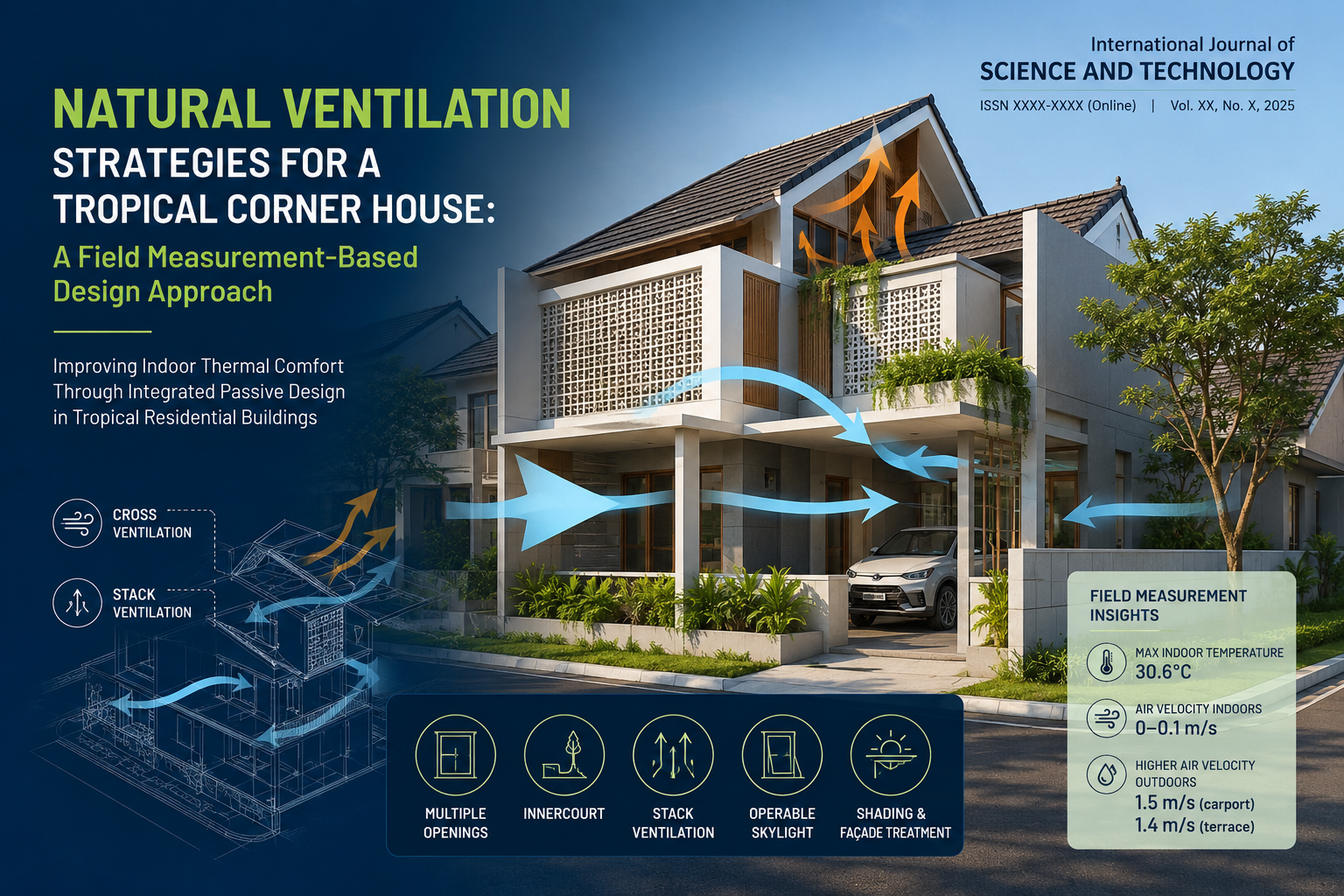
Natural ventilation is an important passive strategy for improving thermal conditions and reducing dependence on mechanical cooling in tropical houses. Corner houses offer greater ventilation potential due to their multiple exposed façades, although inappropriate spatial and opening configurations may limit airflow. Objective: This study develops a corner-house design model to improve natural ventilation based on the environmental evaluation of an existing residential building. Methodology: A descriptive qualitative and quantitative approach was applied to a type 27/60 corner house in Forest Hill Housing. Literature and SNI standards were reviewed, while air temperature, relative humidity, and air velocity were measured using a hygro-thermometer and an anemometer. The results were evaluated to identify ventilation problems and formulate design solutions. Findings: Most indoor spaces recorded air velocities of only 0–0.1 m/s, while the carport and terrace reached 1.5 and 1.4 m/s at midday. Indoor temperatures reached 30.6°C in the drying area and 30.5°C in the dining room, indicating that available outdoor airflow was not effectively distributed indoors. The proposed redesign therefore integrates additional openings, cross and stack ventilation, operable skylights, an innercourt, increased ceiling height, spatial reconfiguration, and solar shading. Implications: The proposed strategies provide practical design considerations for improving natural ventilation in tropical corner houses and potentially reducing reliance on mechanical cooling. Originality: This study translates field-measured environmental deficiencies into an integrated passive redesign that combines multiple exposed façades, horizontal and vertical airflow strategies, spatial reconfiguration, and solar control.
References
Andriawan, I. (2021). Pencahayaan dan penghawaan alami pada rumah tinggal, Kembaran, Wonosobo. Jurnal Ilmiah Arsitektur, 11(1), 23-27.
Chen, H., Ding, X., Li, R., Gong, S., Liu, B., Li, Q., & Gao, W. (2024). An experimental case study of natural ventilation effects on the residential thermal environment and predicted thermal comfort in Kunming. Case Studies in Thermal Engineering, 56, 104198. https://doi.org/10.1016/j.csite.2024.104198
Fitrawansyah, Bunawardi, R. S., & Burhanuddin. (2021). Optimalisasi pencahayaan dan penghawaan alami pada rumah adat Mandar. Timpalaja: Architecture Student Journals, 3(1), 30-36.
Heidari, S., Poshtiri, A. H., & Gilvaei, Z. M. (2024). Enhancing thermal comfort and natural ventilation in residential buildings: A design and assessment of an integrated system with horizontal windcatcher and evaporative cooling channels. Energy, 289, 130040. https://doi.org/10.1016/j.energy.2023.130040
Idris, N. A., Sirhadi, J., Arlino, D., & Jurumai, L. P. (2024). Kajian solusi desain penerapan pencahayaan alami pada Masjid Al-Azhar. Rustic: Jurnal Arsitektur, 4(2), 163-178.
Iqbal, M., Ozaki, A., Choi, Y., & Arima, Y. (2023). Performance improvement plan towards energy-efficient naturally ventilated houses in tropical climate regions. Sustainability, 15(16), 12173. https://doi.org/10.3390/su151612173
Lapisa, R., Arwizet, Kurniawan, A., Krismadinata, Rahman, H., & Romani, Z. (2022). Optimized design of residential building envelope in tropical climate region: Thermal comfort and cost efficiency in an Indonesian case study. Journal of Architectural Engineering, 28(2), 05022002. https://doi.org/10.1061/(ASCE)AE.1943-5568.0000529
Lestari, D. W., & Pasaribu, R. P. (2022). Penghawaan alami pada rumah tinggal di kawasan permukiman Waduk Pluit dengan pendekatan konsep rumah sehat. Mintakat: Jurnal Arsitektur, 23(1), 85-96.
Pratiwi, F. K., Baihaqi, M. A. F., & Gandarum, D. N. (2023). Pengaruh penghawaan dan pencahayaan alami pada bangunan semi terbuka terhadap kenyamanan dan produktivitas: Studi kasus Kafe Tanatap Ampera, Jakarta Selatan. Jurnal Arsitektur ARCADE, 7(2), 189-199.
Rachmalia, I., Romadhoni, N., Tarra, B. M., & Arfianti, A. (2023). Pengaruh bukaan terhadap penghawaan dan pencahayaan alami pada bangunan Terminal Joyoboyo Surabaya. Seminar Nasional Arsitektur Pertahanan 2023, UPN Veteran Jawa Timur,
Sabtalistia, Y. A. (2024). Pengaruh innercourt terhadap pencahayaan alami. Jurnal Arsitektur PAWON, 8(1), 77-92.
Salsabila, S., Hanif, M., Hermawan, & Arrizqi, A. N. (2021). Pencahayaan dan penghawaan alami pada rumah berdinding plaster di Kecamatan Wonosobo. Journal of Economic, Business and Engineering (JEBE), 3(1), 132-137.
Taing, K., Andre, P., & Leclercq, P. (2023). Analysis of thermal performance of naturally ventilated residential building in tropical climate: Case study of Phnom Penh, Cambodia. IOP Conference Series: Earth and Environmental Science, 1199(1), 012038. https://doi.org/10.1088/1755-1315/1199/1/012038
Tan, R., Hie, G. J., Sumita, V. C. N., Marcellio, R., Verdianza, C., Laurenzo, M., & Darmawan, S. (2023). Analisis aliran udara pada ruang toilet dengan menggunakan metode computational fluid dynamics (CFD). Jurnal Serina Sains, Teknik, dan Kedokteran, 1(2), 309-318.
Vidiyanti, C., Tambunan, S. F. D. B., & Alfian, Y. (2018). Kualitas pencahayaan alami dan penghawaan alami pada bangunan dengan fasade roster. Jurnal Arsitektur, Bangunan & Lingkungan, 7(2), 99-106.
Yadeta, C., Indraganti, M., Alemayehu, E., & Tucho, G. T. (2022). An investigation of human thermal comfort and adaptation in naturally ventilated residential buildings and its implication for energy use in tropical climates of Ethiopia. Science and Technology for the Built Environment, 28(7), 896-915. https://doi.org/10.1080/23744731.2022.2048574
Downloads
Published
How to Cite
Issue
Section
Citation Check
License
Copyright (c) 2026 Doddy Yuono, Yunita Ardianti Sabtalistia

This work is licensed under a Creative Commons Attribution-ShareAlike 4.0 International License.