Performance Evaluation of Porous Asphalt Mixtures Incorporating Cotton Cloth Ash as Filler Based on Marshall Characteristics and Permeability
DOI:
https://doi.org/10.56127/ijst.v5i1.2653Keywords:
Porous Asphalt, Cotton Cloth Ash, Marshall Characteristics, Permeability, Optimum Asphalt ContentAbstract
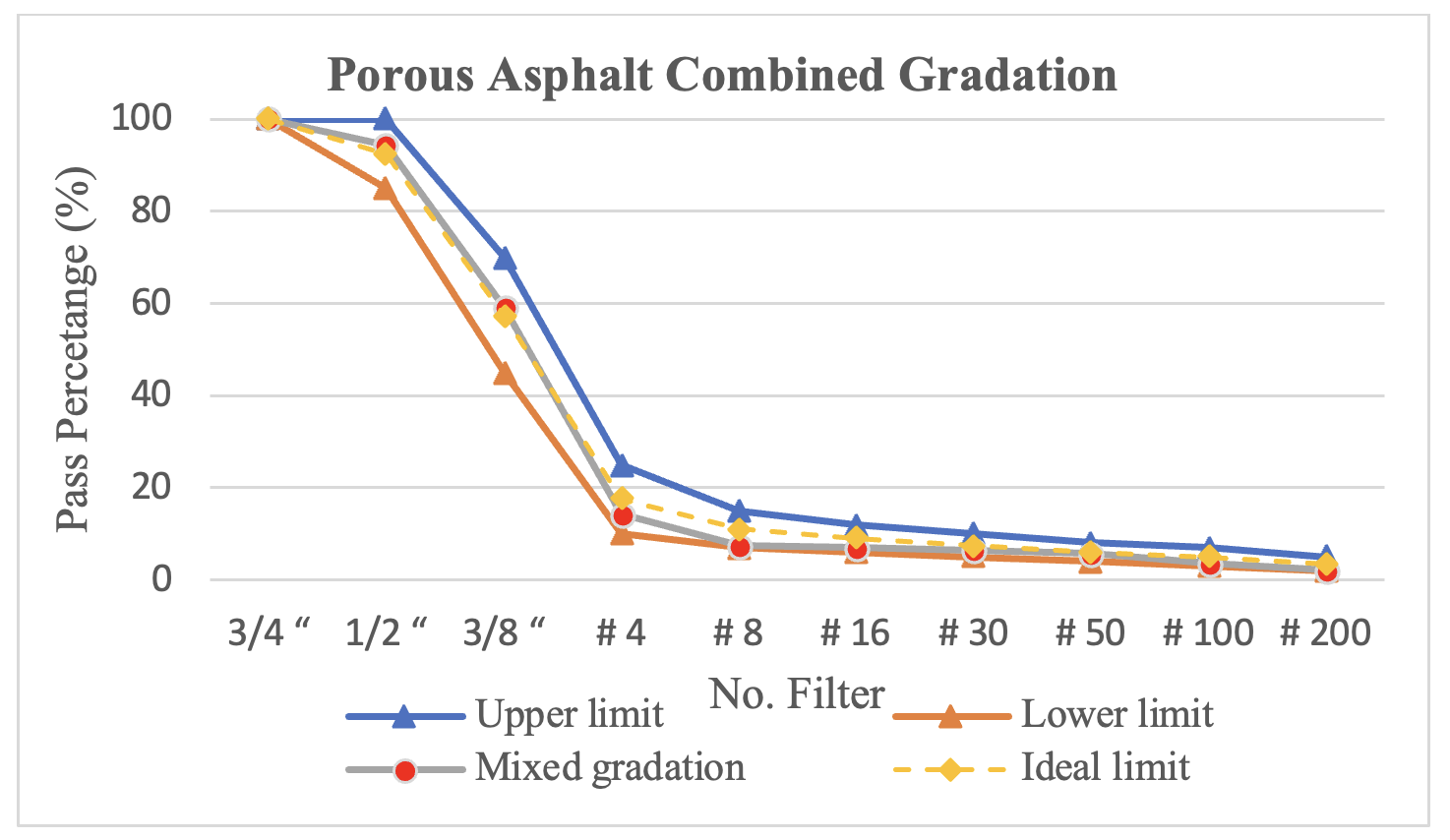
Porous asphalt is designed to improve surface drainage and reduce water accumulation; however, its performance depends on the balance between mechanical strength and permeability. The use of alternative filler materials, particularly textile-derived waste such as cotton cloth ash, remains limited. Objective: This study aims to evaluate the performance of porous asphalt mixtures incorporating cotton cloth ash as a substitute filler, focusing on optimum asphalt content, Marshall characteristics, and permeability behavior. Methodology: An experimental quantitative approach was conducted in a laboratory. The mixture design followed the Australian Asphalt Pavement Association (AAPA, 2004) method. Data were obtained through material testing, Marshall testing, and permeability testing. Key parameters analyzed included Void in Mix (VIM), Stability, Flow, Marshall Quotient (MQ), Cantabro Loss (CL), Asphalt Flow Down (AFD), and permeability. Findings: The Optimum Asphalt Content (OAC) was identified at 4.80%. The best mechanical performance occurred at 4.5%–5% asphalt content, with maximum stability of 832 kg and MQ of 530 kg/mm. Permeability increased with asphalt content, reaching 0.20 liter/second at 6%, indicating improved drainage but reduced structural performance at higher binder levels. Implications: The results highlight the importance of optimizing asphalt content to achieve a balance between mechanical strength and hydraulic performance in porous asphalt design. Originality: This study introduces cotton cloth ash as an alternative filler, demonstrating its feasibility in maintaining functional and structural performance while supporting sustainable pavement materials.
References
Australian Asphalt Pavement, A. (2004). National asphalt specification.
Bappenas. (2021). Indonesia’s Long-Term Strategy for Low Carbon and Climate Resilience 2050 (LTS-LCCR 2050). https://www.bappenas.go.id
BMKG, B. M. K. d. G. (2023). Buletin hujan bulanan: Updated Desember 2023. https://www.bmkg.go.id/iklim/buletin-hujan-bulanan-updated-desember-2023
Chen, J. S., & Yang, C. H. (2020). Porous asphalt concrete: A review of design, construction, performance and maintenance. International Journal of Pavement Research and Technology, 13(6), 601-612. https://doi.org/10.1007/s42947-020-0039-7
Direktorat Jenderal Bina, M. (2021). Pedoman desain drainase jalan (Pedoman No. 15/P/BM/2021, Issue. https://binamarga.pu.go.id/uploads/files/1499/Surat-Edaran-Direktur-Jenderal-Bina-Marga-Nomor-23SEDb2021-tentang-Pedoman-Desain-Drainase-Jalan-Pedoman-Nomor-15PBM2021.pdf
Direktorat Jenderal Bina, M. (2023). Pedoman inventarisasi drainase jalan (Pedoman No. 06/P/BM/2023, Issue. https://binamarga.pu.go.id/uploads/files/1909/06pbm2023-pedoman-inventarisasi-drainase-jalan.pdf
Elmagarhe, A., Lu, Q., Alamri, M., Alharthai, M., & Elnihum, A. (2024). Laboratory performance evaluation of porous asphalt mixture containing recycled concrete aggregate and fly ash. Case Studies in Construction Materials, 20, e02827.
Guo, Y., Tataranni, P., & Sangiorgi, C. (2023). The use of fibres in asphalt mixtures: A state of the art review. Construction and Building Materials, 390, 131678. https://doi.org/10.1016/j.conbuildmat.2023.131678
Huang, W., Yu, H., Lin, Y., & Zheng, Y. (2022). Energy analysis for evaluating durability of porous asphalt mixture. Construction and Building Materials, 326, 126819. https://doi.org/10.1016/j.conbuildmat.2022.126819
Jin, D., Mohammadi, S., Xin, K., Yin, L., & You, Z. (2024). Laboratory performance and field demonstration of asphalt overlay with recycled rubber and tire fabric fiber. Construction and Building Materials, 438, 136941. https://doi.org/10.1016/j.conbuildmat.2024.136941
Jwaida, Z., Al Quraishy, Q. A., Almuhanna, R. R. A., Dulaimi, A., Bernardo, L. F. A., & Andrade, J. M. d. A. (2024). The use of waste fillers in asphalt mixtures: A comprehensive review. CivilEng, 5(4), 801-826. https://doi.org/10.3390/civileng5040042
Kementerian Lingkungan Hidup dan, K. (2022). Sistem Informasi Pengelolaan Sampah Nasional (SIPSN) – Data Timbulan Sampah Indonesia Tahun 2022. https://sipsn.menlhk.go.id
Li, Q., Zeng, X., Wang, J., Luo, S., Meng, Y., Gao, L., & Wang, X. (2022). Aging performance of high viscosity modified asphalt under complex heat-light-water coupled conditions. Construction and Building Materials, 325, 126314.
Miera-Domínguez, H., DeLaFuente-Navarro, C., Lastra-González, P., Indacoechea-Vega, I., & Castro-Fresno, D. (2025). Reinforcement of porous asphalt mixtures with recycled fibers from industrial processes. Construction and Building Materials, 495, 143595. https://doi.org/10.1016/j.conbuildmat.2025.143595
Rahman, S. S., Siddiqua, S., & Cherian, C. (2022). Sustainable applications of textile waste fiber in the construction and geotechnical industries: A retrospect. Cleaner Engineering and Technology, 6, 100420. https://doi.org/10.1016/j.clet.2022.100420
Shahnewaz, S. M., Masri, K. A., Ahmad Abdul Ghani, N. A., Putra Jaya, R., Siew Choo, C., Giannakopoulou, P. P., Rogkala, A., Lampropoulou, P., & Petrounias, P. (2023). Porous asphalt mixtures enriched with bamboo fibers as a new approach for future sustainable construction. Construction and Building Materials, 407, 133456. https://doi.org/10.1016/j.conbuildmat.2023.133456
Slebi-Acevedo, C. J., Lastra-González, P., & Castro-Fresno, D. (2020). Laboratory assessment of porous asphalt mixtures reinforced with synthetic fibers. Construction and Building Materials, 234, 117224. https://doi.org/10.1016/j.conbuildmat.2019.117224
Wu, Y., Airey, G., & Chen, X. (2019). Evaluation of experimental testing methods for the design and characterization of permeable friction course mixtures. Construction and Building Materials, 215, 403-417. https://doi.org/10.1016/j.conbuildmat.2019.01.229
Yan, J., Du, X., & Lin, H. (2025). Performance evaluation of porous asphalt mixture reinforced with waste cellulose acetate fibers. Sustainability, 17(8), 3447. https://doi.org/10.3390/su17083447
Youssef, A. M., & Fahmy, E. A. (2023). Evaluation of porous asphalt mixtures stabilized by human scalp hair. Case Studies in Construction Materials, 19, e02524. https://doi.org/10.1016/j.cscm.2023.e02524
Downloads
Published
How to Cite
Issue
Section
Citation Check
License
Copyright (c) 2026 Dicky Dwi Firmansyah, Aditya Rizkiardi, Nurani Hartatik

This work is licensed under a Creative Commons Attribution-ShareAlike 4.0 International License.