A Systematic Analysis of AI-Assisted Vibe Coding in Software Development: Opportunities, Challenges, and Risks
DOI:
https://doi.org/10.56127/ijst.v5i2.3000Keywords:
Vibe Coding, AI-Assisted Software Development, Systematic Literature Review, Low-Code Development, Software Engineering, Technical DebtAbstract
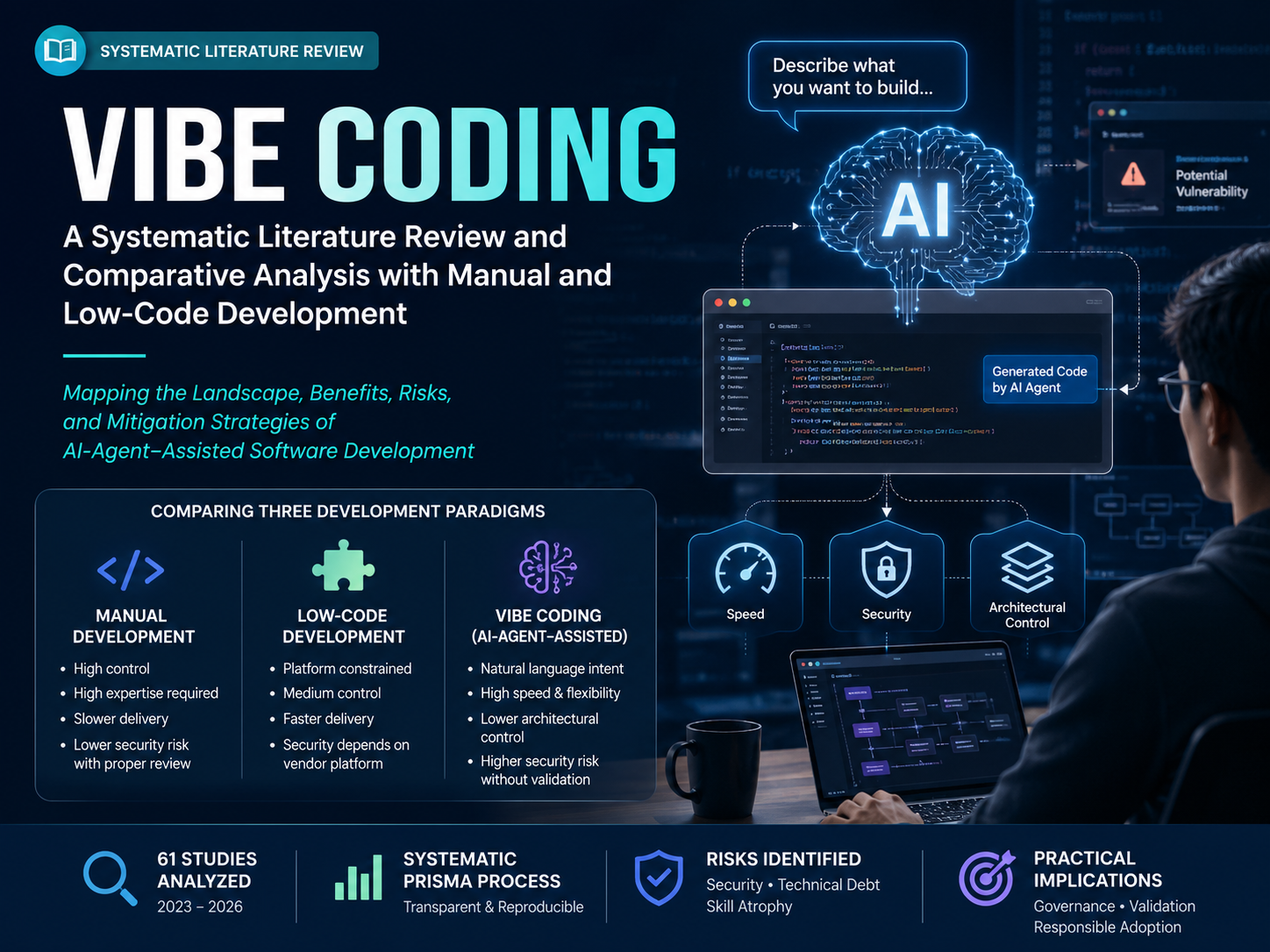
The literature on vibe coding has grown rapidly; however, it remains fragmented and is largely dominated by industry reports, leaving its position relative to traditional manual programming and low-code development insufficiently examined. This gap makes it difficult for both researchers and practitioners to determine when vibe coding is appropriate and what risks should be anticipated. Purpose: This study aims to systematically map the current landscape of vibe coding, develop a comparative framework against manual and low-code software development approaches, and propose practical risk mitigation recommendations for software development practitioners. Methodology: A Systematic Literature Review (SLR) was conducted following the PRISMA protocol. Relevant publications from 2023 to 2026 were retrieved from IEEE Xplore, ACM Digital Library, Springer, ScienceDirect, and arXiv, resulting in 61 studies that were analyzed using thematic analysis. Findings: The results indicate that vibe coding can accelerate software prototyping by approximately 40–60% compared with manual development. However, it introduces a verification bottleneck by shifting developers' workload from code implementation to quality assurance and validation. Compared with low-code development, vibe coding provides greater flexibility in expressing user intent but exhibits lower output predictability. In comparison with manual development, it offers significant gains in development speed while sacrificing architectural control and code security, thereby increasing the risks of technical skill degradation, hidden security vulnerabilities, and accumulated technical debt. Implications: The findings provide practical guidance for software development teams in identifying project phases that are suitable for extensive adoption of vibe coding and those that still require manual architectural review. The study also emphasizes the importance of integrating security auditing and technical debt monitoring into AI-assisted software development workflows. Originality/Value: The novelty of this study lies in its explicit comparative framework, which systematically positions vibe coding alongside manual and low-code development across six technical dimensions, extending previous studies that have generally examined vibe coding in isolation.
References
Aiersilan, A. (2026). The vibe-check protocol: Quantifying cognitive offloading in AI programming. Cornell University. https://doi.org/10.48550/arxiv.2601.02410
Beaulieu, N., Dascalu, S. M., & Hand, E. (2025). Vibe coding: A multivocal systematic mapping study. 266-273. https://doi.org/10.1109/snpd65828.2025.11254176
Elgendy, I. A., & et al. (2026). Responsible vibe coding: Architecture, opportunities, and research agenda. Journal of Computer Information Systems, 1-19. https://doi.org/10.1080/08874417.2026.2621186
Gadde, A. (2025). Democratizing software engineering through generative AI and vibe coding: The evolution of no-code development. Journal of Computer Science and Technology Studies, 7(4), 556-572. https://doi.org/10.32996/jcsts.2025.7.4.66
Huang, R., Reyna, A. M., Lerner, S., Xia, H., & Hempel, B. (2025). Professional software developers don't vibe, they control: AI agent use for coding in 2025. https://doi.org/10.48550/arxiv.2512.14012
Maes, S. H. (2025). The gotchas of AI coding and vibe coding. It's all about support and maintenance. https://doi.org/10.5281/zenodo.15343349
Meske, C., Hermanns, T., Weiden, E. V. D., Loser, K., & Berger, T. (2025). Vibe coding as a reconfiguration of intent mediation in software development: Definition, implications, and research agenda. IEEE Access, 13, 213242-213259. https://doi.org/10.1109/ACCESS.2025.3645466
Mohamed, A., Assi, M., & Guizani, M. (2026). The impact of LLM-assistants on software developer productivity: A systematic review and mapping study. Cornell University. https://doi.org/10.1145/3809494
Nettur, S. B., & et al. (2025). The role of GitHub Copilot on software development: A perspective on productivity, security, best practices and future directions. https://doi.org/10.48550/arxiv.2502.13199
Pimenova, V., Fakhoury, S., Bird, C., Storey, M., & Endres, M. (2025). Good vibrations? A qualitative study of co-creation, communication, flow, and trust in vibe coding. https://doi.org/10.48550/arxiv.2509.12491
Sapkota, R., Roumeliotis, K. I., & Karkee, M. (2025). Vibe coding vs. agentic coding: Fundamentals and practical implications of agentic AI. https://doi.org/10.48550/arxiv.2505.19443
Sartori, C. C. (2025). Architectures of error: A philosophical inquiry into AI and human code generation. https://doi.org/10.48550/arxiv.2505.19353
Sergeyuk, A., Golubev, Y., Bryksin, T., & Ahmed, I. (2024). Using AI-based coding assistants in practice: State of affairs, perceptions, and ways forward. Information and Software Technology, 178, 107610. https://doi.org/10.1016/j.infsof.2024.107610
van Hurne, M. H. K. (2025). A technical debt-aware prompting framework for sustainable vibe coding: Addressing the production readiness crisis in AI-assisted software development. https://doi.org/10.36227/techrxiv.175459417.76916566/v1
Zhao, S., Wang, D., Zhang, K., Luo, J., Li, Z., & Li, L. (2025). Is vibe coding safe? Benchmarking vulnerability of agent-generated code in real-world tasks. https://doi.org/10.48550/arxiv.2512.03262
Downloads
Published
How to Cite
Issue
Section
Citation Check
License
Copyright (c) 2026 Amrin Fakhruddin Jauhari, Fahmi Fathullah, Indra Adi Permana, Robby Nugraha

This work is licensed under a Creative Commons Attribution-ShareAlike 4.0 International License.