Design of a Shallot Peeling Machine for EA Kitchen MSME Using Voice of Customer, Quality Function Deployment, and Anthropometric Analysis
DOI:
https://doi.org/10.56127/juit.v5i2.2807Keywords:
shallot peeling machine, Voice of Customer, Quality Function Deployment, anthropometry, MSMEAbstract
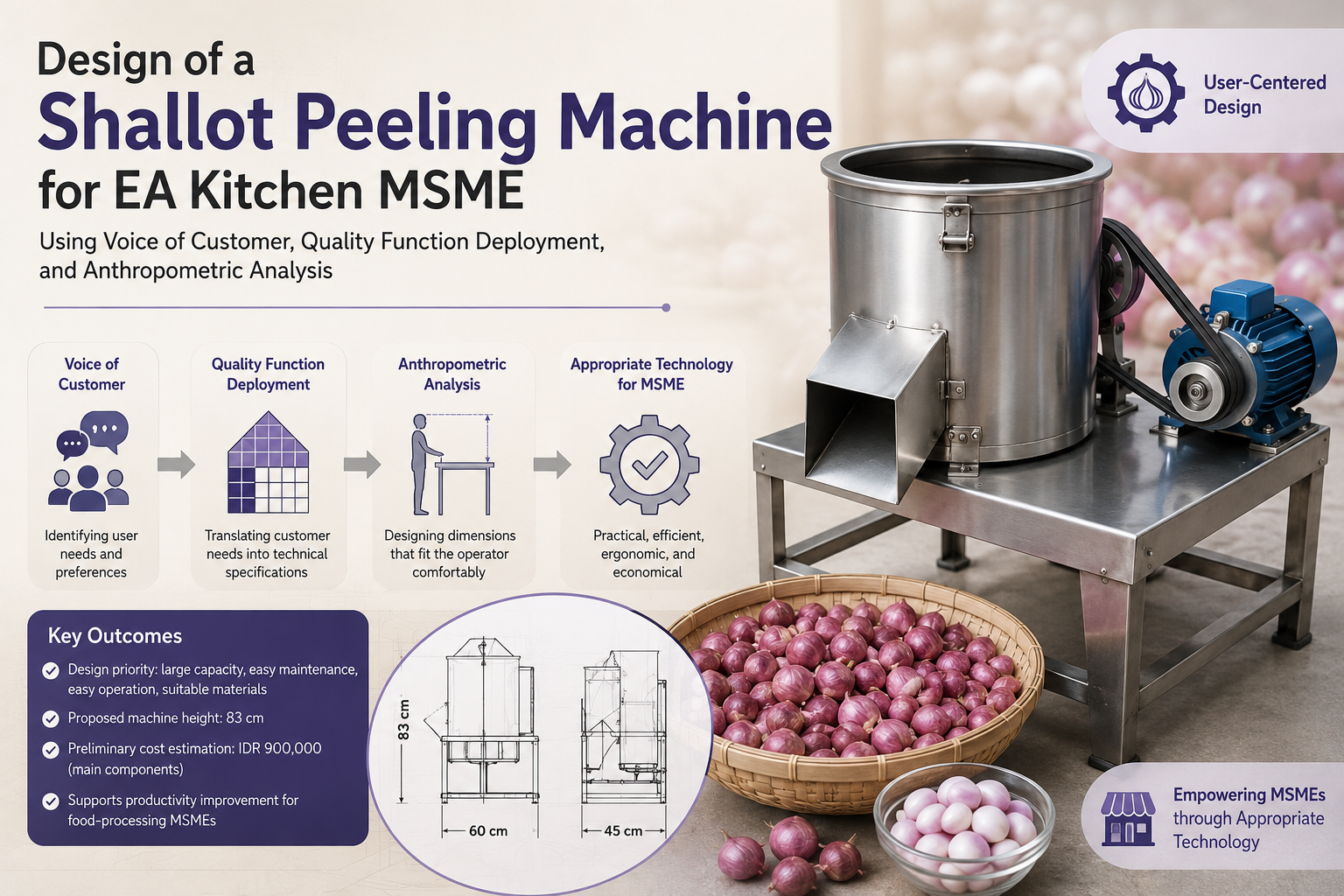
Manual shallot peeling remains a time-consuming and labor-intensive activity in small-scale food-processing enterprises. Therefore, appropriate peeling equipment is needed to improve efficiency while remaining suitable for the operational conditions of micro, small, and medium enterprises (MSMEs). Objective: This study aimed to develop a user-oriented shallot peeling machine design that meets the operational, ergonomic, and economic requirements of EA Kitchen, a food-processing MSME located in Driyorejo, Gresik, Indonesia. Methods: This study employed a product design and development approach. Data were collected through field observations, interviews, questionnaires, and anthropometric measurements. User requirements were identified using the Voice of Customer (VoC) approach and translated into technical priorities through Quality Function Deployment (QFD) and the House of Quality (HoQ). Anthropometric analysis was used to determine the appropriate machine height, while preliminary cost analysis was conducted to estimate fabrication requirements. Results: The results showed that design was the highest-priority customer attribute, with a weight of 47.3%, followed by quality at 31.5% and safety at 21.0%. Large capacity was identified as the most important technical response at 31.49%, followed by ease of maintenance at 28.03%, ease of operation at 21.80%, and material selection at 18.69%. The proposed machine height was 83 cm, while the preliminary cost of the identified main components was IDR 900,000. Implications: The findings provide a practical basis for developing a shallot peeling machine that is more compatible with the production capacity, ergonomic requirements, operational simplicity, and financial limitations of small-scale food-processing enterprises. Originality: The originality of this study lies in the integration of VoC, QFD, anthropometric considerations, and cost evaluation into a single user-centered design framework specifically applied to the development of shallot-peeling equipment for MSMEs.
References
Badan Pusat, S. (2024). Statistik Penyediaan Makanan Minuman 2023. https://www.bps.go.id/
Badan Pusat, S. (2025). Statistik Penyediaan Makanan Minuman 2024. https://www.bps.go.id/id/publication/2025/12/31/e46a55af756331ede8016b91/statistik-penyediaan-makanan-minuman-2024.html
Boothroyd, G., Dewhurst, P., & Knight, W. A. (2011). Product Design for Manufacture and Assembly (3 ed.). CRC Press.
Caesaron, D., Ardani, F., Yudistira, Y., & Mufidah, I. (2024). Ergonomic Design of Shovel to Improve Productivity in Sorghum Silage Industry. Industria: Jurnal Teknologi dan Manajemen Agroindustri, 13(2). https://industria.ub.ac.id/index.php/industri/article/view/5590
Cohen, L. (1995). Quality Function Deployment: How to Make QFD Work for You. Addison-Wesley.
El-Ghobashy, H., Bhansawi, A., Ali, S. A., Afify, M. T., & Emara, Z. (2012). Development and Evaluation of an Onion Peeling Machine. Misr Journal of Agricultural Engineering, 29(2), 663-682. https://doi.org/10.21608/MJAE.2012.102323
Fadeyibi, A., & Ajao, O. F. (2020). Design and Performance Evaluation of a Multi-Tuber Peeling Machine. AgriEngineering, 2(1), 55-71. https://doi.org/10.3390/agriengineering2010004
Gustafsson, A., Ekdahl, F., & Edvardsson, B. (1999). Customer Focused Service Development in Practice: A Case Study at Scandinavian Airlines System. International Journal of Service Industry Management, 10(4), 344-358.
Hakim, A., Rahdiana, N., & Suhara, A. (2022). Perancangan Produk Softener Pakaian dengan Metode Quality Function Deployment pada UMKM Suci Laundry. Buana Ilmu, 7(1), 96-105. https://doi.org/10.36805/bi.v7i1.3020
Leony, F., Halim, W., Suhada, K., & Tjahjadi, K. (2025). Design of an Ergonomic Ironing Station for Home-Based Laundry Service Providers Using an Anthropometric and Quality Function Deployment Approach. Jurnal Rekayasa Sistem Industri, 14(1), 60-75. https://doi.org/10.26593/jrsi.v14i1.7912.60-75
Maghfurah, F., Effendi, R., & Aini, M. N. (2020). Design of Onion Epidermis Peeling and Onion Smoothing Machine with Rubber Friction Method Application. Jurnal Polimesin, 18(1), 39-46. https://doi.org/10.30811/jpl.v18i1.1459
Nugroho, A. J., Kusumaningsih, E., Yuamita, F., & Pradana, A. Y. (2019). Redesign N Metal Casting Tools Using Anthropometry and QFD. International Journal of Engineering Technology and Natural Sciences, 1(2), 16-23. https://doi.org/10.46923/ijets.v1i2.46
Pheasant, S., & Haslegrave, C. M. (2006). Bodyspace: Anthropometry, Ergonomics and the Design of Work (3 ed.). CRC Press.
Sabilah, A. I., & Daonil, D. (2023). Analisis Promosi Penjualan dan Kualitas Pelayanan di CV SAU dengan Metode Quality Function Deployment (QFD). Blend Sains Jurnal Teknik, 2(1), 84-93. https://doi.org/10.56211/blendsains.v2i1.292
Shi, J. (2024). An Entropy-Based Fuzzy QFD Model on Used Product Remanufacturing Design. Green Manufacturing Open. https://www.oaepublish.com/articles/gmo.2023.103101
Ulrich, K. T., & Eppinger, S. D. (2016). Product Design and Development (6 ed.). McGraw-Hill Education.
Ulum, B. (2023). Design and Manufacturing Process of an Onion Peeling, Cutting, and Grinding Machine. Jurnal Mesin dan Pembelajaran Mekanika, 7(1). https://doi.org/10.18196/JMPM.V7I1.18481
Wahyuningsih, U. (2023). Pengembangan Desain Produk Sepeda Motor Listrik Menggunakan Metode Pengintegrasian Kano Model dalam Quality Function Deployment (QFD). KILAT, 12(1), 49-63. https://doi.org/10.33322/kilat.v12i1.1893
Widiasih, W., & Murnawan, H. (2016). Penyusunan Konsep untuk Perancangan Produk Pot Portable dengan Pendekatan Quality Function Deployment (QFD). Seminar Internasional dan Konferensi Nasional IDEC 2016, Surakarta.
Downloads
Published
How to Cite
Issue
Section
Citation Check
License
Copyright (c) 2026 Indah Putri Herlambang, Wiwin Widiasih

This work is licensed under a Creative Commons Attribution-ShareAlike 4.0 International License.