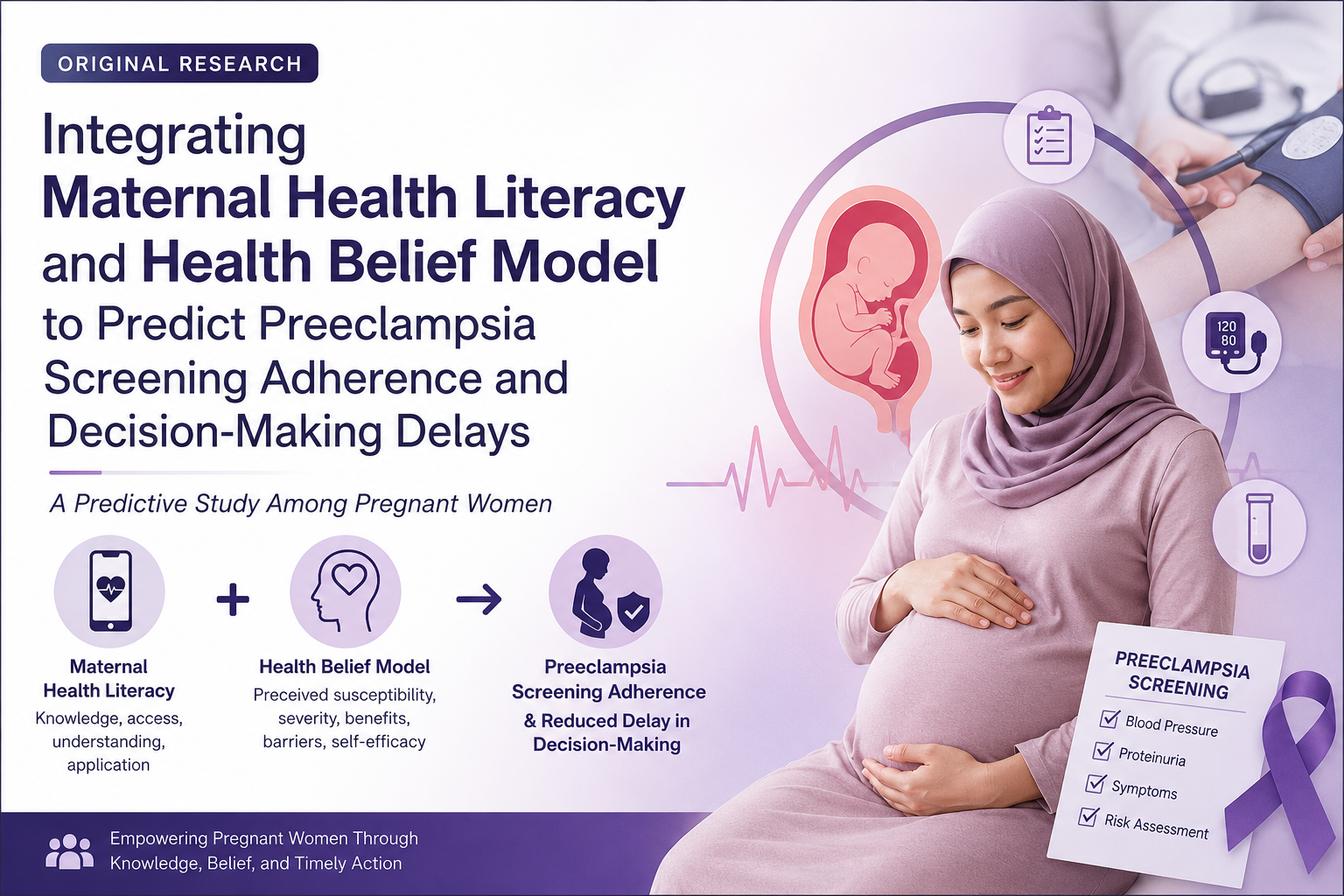
Integrating Maternal Health Literacy and the Health Belief Model for Predicting Preeclampsia Screening Adherence
DOI:
https://doi.org/10.56127/jukeke.v5i2.3029Keywords:
Maternal Health Literacy, Health Belief Model, Preeclampsia, Screening Adherence, Delay in Decision-MakingAbstract
Preeclampsia remains one of the leading causes of maternal morbidity and mortality, highlighting the importance of improving pregnant women's adherence to early screening and timely clinical decision-making. Objective: This study aims to examine the integrated role of Maternal Health Literacy (MHL) and the Health Belief Model (HBM) in predicting preeclampsia screening adherence and mitigating delays in medical decision-making among pregnant women. Methods: A quantitative predictive study with a cross-sectional design was conducted involving 64 pregnant women at the Sarfina Sembiring Primary Clinic selected through purposive sampling. Data were collected using validated questionnaires measuring MHL and HBM constructs and analyzed using multiple logistic regression. Findings: The results showed that both MHL and HBM significantly predicted preeclampsia screening adherence and mitigation of delay in decision-making. HBM was identified as the strongest predictor of screening adherence (OR = 6.52), whereas MHL demonstrated the greatest influence on reducing delays in clinical decision-making (OR = 8.21). These findings indicate that psychological beliefs and cognitive health literacy play complementary roles in improving maternal preventive health behavior. Implications: The findings support the development of integrated maternal health education programs that combine health literacy enhancement with behavior-based interventions, including digital health education and counseling, to strengthen screening adherence and maternal self-efficacy in primary healthcare settings. Originality: This study proposes and empirically validates an integrated predictive framework combining Maternal Health Literacy and the Health Belief Model. Unlike previous studies that examined these constructs separately, this research demonstrates their complementary roles in improving preeclampsia prevention strategies and reducing delays in maternal healthcare decision-making.
References
Al Joefrie, H. A., Rahmawati, I., & Wuryaningsih, E. (2026). Using mobile health applications to prevent preeclampsia in pregnant women: a scoping review. Malahayati Nursing Journal, 8, 44-74. https://doi.org/10.33024/mnj.v8i8.25441
Bakara, S. M. P., Sianga, S. N., Manurung, H. R., Surbakti, I. S., & Sinaga, R. (2025). Expert System and Artificial Intelligence For Diagnosing of Anemia: A Literature Review.
Behnke Gerdes, S. M., Ekelund, C. K., Rode, L., Miltoft, C. B., Midtgaard, J., Jørgensen, F. S., Pihl, K., Tabor, A., & Riishede, I. (2023). Motivation towards first trimester screening for preeclampsia among pregnant women in Denmark: A cross-sectional questionnaire study. Acta Obstetricia et Gynecologica Scandinavica, 1531-1540. https://doi.org/10.1111/aogs.14632
Dafroyati, Y. (2024). Health belief model analysis on the maternal through antenatal care as an effort to prevent mortality. Gaceta Medica de Caracas, 132(3), 656-664. https://doi.org/10.47307/GMC.2024.132.3.8
Dinas Kesehatan Kota, M. (2024). Laporan Tahunan Kesehatan Maternal dan Profil Kesehatan Kota Medan.
Dinas Kesehatan Provinsi Sumatera, U. (2024). Profil Kesehatan Provinsi Sumatera Utara.
Fauzianty, A. (2025). Effectiveness of a family-centered empowerment-based digital pocketbook on self-efficacy and iron supplement adherence among pregnant women: A quasi-experimental study. Aceh Nutrition Journal, 10(4), 1184-1193. https://doi.org/10.30867/action.v10i4.3039
Gelaw, K. A., Atalay, Y. A., Zerefu, F., & Gebeyehu, N. A. (2024). Delays in the decision to seek care and associated factors among mothers who delivered in rural health centers in Wolaita Zone, Southern Ethiopia. Frontiers in Global Women's Health, 4. https://doi.org/10.3389/fgwh.2023.1236242
Haryanti, P., Pandugaran, S. L., & Aljaber, M. (2024). The Application Of The Health Belief Model In Improving Healthy Behaviors Among Pregnant Women: A Literature Review. International Journal of Health Sciences, 2(1), 325-337. https://doi.org/10.59585/ijhs.v2i1.309
Kementerian Kesehatan, R. I. (2024). Profil Kesehatan Indonesia 2024.
Liberato, F. d. J., Wahyuni, S., Abdurrouf, M., & Susanto, H. (2026). Health belief model-based health education and maternal health behaviors during pregnancy: A literature review. Indonesian Journal of Global Health Research, 8(3), 943-950. https://doi.org/10.37287/ijghr.v8i3.1340
Muhindo, G. (2025). Barriers and enablers of early health-seeking behaviour among women with preeclampsia and eclampsia: a qualitative study at a National referral hospital in Uganda. BMC Pregnancy and Childbirth, 25. https://doi.org/10.1186/s12884-025-07946-w
Mustary, M. (2025). Health literacy and risk factors for preeclampsia: A case-control study in community health centers of Maros district, South Sulawesi. Journal of Education and Health Promotion, 14, 315. https://doi.org/10.4103/jehp.jehp_1741_24
Ningrum, E. W. (2024). Improving maternal health literacy among low-income pregnant women: A systematic review. Narra J, 4(2). https://doi.org/10.52225/narra.v4i2.886
Santi, D. R., & Suminar, D. R. (2023). Pregnant women behaviours in early detection of preeclampsia warning signs based on health belief model: A structural equal modelling analysis. Pharmacy Education, 23, 76-81. https://doi.org/10.46542/pe.2023.234.7681
Sihombing, R. (2025). The Effect of Pregnant Women's Knowledge on Antenatal Care Visit Compliance: A Behavioral Analysis with the Health Belief Model. 16(4). https://doi.org/10.54209/eduhealth.v16i04
Situmorang, F. N. S., & Fauzianty, A. (2025). Effectiveness of foot soaking therapy using lemongrass (Cymbopogon citratus) decoction to reduce blood pressure among pregnant women with mild hypertension. Journal of Applied Nursing and Health, 7(3), 728-737. https://doi.org/10.55018/janh.v7i3.421
Tahira, T., & Fatima, D. (2024). Literacy on Pregnancy Complications: Causal Factors and Prevention. Advances in Healthcare Research. https://doi.org/10.60079/ahr.v2i2.374
Vicente-Díaz, E. I., & Alvariñas-Villaverde, M. (2025). Health Literacy in Pregnant Women and Its Associations with Personal, Socioeconomic, and Health-Related Factors in Primary Care. Nursing Reports, 15(12). https://doi.org/10.3390/nursrep15120436