Consumer Preference-Based Redesign of Vanish Detergent Packaging Using Conjoint Analysis
DOI:
https://doi.org/10.56127/juit.v5i2.2847Keywords:
Conjoint Analysis, consumer preference, detergent packaging, packaging redesign, ziplock pouchAbstract
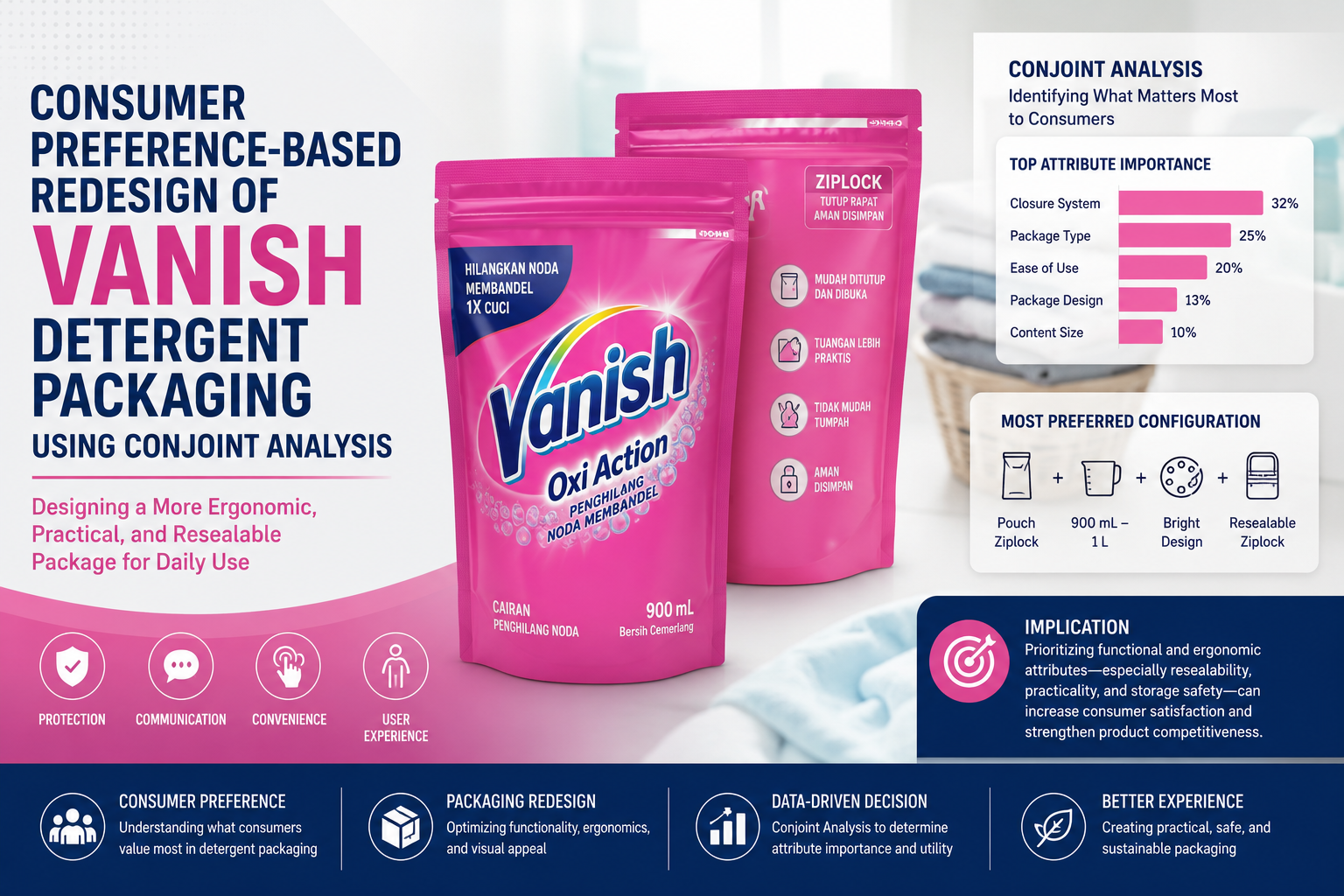
Packaging is an essential component of household cleaning products because it influences consumer convenience, product safety, storage efficiency, and repeated product use. However, detergent packaging redesign based on consumer preferences, especially by integrating functional and ergonomic attributes, remains limited. Objective: This study aims to redesign Vanish detergent packaging by identifying the most influential packaging attributes and determining the optimal packaging configuration using Conjoint Analysis. Methodology: This study used a quantitative approach with Conjoint Analysis. Primary data were collected through questionnaires distributed to 50 respondents who had experience using laundry cleaning products. Five packaging attributes were evaluated: package type, content size, package design, closure system, and ease of use. Consumer preferences were analyzed by estimating utility values and the relative importance of each attribute. Findings: The results showed that the closure system was the most influential attribute, with an importance value of 32%, followed by package type (25%), ease of use (20%), package design (13%), and content size (10%). The ziplock closure system obtained the highest utility value (+1.42), followed by pouch ziplock packaging (+1.18) and bright package design (+0.96). The most preferred packaging configuration was a bright pouch ziplock package with a content size of 900 mL to 1 L and a resealable ziplock closure system. Implications: The findings suggest that detergent packaging redesign should prioritize functional and ergonomic attributes, particularly resealability, practicality, and storage safety, to improve consumer satisfaction and product competitiveness. Originality: This study contributes to packaging design research by applying Conjoint Analysis to identify the optimal combination of functional, ergonomic, and visual attributes for Vanish detergent packaging.
References
Baccarella, C. V., Maier, L., & Voigt, K. I. (2021). How consumption-supportive packaging functionality influences consumers' purchase intentions: The mediating role of perceived product meaningfulness. European Journal of Marketing, 55(8), 2239-2268. https://doi.org/10.1108/EJM-10-2019-0799
Boz, Z., Korhonen, V., & Sand, C. K. (2020). Consumer considerations for the implementation of sustainable packaging: A review. Sustainability, 12(6), 2192. https://doi.org/10.3390/su12062192
ISO, I. O. f. S. (2018). ISO 9241-11:2018 Ergonomics of human-system interaction—Part 11: Usability: Definitions and concepts.
Ketelsen, M., Janssen, M., & Hamm, U. (2020). Consumers' response to environmentally friendly food packaging: A systematic review. Journal of Cleaner Production, 254, 120123. https://doi.org/10.1016/j.jclepro.2020.120123
Liu, C., Zhang, Y., & Wang, X. (2025). The impact of visual elements of packaging design on consumers' purchase decisions. Behavioral Sciences, 15(2), 181. https://doi.org/10.3390/bs15020181
McKinsey, & Company. (2025). Sustainability in Packaging 2025: Inside the Minds of Global Consumers.
Rahimi, Z. (2025). Product packaging and consumer purchase intentions. Cogent Business & Management, 12(1), 2506609. https://doi.org/10.1080/23311975.2025.2506609
Sonck-Rautio, K., Järvelä, K., & Niva, M. (2024). Consumer meaning-making of packaging functions for food and beverages. Cleaner and Responsible Consumption, 13, 100194. https://doi.org/10.1016/j.clrc.2024.100194
Su, J., Wang, S., & Li, M. (2024). Influence of food packaging color and food type on consumer purchase intention. Frontiers in Nutrition, 10, 1344237. https://doi.org/10.3389/fnut.2023.1344237
Wang, F., Wang, J., Ma, Y., & Zhang, Y. (2022). Consumer preference for yogurt packaging design using conjoint analysis. Sustainability, 14(6), 3463. https://doi.org/10.3390/su14063463
Yokokawa, N., Amasawa, E., & Hirao, M. (2021). Design assessment framework for food packaging integrating consumer preferences and environmental impact. Sustainable Production and Consumption, 27, 1514-1525. https://doi.org/10.1016/j.spc.2021.03.027
Downloads
Published
How to Cite
Issue
Section
Citation Check
License
Copyright (c) 2026 Rifky Maulana, Muhammad Daffa Fadhlur Rohman, Candra Herawan, Jeims Strong Saragih, Arya Akidnaram, Rizky Wahyudi

This work is licensed under a Creative Commons Attribution-ShareAlike 4.0 International License.