Effects of Different Compost Types on the Growth and Yield of Amaranth (Amaranthus spp.)
DOI:
https://doi.org/10.56127/ijst.v5i1.2658Keywords:
Amaranth, Compost, Cow Manure, Growth, YieldAbstract
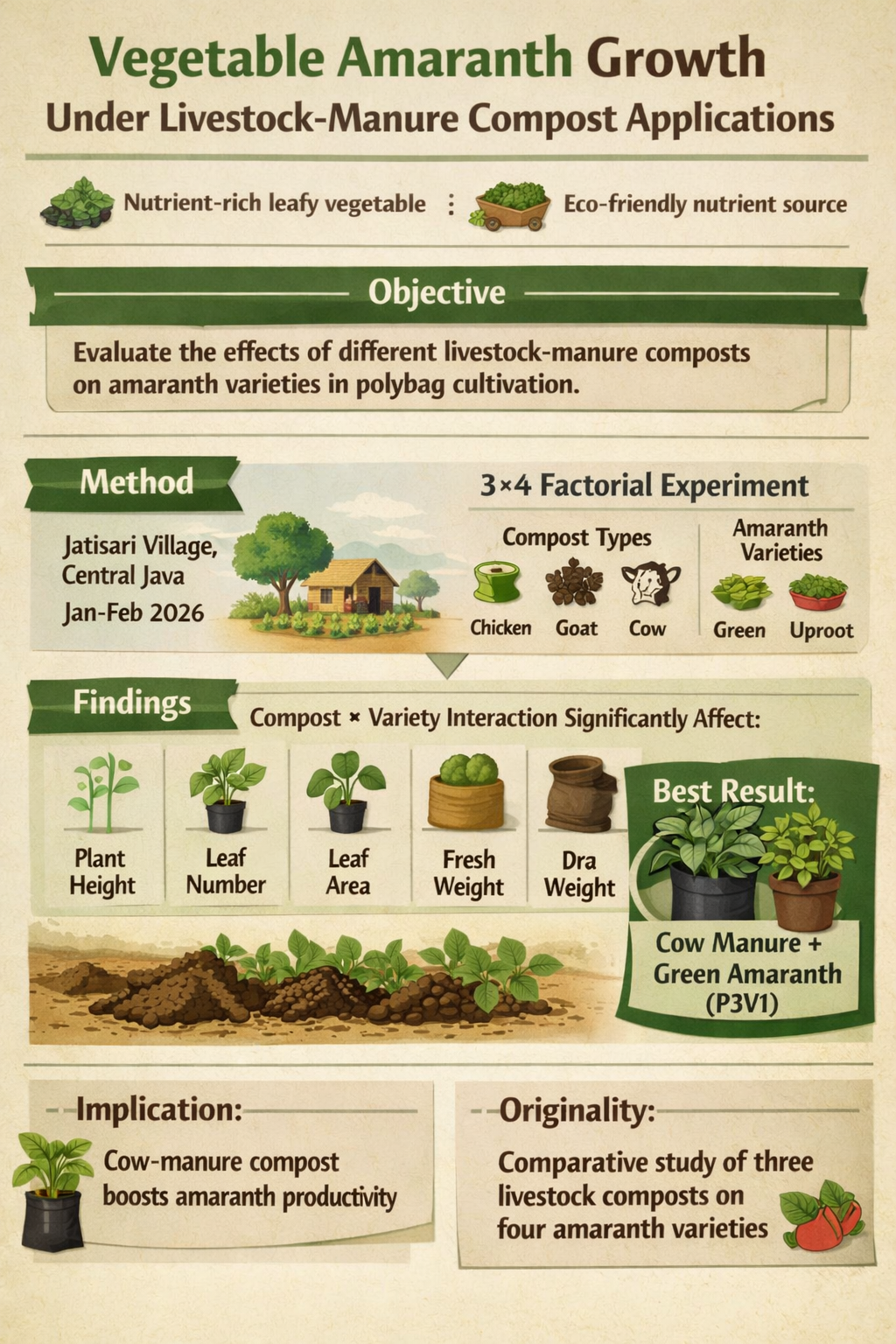
Vegetable amaranth is a fast-growing leafy vegetable with high nutritional value and strong potential for sustainable cultivation. Livestock-manure compost is increasingly used as an environmentally friendly nutrient source to improve crop growth and reduce dependence on inorganic fertilizers. Objective: This study aimed to evaluate the effects of different livestock-manure composts on the growth and yield of several vegetable amaranth varieties under polybag cultivation and to identify the most effective treatment combination. Method: The study was conducted in Jatisari Village, Kebumen District, Central Java, Indonesia, from January to February 2026. A quantitative experimental approach was applied using a 3 × 4 factorial randomized complete block design with nine effective blocks. The first factor was compost type, namely chicken-, goat-, and cow-manure compost, while the second factor was amaranth variety, namely green, uproot, red, and batik amaranth. Data were collected through direct plant measurements and analyzed using ANOVA followed by DMRT at the 5% level. Findings: The interaction between compost type and variety significantly affected plant height, number of leaves, leaf area, fresh plant weight, dry plant weight, fresh root weight, and dry root weight, but did not significantly affect root length. The best overall performance was obtained from cow-manure compost combined with green amaranth (P3V1). Implications: Cow-manure compost is a promising organic input for improving vegetable amaranth productivity under polybag cultivation. Originality: This study provides comparative evidence on three livestock-manure composts across four amaranth varieties under local cultivation conditions.
References
Anwar, Z., Irshad, M., Mahmood, Q., Hafeez, F., & Bilal, M. (2017). Nutrient Uptake And Growth Of Spinach As Affected By Cow Manure Co-Composted With Poplar Leaf Litter. International Journal Of Recycling Of Organic Waste In Agriculture, 6(1), 79-88. https://doi.org/10.1007/S40093-017-0154-X
Aprilia, R. L., & Sukur, S. (2022). Kajian Sifat Fisik, Kimia, Dan Biologi Pada Tanah Berpasir Di Beberapa Wilayah Indonesia. Agronu: Jurnal Agroteknologi, 1(02), 71-79. https://doi.org/10.53863/Agronu.V1i02.475
Ayenan, M. A. T., Aglinglo, L. A., Amoussou, L. C., Sossa, R. M., Zokpon, C., Dinssa, F. F., & Schafleitner, R. (2025). Agronomic Performance And Stability Of Vegetable Amaranth (Amaranthus Spp.) Genotypes In Benin. Plant-Environment Interactions, 6(4), E70076. https://doi.org/10.1002/Pei3.70076
Ho, T. T. K., Tra, V. T., Le, T. H., Nguyen, N. K. Q., Tran, C. S., Nguyen, P. T., Vo, T. D. H., Thai, V. N., & Bui, X. T. (2022). Compost To Improve Sustainable Soil Cultivation And Crop Productivity. Case Studies In Chemical And Environmental Engineering, 6, 100211. https://doi.org/10.1016/J.Cscee.2022.100211
Jahan, N., Sarker, U., Hasan Saikat, M. M., Hossain, M. M., Azam, M. G., Ali, D., Ercisli, S., & Golokhvast, K. S. (2023). Evaluation Of Yield Attributes And Bioactive Phytochemicals Of Twenty Amaranth Genotypes Of Bengal Floodplain. Heliyon, 9(9), E19644. https://doi.org/10.1016/J.Heliyon.2023.E19644
Jiménez-Aguilar, D. M., & Grusak, M. A. (2017). Minerals, Vitamin C, Phenolics, Flavonoids And Antioxidant Activity Of Amaranthus Leafy Vegetables. Journal Of Food Composition And Analysis, 58, 33-39. https://doi.org/10.1016/J.Jfca.2017.01.005
Liu, W., Yang, Z., Ye, Q., Peng, Z., Zhu, S., Chen, H., Liu, D., Li, Y., Deng, L., Shu, X., & Huang, H. (2023). Positive Effects Of Organic Amendments On Soil Microbes And Their Functionality In Agro-Ecosystems. Plants, 12(22), 3790. https://doi.org/10.3390/Plants12223790
Namah, C. N., & Abineno, J. C. (2024). Optimization Of Agricultural Land Use Through Water Saving And Environmentally Friendly Agriculture. International Journal Science And Technology, 3(2), 77-82. https://doi.org/10.56127/Ijst.V3i2.1524
Ouyang, Y., Reeve, J. R., & Norton, J. M. (2022). The Quality Of Organic Amendments Affects Soil Microbiome And Nitrogen-Cycling Bacteria In An Organic Farming System. Frontiers In Soil Science, 2, 869136. https://doi.org/10.3389/Fsoil.2022.869136
Sarker, U., Rabbani, M. G., Oba, S., Eldehna, W. M., Al-Rashood, S. T., Mostafa, N. M., & Eldahshan, O. A. (2022). Phytonutrients, Colorant Pigments, Phytochemicals, And Antioxidant Potential Of Orphan Leafy Amaranthus Species. Molecules, 27(9), 2899. https://doi.org/10.3390/Molecules27092899
Sefasi, A., Nyasulu, M., Kamanga, R. M., Yalaukani, L., Pilanazo Katengeza, S., Monjerezi, M., Malidadi, C., & Masamba, K. (2025). Phenotypic Diversity And Multivariate Analyses Of Yield And Yield-Related Traits In Amaranth Accessions From Malawi. BMC Plant Biology, 25(1), 1145. https://doi.org/10.1186/S12870-025-07190-6
Xu, C., & Mou, B. (2016). Short-Term Effects Of Composted Cattle Manure Or Cotton Burr On Growth, Physiology, And Phytochemical Of Spinach. HortScience, 51(12), 1517-1523. https://doi.org/10.21273/Hortsci11099-16
Downloads
Published
How to Cite
Issue
Section
Citation Check
License
Copyright (c) 2026 Akhmad Hamam Nasirudin, Rennanti Lunnadiyah Aprilia

This work is licensed under a Creative Commons Attribution-ShareAlike 4.0 International License.