Comparative Evaluation of TOON and JSON Serialization Formats for Token Efficiency, Answer Accuracy, and Structural Reliability in DeepSeek
DOI:
https://doi.org/10.56127/ijst.v5i3.2669Keywords:
Answer Accuracy, DeepSeek, JSON, Token Efficiency, Token-Oriented Object NotationAbstract
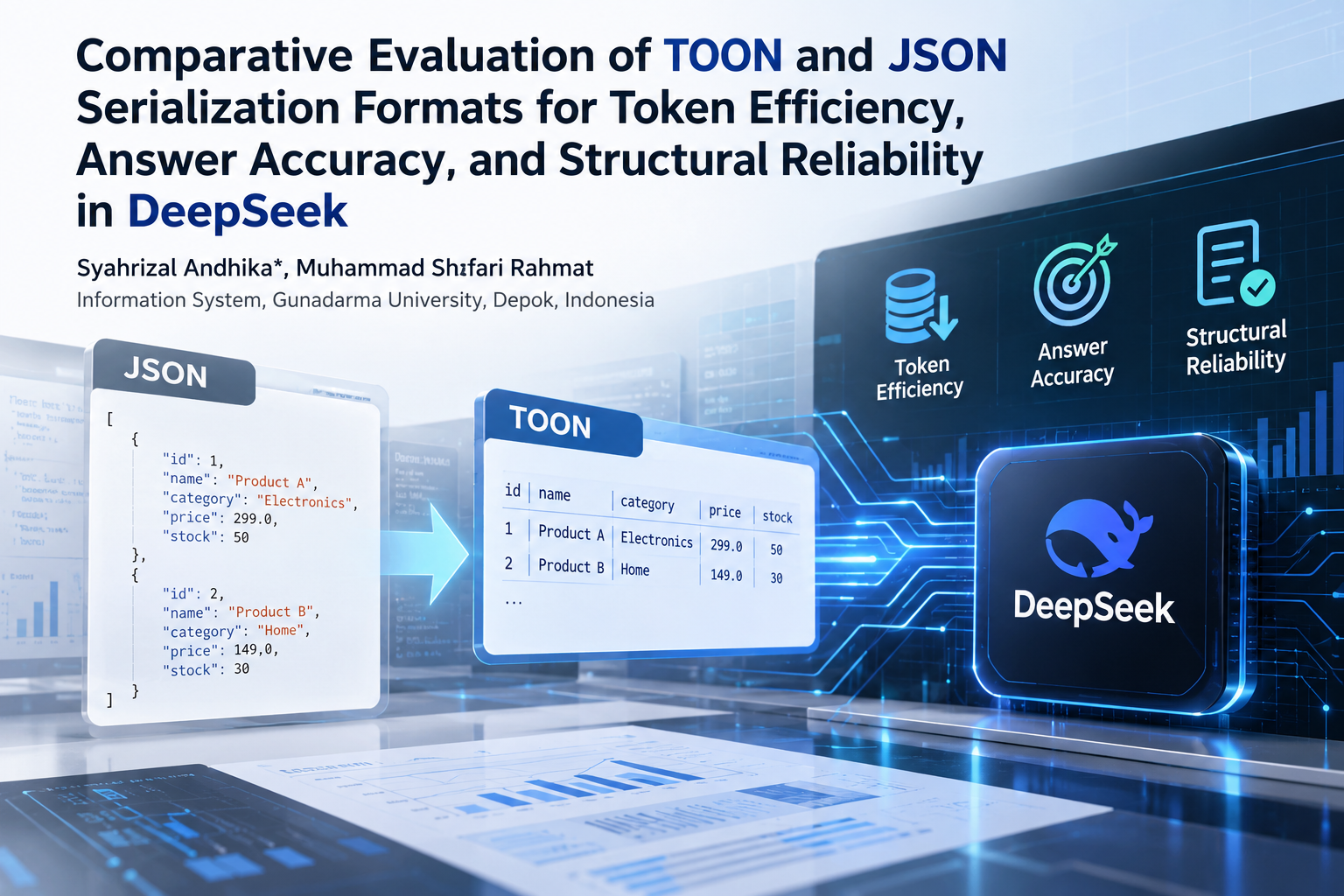
The increasing adoption of Large Language Models (LLMs) requires efficient structured-data serialization to reduce token consumption and operational costs without compromising accuracy. Token-Oriented Object Notation (TOON) offers an alternative to JavaScript Object Notation (JSON), but its performance on DeepSeek remains insufficiently evaluated. Objective: This study evaluates token efficiency, answer accuracy, structural validation reliability, and estimated API processing costs across six serialization formats. Methods: A descriptive comparative experiment employed 11 official benchmark datasets, five synthetic datasets, and 209 evaluation questions. A total of 1,154 DeepSeek API requests were performed, while offline token consumption was measured separately using the o200k_base tokenizer. Results: TOON reduced token consumption by 58.8% for flat datasets and 21.9% for mixed-structure datasets compared with pretty-printed JSON. TOON achieved the highest observed answer accuracy (96.2%), compared with JSON (95.2%), although structural validation accuracy remained at 60.0%. Implications: The findings support workload-dependent serialization selection and emphasize the importance of deterministic schema validation and output-token monitoring for reliable, cost-efficient LLM applications. Originality: This study extends the official TOON benchmarking framework to DeepSeek and integrates token efficiency, accuracy, structural reliability, and cost evaluation, demonstrating that compression advantages do not necessarily correspond to improved accuracy or lower processing costs.
References
Bray, T. (2017). The JavaScript Object Notation (JSON) Data Interchange Format (RFC 8259, Issue. https://www.rfc-editor.org/rfc/rfc8259
DeepSeek. (2026). Models & Pricing. https://api-docs.deepseek.com/quick_start/pricing/
Jiang, H., Wu, Q., Lin, C.-Y., Yang, Y., & Qiu, L. (2023). LLMLingua: Compressing Prompts for Accelerated Inference of Large Language Models. Proceedings of the 2023 Conference on Empirical Methods in Natural Language Processing,
Kutschka, L., & Geiger, B. (2026). Notation Matters: A Benchmark Study of Token-Optimized Formats in Agentic AI Systems. https://arxiv.org/abs/2605.29676
Li, Z., Liu, Y., Su, Y., & Collier, N. (2025). Prompt Compression for Large Language Models: A Survey. Proceedings of the 2025 Conference of the Nations of the Americas Chapter of the Association for Computational Linguistics: Human Language Technologies (Volume 1: Long Papers),
Markowitz, E., Galiya, K., Ver Steeg, G., & Galstyan, A. (2025). KG-LLM-Bench: A Scalable Benchmark for Evaluating LLM Reasoning on Textualized Knowledge Graphs. https://arxiv.org/abs/2504.07087
Matveev, I. (2026). Token-Oriented Object Notation vs JSON: A Benchmark of Plain and Constrained Decoding Generation. https://arxiv.org/abs/2603.03306
Tam, Z. R., Wu, C.-K., Tsai, Y.-L., Lin, C.-Y., Lee, H.-y., & Chen, Y.-N. (2024). Let Me Speak Freely? A Study On The Impact Of Format Restrictions On Large Language Model Performance. Proceedings of the 2024 Conference on Empirical Methods in Natural Language Processing: Industry Track,
toon, f. (2025a). Benchmarks (GitHub. https://github.com/toon-format/toon/tree/main/benchmarks
toon, f. (2025b). TOON: Token-Oriented Object Notation. In GitHub. https://github.com/toon-format/toon
Downloads
Published
How to Cite
Issue
Section
Citation Check
License
Copyright (c) 2026 Syahrizal Andhika, Muhammad Shafari Rahmat

This work is licensed under a Creative Commons Attribution-ShareAlike 4.0 International License.