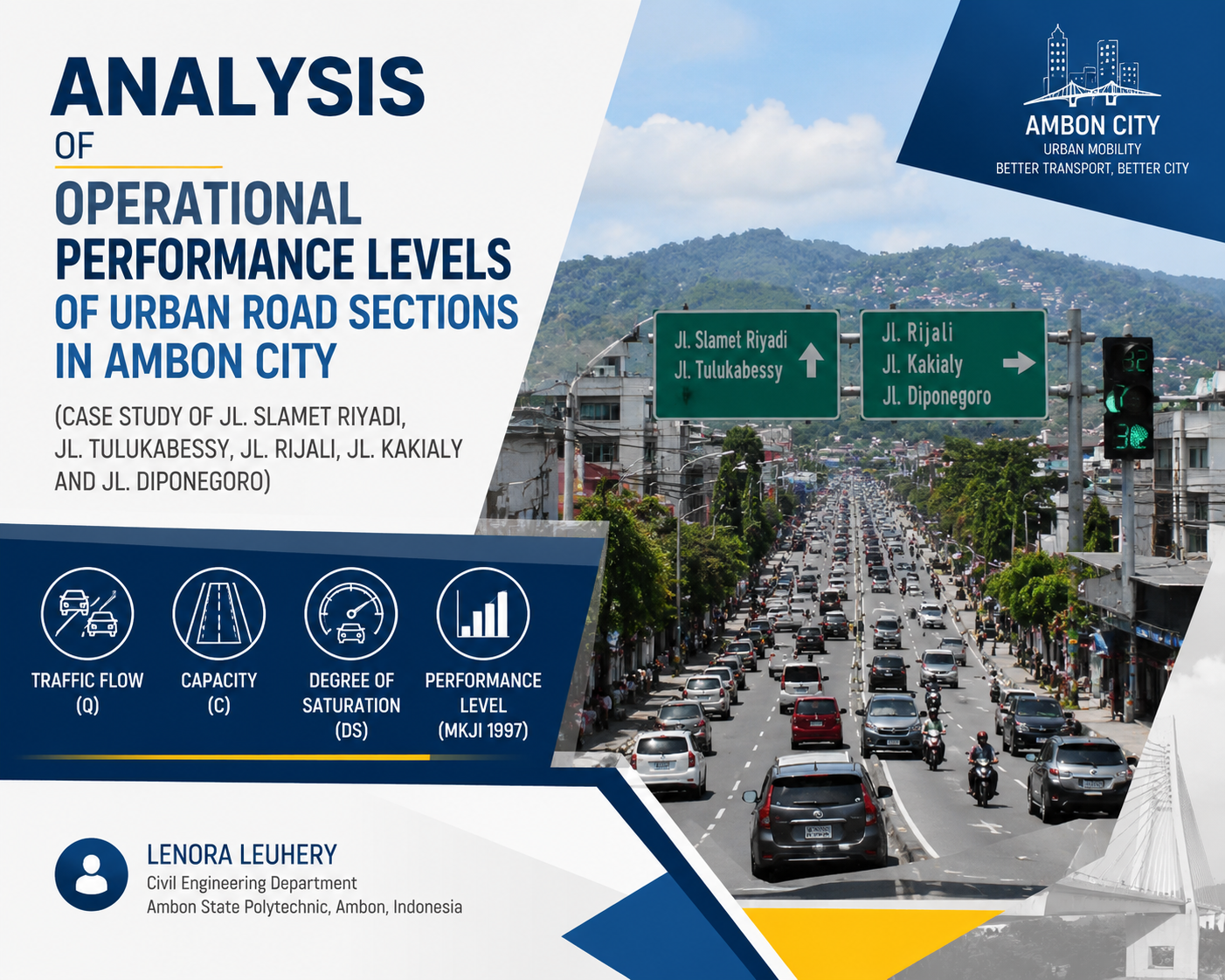
Analysis of Operational Performance Levels of Urban Road Sections in Ambon City
DOI:
https://doi.org/10.56127/ijst.v5i2.3043Keywords:
degree of saturation, road capacity, road performance, traffic flow, urban trafficAbstract
Urban road congestion in Ambon City is influenced by high traffic demand and intensive roadside activities, particularly along commercial corridors, which reduce effective road capacity and disrupt traffic flow. Objective: This study aims to evaluate the operational performance of selected urban road sections in Ambon City and identify critical corridors requiring priority traffic-management interventions. Methodology: An analytical–numerical approach based on the Indonesian Road Capacity Manual (MKJI 1997) was applied. Primary data were collected through field observations and traffic-volume counts at seven observation points along Jl. Slamet Riyadi, Jl. Tulukabessy, Jl. Rijali, Jl. Kakialy, and Jl. Diponegoro. Traffic flow (Q), road capacity (C), and degree of saturation (DS) were analyzed to determine operational performance. Findings: Jl. Slamet Riyadi (DS = 1.30), Jl. Tulukabessy (DS = 1.68), and Jl. Kakialy (DS = 1.09) operate at Level F, indicating forced-flow conditions where traffic demand exceeds practical capacity. In contrast, the three observation points on Jl. Rijali recorded DS values of 0.14–0.69, while Jl. Diponegoro recorded a DS of 0.61, indicating free-to-stable traffic conditions. Implications: Traffic-management interventions should prioritize Jl. Tulukabessy, Jl. Slamet Riyadi, and Jl. Kakialy through parking control, reduction of roadside friction, regulation of roadside access, and feasible geometric improvements. These findings can support local authorities in prioritizing traffic-management and infrastructure programs. Originality: This study integrates empirical traffic flow, capacity, and saturation measurements with localized traffic-conflict conditions across strategic urban corridors, extending MKJI 1997 from conventional capacity analysis into a practical framework for identifying and prioritizing critical urban road interventions.
References
Direktorat Jenderal Bina Marga. (1997). Manual Kapasitas Jalan Indonesia (MKJI). Departemen Pekerjaan Umum Republik Indonesia.
Khisty, C. J., & Lall, B. K. (2003). Transportation Engineering: An Introduction (3rd ed.). USA: Prentice Hall.
Prasetyanto, Dwi. (2019). Rekayasa Lalu Lintas dan Keselamatan Jalan. Bandung: Iternas.
Angkoso, G. S., Nor. H., & Yayan. A. S. (2021). Analisis Kinerja Ruas Jalan Menggunakan Metode Manual Kapasitas Jalan Indonesia (MKJI) 1997 Pada Ruas Jalan Jepara – Kudus Km 11 Sampai Km 15. Jurnal Civil Engineering Study, Vol. 1, pp. 19-25.
Ranto, W. Audie. L. E. R., James. A. T. 2020. Analisa Kinerja Ruas Jalan Menggunakan Metode Manual Kapasitas Jalan Indonesia (MKJI) 1997. Jurnal Sipil Statik, Vol. 8, pp. 77-82.
Titirlolobi, A. I., Lintong. E., James. A. Timboeleng. (2016). Analisa Kinerja Ruas Jalan Hasanuddin Kota Manado. Jurnal Sipil Statik, Vol. 4, pp. 423-431.
Wahab, W. Revina. A., Andi. M. R. (2021). Studi Analisis Kinerja Ruas Jalan Jhoni Anwar dan Gajah Mada Kota Padang. Jurnal Teknik Sipil ITP, Vol. 8, pp. 81-87.
Downloads
Published
How to Cite
Issue
Section
Citation Check
License
Copyright (c) 2026 Lenora Leuhery

This work is licensed under a Creative Commons Attribution-ShareAlike 4.0 International License.