Cost and Quality Analysis of Prestressed Concrete Piles at PT Varia Usaha Beton Using Statistical Process Control
DOI:
https://doi.org/10.56127/ijst.v5i3.3128Keywords:
Concrete Quality, Prestressed Concrete Piles, Slump, Statistical Process Control, Water–Cement RatioAbstract
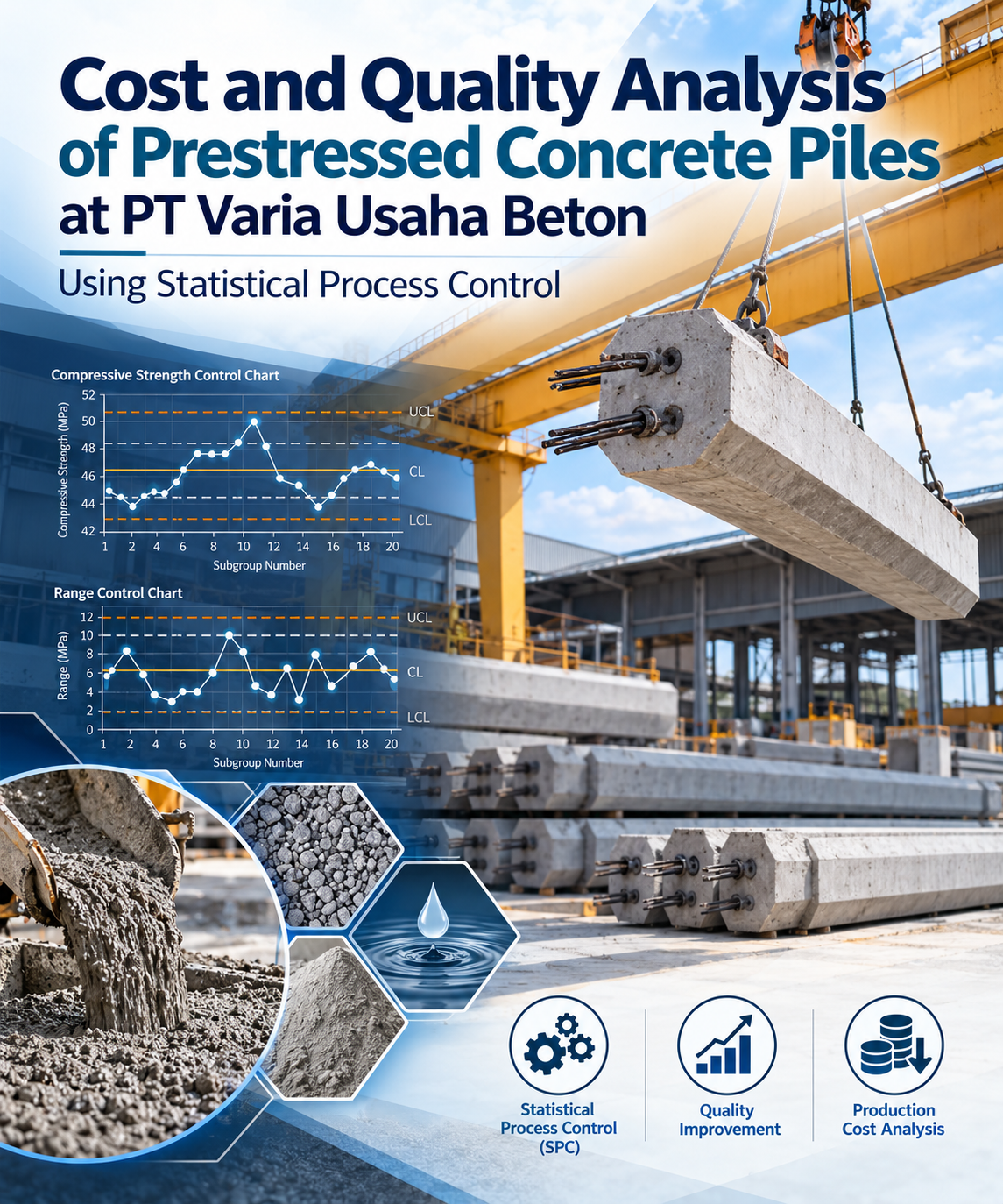
Prestressed concrete piles are crucial foundation elements in large-scale infrastructure projects, where consistency of concrete quality, particularly slump and compressive strength, is critical. Despite having implemented ISO 9001:2015, PT Varia Usaha Beton faces product nonconformities, with 95.24% of issues related to compressive strength. Objective : To apply Statistical Process Control (SPC) at PT Varia Usaha Beton to evaluate process capability, identify root causes of nonconformities, and assess the impact of corrective measures on quality and production costs. Method : A case study using descriptive quantitative analysis employed the seven quality control tools, including histograms, control charts, cause-and-effect diagrams, and scatter plots. Results : A strong negative relationship between slump and compressive strength led to an adjustment of the slump interval from 10–14 cm to 12–16 cm. Modifying the water–cement ratio from 0.36 to 0.38 increased the process capability index for the lower specification limit (Cpl) from 1.77 to 2.03, although some subgroups remained outside the control limits. Production costs increased by Rp 2,805/m (2.07%). Implications : Continued process monitoring is required to support control of the water–cement ratio and slump; the relatively minor cost increase provides an economic basis for quality improvement. Originality : The study integrates process capability analysis and production cost evaluation for prestressed concrete piles in a single industrial case study.
References
Abdel-Motaleb, H. (2022). Statistical process control. Cutting Tool Engineering, 74(5), 32-35. https://ctemag.com/articles/statistical-process-control/
Adma, N. A. A., Ahmad, F., & Phelia, A. (2020). Evaluasi daya dukung tiang pancang pada pembangunan jetty. Jurnal SENDI, 1(1), 7-14.
Aini, N., & Suryanto Hs, M. (2017). Pengendalian mutu produk precast dengan menggunakan metode SPC (Statistical Process Control) di PT. Waskita Precast Plant Sidoarjo. Rekayasa Teknik Sipil, 2(2), 186-195. https://ejournal.unesa.ac.id/index.php/rekayasa-teknik-sipil/article/view/18961
Aprilia, D. P., & Suryanto Hs, M. (2020). Penerapan metode Statistical Process Control sebagai pengendalian mutu panel lantai. Jurnal Rekayasa Teknik Sipil, 8(1), 1-10. https://ejournal.unesa.ac.id/index.php/rekayasa-teknik-sipil/article/view/32120
Badan Standardisasi, N. (2019). Persyaratan beton struktural untuk bangunan gedung dan penjelasan (ACI 318M-14 dan ACI 318RM-14, MOD) (SNI 2847:2019). https://pesta.bsn.go.id/produk/detail/12731-sni28472019
Budiman, R., Setiadi, M., & Pranoto, W. A. (2024). Studi kelayakan investasi usaha produksi tiang pancang. JMTS: Jurnal Mitra Teknik Sipil, 7(3), 1073-1082. https://doi.org/10.24912/jmts.v7i3.28179
Gandara, G. S., & Hasibuan, S. (2020). Analisis penerapan SNI ISO 9001:2015 melalui jumlah ketidaksesuaian produk, proses dan pelayanan pada PT. X. Jurnal Standardisasi, 22(3), 171-188. https://doi.org/10.31153/js.v22i3.833
Gaspersz, V. (2001). Metode analisis untuk peningkatan kualitas. Gramedia Pustaka Utama.
Helena, A., & Suryanto Hs, M. (2020). Penerapan metode Statistical Process Control sebagai pengendalian kualitas mortar. Jurnal Rekayasa Teknik Sipil, 8(1), 1-10. https://ejournal.unesa.ac.id/index.php/rekayasa-teknik-sipil/article/view/32167
Hübsch, C. (2007). Miracle weapon admixtures? Developments in admixture technology for precast concrete products. Betonw. und Fert. Plant Precast Technol., 73(2), 70-73.
Ishikawa, K. (1985). What is total quality control? The Japanese way. Prentice-Hall.
Jannah, M., & Dani, H. (2018). Pengendalian mutu genteng beton menggunakan metode Statistical Process Control di PT. Varia Usaha Beton. Rekayasa Teknik Sipil, 1(1), 110-117. https://ejournal.unesa.ac.id/index.php/rekayasa-teknik-sipil/article/view/22642
Knop, K. (2022). Multivariate nonconformity analysis for paving stone manufacturing process improvement. Management Systems in Production Engineering, 30(4), 331-341. https://doi.org/10.2478/mspe-2022-0042
Kumala, I. S., & Suryanto Hs, M. (2018). Analisis pengendalian kualitas produk batako dengan menggunakan Statistical Process Control (SPC) pada PT. Varia Usaha Beton. Jurnal Rekayasa Teknik Sipil, 6(2). https://ejournal.unesa.ac.id/index.php/rekayasa-teknik-sipil/article/view/23994
Lins, R. G., Eduardo Dos Santos, R., & Gaspar, R. (2025). Vision-based measurement for quality control inspection integrated into a die-casting process in Industry 4.0 era. IEEE Access, 13, 75047-75070. https://doi.org/10.1109/ACCESS.2025.3563800
Montgomery, D. C. (2020). Introduction to statistical quality control (8th ed.). Wiley.
Neville, A. M., & Brooks, J. J. (1987). Concrete technology. Longman Scientific & Technical.
Oakland, J. S. (2007). Statistical process control (6th ed.). Routledge. https://doi.org/10.4324/9780080551739
Okwori, E., Moyo, P., & Matongo, K. (2015). An investigative study into the application of non-destructive testing techniques for integrity assessment of RC piles. In F. Dehn, H. D. Beushausen, M. G. Alexander, & P. Moyo (Eds.), Concrete repair, rehabilitation and retrofitting IV (pp. 51). CRC Press. https://doi.org/10.1201/b18972-33
Park, S. H., Ryu, H. S., & Park, W. J. (2024). Influence of unit water content control on concrete performance in the ready-mixed concrete production process. Materials, 17(4), 834. https://doi.org/10.3390/ma17040834
Robertson, J. B., & Ley, M. T. (2020). Determining the water to cement ratio of fresh concrete by evaporation. Construction and Building Materials, 242, 117972. https://doi.org/10.1016/j.conbuildmat.2019.117972
Ryan, T. P. (2000). Statistical methods for quality improvement (2nd ed.). Wiley.
Saiful Islam, M., Islam, M. M., Imran, H. R. T., Skitmore, M., & Nepal, M. P. (2021). Grasping the nonconformities in building construction supply chains. Journal of Performance of Constructed Facilities, 35(1), 04020141. https://doi.org/10.1061/(ASCE)CF.1943-5509.0001546
Sinaga, G., & Sriyanto. (2019). Penerapan Statistical Process Control untuk meningkatkan produksi whitebody (Studi kasus Departemen Produksi PT Sango Ceramics Indonesia). Industrial Engineering Online Journal, 7(4). https://ejournal3.undip.ac.id/index.php/ieoj/article/view/23041
Solís-Carcaño, R., Moreno, E. I., & Arcudia-Abad, C. (2008). Study of the concrete’s compressive strength due to the combined effect of the water-cement ratio, the coarse-fine aggregate ratio and the source of the aggregates. Revista Técnica de la Facultad de Ingeniería Universidad del Zulia, 31(3), 213-224.
Suwandi, A. (2012). Pengendalian kualitas beton melalui pengujian kuat tekan dengan metode Design of Experiment (DOE). INOVISI, 8(1). https://ejurnal.esaunggul.ac.id/index.php/inovisi/article/view/960
Utomo, A. C. (2015). Pengendalian mutu beton menggunakan metode Statistical Procces Control (SPC) pada proses produksi beton precast (studi kasus PT. Wijaya Karya Beton) [Undergraduate thesis, Universitas Negeri Malang]. https://repository.um.ac.id/44514/
Wheeler, D. J., & Chambers, D. S. (1992). Understanding statistical process control (2nd ed.). SPC Press.
Widya Putri, T., & Suryanto Hs, M. (2020). Penerapan metode Statistical Process Control sebagai pengendalian mutu bata ringan. Jurnal Rekayasa Teknik Sipil, 8(2), 1-9. https://ejournal.unesa.ac.id/index.php/rekayasa-teknik-sipil/article/view/32168
Yibing, L., Shunsheng, G., & Chunyang, Z. (2007). Application of Statistical Process Control in quality management of ERP. WUHAN LIGONG DAXUE XUEBAO JIAOTONG KEXUE YU GIONGCHENG BAN, 31(6), 1094.
Zagloel, Y. M., & Nurcahyo, R. (2022). TQM Manajemen kualitas total dalam perspektif teknik industri.
Downloads
Published
How to Cite
Issue
Section
Citation Check
License
Copyright (c) 2026 Nurul Kurniawan, Budi Witjaksana, Hanie Teki Tjendani

This work is licensed under a Creative Commons Attribution-ShareAlike 4.0 International License.