Integrated Biorefinery Pathways for Organic Waste Valorisation: A Systematic Literature Review of Biological, Thermochemical, and Anaerobic Digestion Technologies
DOI:
https://doi.org/10.56127/juit.v5i2.2866Keywords:
Biorefinery, Waste Valorisation, Circular Bioeconomy, Black Soldier Fly, Hydrothermal CarbonisationAbstract
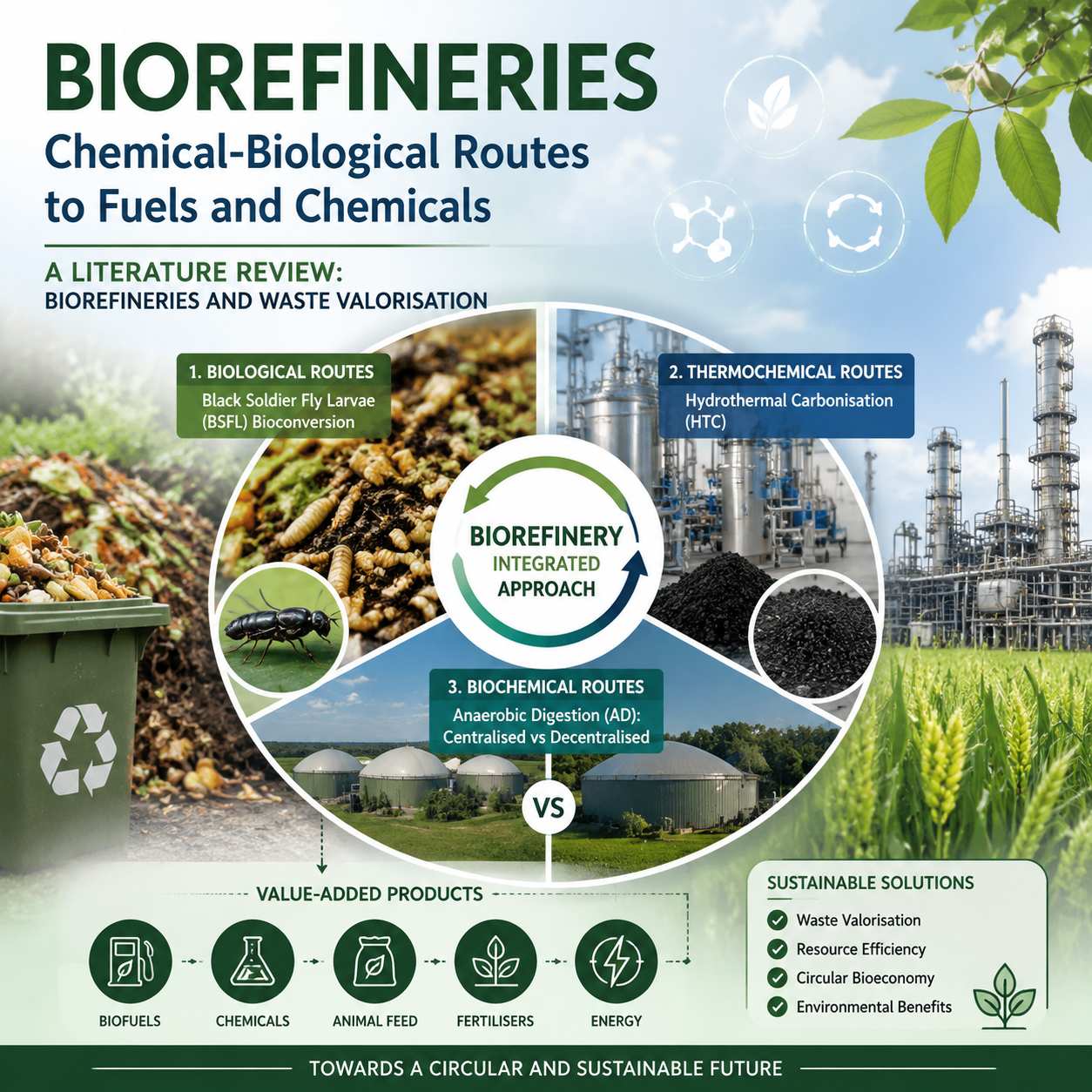
The increasing generation of organic and lignocellulosic waste has created significant environmental challenges, requiring sustainable and efficient waste management strategies. Biorefinery systems have emerged as a key approach within the circular bioeconomy framework, enabling the conversion of complex waste streams into value-added products such as biofuels, platform chemicals, animal feed, and fertilisers. Objective: This study aims to systematically review recent developments in biorefinery-based waste valorisation technologies and evaluate their environmental and technological performance within a circular bioeconomy perspective. Methods: This research employs a qualitative systematic literature review (SLR) approach. Data were collected from peer-reviewed journal articles indexed in Scopus, ScienceDirect, Web of Science, and Google Scholar. The analysis was conducted using narrative synthesis and comparative evaluation of biological, thermochemical, and hybrid biorefinery technologies published between 2015 and 2026. Results: The results indicate that Black Soldier Fly (BSF) bioconversion can reduce organic waste mass by approximately 50% while producing high-value protein and lipid products. Hydrothermal Carbonisation (HTC) effectively converts wet biomass into hydrochar at 180–280 °C. Decentralised anaerobic digestion systems show superior environmental performance compared to incineration, particularly in reducing Global Warming Potential (GWP) and Fossil Fuel Depletion Potential (FFP). Lignin valorisation demonstrates strong potential for producing aromatic chemicals, although it remains constrained by feedstock variability and processing challenges. Implications: The findings suggest that integrated biorefinery systems supported by Life Cycle Assessment (LCA) offer a more sustainable pathway for organic waste management compared to single-process technologies. However, scalability, feedstock heterogeneity, and process optimisation remain key challenges for industrial implementation. Originality: The originality of this study lies in its integrated comparative analysis of biological, thermochemical, and hybrid biorefinery technologies within a circular bioeconomy framework, combining environmental performance assessment and technological evaluation to provide a comprehensive perspective for sustainable waste management development.
References
Amrul, N. F. (2022). A review of organic waste treatment using Black Soldier Fly (Hermetia illucens). Sustainability, 14(8). https://doi.org/10.3390/su14084565
Attard, T. M. (2020). Recent developments in key biorefinery areas. Current Opinion in Green and Sustainable Chemistry, 21, 64-74. https://doi.org/10.1016/j.cogsc.2019.12.002
Cheong, J. C. (2020). Closing the food waste loop: Food waste anaerobic digestate as fertilizer. Science of the Total Environment, 715. https://doi.org/10.1016/j.scitotenv.2020.136789
Das, R. K. (2015). Fermentative production of fumaric acid using apple waste biomass. Fungal Biology, 119(12), 1279-1290. https://doi.org/10.1016/j.funbio.2015.10.001
De Smet, J. (2018). Microbial community dynamics during rearing of Black Soldier Fly larvae. Applied and Environmental Microbiology, 84(9). https://doi.org/10.1128/AEM.02722-17
Fava, F. (2015). Biowaste biorefinery in Europe: Opportunities and research and development needs. New Biotechnology, 32(1), 100-108. https://doi.org/10.1016/j.nbt.2013.11.003
Kaza, S., Yao, L., Bhada-Tata, P., & Van Woerden, F. (2018). What a Waste 2.0: A Global Snapshot of Solid Waste Management to 2050. World Bank.
Khoshnevisan, B. (2018). Life cycle assessment of energy and nutrient recovery from organic waste. Journal of Cleaner Production, 180, 360-374. https://doi.org/10.1016/j.jclepro.2018.01.198
Nguyen, T. T. X. (2015). Ability of Black Soldier Fly larvae to recycle food waste. Environmental Entomology, 44(2), 406-410. https://doi.org/10.1093/ee/nvv002
Petrović, J. (2024). Hydrothermal carbonization of waste biomass: A review. Processes, 12(1). https://doi.org/10.3390/pr12010207
Piwowarek, K. (2016). Use of apple pomace in fermentation processes. Electronic Journal of Biotechnology, 23, 1-6. https://doi.org/10.1016/j.ejbt.2016.07.004
Ponnusamy, V. K. (2019). A review on lignin structure, pretreatments and biorefinery potential. Bioresource Technology, 271, 462-472. https://doi.org/10.1016/j.biortech.2018.09.070
Sarker, A., Ahmmed, R., & Ahsan, S. M. (2023). A comprehensive review of food waste valorization for sustainable management of global food waste. Sustainable Food Technology, 2(1), 48-69. https://doi.org/10.1039/D3FB00156C
Tian, H. (2021). Life cycle assessment of food waste to energy and resources: Centralized and decentralized anaerobic digestion. Renewable and Sustainable Energy Reviews, 150. https://doi.org/10.1016/j.rser.2021.111489
Tong, H. (2018). Comparative life cycle assessment on food waste to energy scenarios. Applied Energy, 225, 1143-1157. https://doi.org/10.1016/j.apenergy.2018.05.062
Venkata Mohan, S. (2016). Waste biorefinery models towards sustainable circular bioeconomy: Critical review and future perspectives. Bioresource Technology, 215, 2-12. https://doi.org/10.1016/j.biortech.2016.03.130
Zurbrügg, C. (2018). From pilot to full scale operation of waste treatment using BSF. Detritus, 1, 18-22.
Downloads
Published
How to Cite
Issue
Section
Citation Check
License
Copyright (c) 2026 Stephanus Benedictus Bera Liwun, Nastiti Siswi Indrasti, Suprihatin Suprihatin, Taufik Djatna

This work is licensed under a Creative Commons Attribution-ShareAlike 4.0 International License.