Analysis and Improvement of Rubber Roll Production Line Balancing Using Ranked Positional Weight (RPW) and Region Approach Methods at CV. ABC
DOI:
https://doi.org/10.56127/juit.v5i2.2901Keywords:
line balancing, Ranked Positional Weight, Region Approach, line efficiency, smoothness indexAbstract
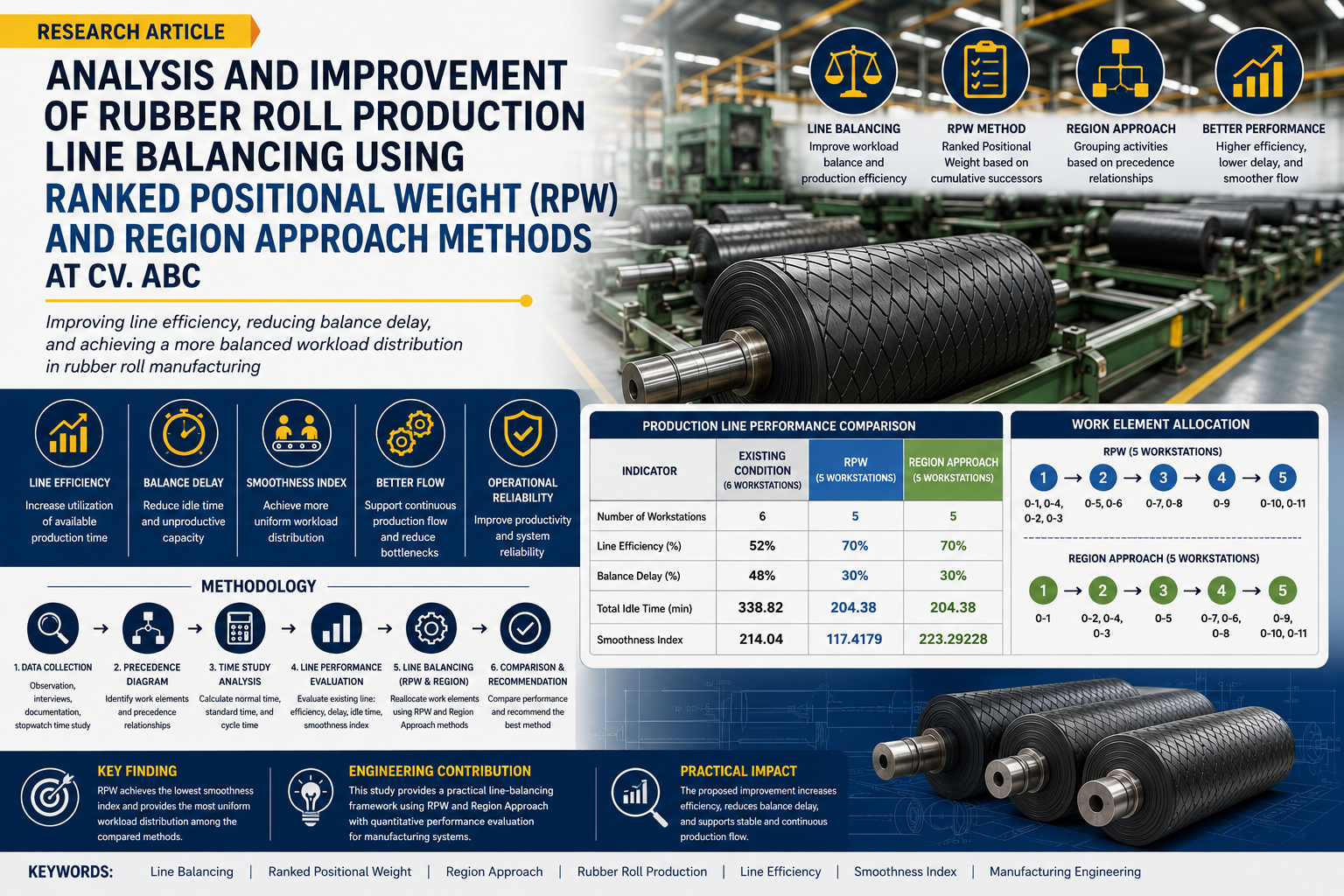
The rubber roll production line at CV. ABC exhibited considerable workload imbalance among workstations, particularly at the steam and turning processes. Differences in processing times resulted in potential bottlenecks, high balance delay, and inefficient utilization of available production-line capacity. Objective: This study aims to analyze the existing rubber roll production-line balance and compare the Ranked Positional Weight (RPW) and Region Approach methods to identify a workstation configuration with improved line utilization and more uniform workload distribution. Methodology: A quantitative engineering case-study approach was applied. Primary data were collected through direct observation, interviews, documentation, and stopwatch time study, while secondary data were obtained from company production records and relevant literature. Processing-time data, precedence relationships, performance ratings, and allowances were analyzed to determine work-element times and production-line characteristics. The existing configuration was evaluated using line efficiency, balance delay, idle time, and smoothness index. Work elements were subsequently reallocated using RPW and the Region Approach, and the resulting production-line performances were compared. Findings: The existing production line consisted of six workstations with a line efficiency of 52%, a balance delay of 48%, and a smoothness index of 214.04. Both RPW and the Region Approach reduced the number of workstations to five and increased line efficiency to 70%, while balance delay decreased to 30%. However, RPW produced a smoothness index of 117.4179, considerably lower than the 223.29228 obtained using the Region Approach. The RPW configuration also resulted in a total idle time of 204.38 min, indicating improved utilization of available workstation capacity. Implications: The findings provide an engineering basis for reorganizing work-element allocation in rubber roll production. The proposed RPW configuration can support more uniform workstation loading and improve production-flow efficiency, particularly in manufacturing processes with substantial variation in processing times. Originality: This study provides a direct comparison between cumulative positional-weight allocation and precedence-region grouping under the same rubber roll production conditions. The results demonstrate that identical line efficiency and balance delay do not necessarily indicate equivalent workload uniformity, highlighting the importance of smoothness index as a complementary criterion for selecting a line-balancing configuration.
References
Albus, M., Hornek, T., Kraus, W., & Huber, M. F. (2025). Towards Scalability for Resource Reconfiguration in Robotic Assembly Line Balancing Problems Using a Modified Genetic Algorithm. Journal of Intelligent Manufacturing, 36(2), 1175-1199. https://doi.org/10.1007/s10845-023-02292-0
Battaïa, O., & Dolgui, A. (2022). Hybridizations in Line Balancing Problems: A Comprehensive Review on New Trends and Formulations. International Journal of Production Economics, 250, 108673. https://doi.org/10.1016/j.ijpe.2022.108673
Breznik, M., Buchmeister, B., & Vujica Herzog, N. (2023). Assembly Line Optimization Using MTM Time Standard and Simulation Modeling—A Case Study. Applied Sciences, 13(10), 6265. https://doi.org/10.3390/app13106265
Christata, B. R., Majid, S., & Asri, V. I. (2023). Perbaikan Keseimbangan Lintasan Lini Produksi dengan Metode Ranked Positional Weight (RPW) untuk Meningkatkan Efisiensi. Jurnal Teknik Industri Terintegrasi (JUTIN), 6(4), 995-1003. https://doi.org/10.31004/jutin.v6i4.18245
Dwinanta, C., & Widiasih, W. (2025). Analisis Lean Manufacturing untuk Mengurangi Cycle Time dan Waste Di Divisi DMS PT XYZ. Jurnal Tekstil: Jurnal Keilmuan dan Aplikasi Bidang Tekstil dan Manajemen Industri, 8(2), 141-154. https://doi.org/10.59432/jurnaltekstil.v8i2.168
Fauzi, A. F., & Saifuddin Z.S, J. A. (2025). Productivity Improvement through Line Balancing Measurement in the Loom Section Using the Ranked Positional Weight (RPW) Method: Peningkatan Produktivitas Melalui Pengukuran Line Balancing Pada Section Loom Menggunakan Metode Ranked Positional Weight (RPW). Indonesian Journal of Innovation Studies, 26(4). https://doi.org/10.21070/ijins.v26i4.1581
Jia, G., Zhang, Y., Shen, S., Liu, B., Hu, X., & Wu, C. (2023). Load Balancing of Two-Sided Assembly Line Based on Deep Reinforcement Learning. Applied Sciences, 13(13), 7439. https://doi.org/10.3390/app13137439
Kuo, Y., Chen, S.-H., Yang, T., & Hsu, W.-C. (2023). Optimizing a U-Shaped Conveyor Assembly Line Balancing Problem Considering Walking Times between Assembly Tasks. Applied Sciences, 13(6), 3702. https://doi.org/10.3390/app13063702
Kusuma, H. I., & Purnomo, H. (2024). Analisis Perancangan Stasiun Kerja dalam Memproduksi Produk Inalcafa Jacket dengan Lima Metode Line Balancing. G-Tech: Jurnal Teknologi Terapan, 8(1), 546-553. https://doi.org/10.33379/gtech.v8i1.3854
Nourmohammadi, A., Fathi, M., Ng, A. H. C., & Mahmoodi, E. (2022). A Genetic Algorithm for Heterogenous Human-Robot Collaboration Assembly Line Balancing Problems. Procedia CIRP, 107, 1444-1448. https://doi.org/10.1016/j.procir.2022.05.172
Novianti, E., & Herwanto, D. (2023). Penerapan Line Balancing Produksi Arm Rear Brake dengan Metode Ranked Positional Weight di PT. Ciptaunggul Karya Abadi. Jurnal Serambi Engineering, 8(2), 5875-5882. https://doi.org/10.32672/jse.v8i2.5977
Poncotoyo, W., Puspita, S. M. R., Zain, M. F., Sholihah, S. A., Ferdiansyah, A., & Ayutia, Y. (2022). Penerapan Metode Line Balancing dengan Pendekatan Ranked Position Weight, Regional Approach, dan Largest Candidate Rules. Jurnal Sistem Transportasi & Logistik, 2(1), 32-38. https://doi.org/10.54324/jstl.v1i3.1088
Ponda, H., Hardono, J., & Pikri, S. K. (2019). Analisa Keseimbangan Lintasan Produksi pada Pembuatan Radiator Mitsubishi PS 220 dengan Metode Ranked Positional Weight (RPW). Journal Industrial Manufacturing, 4(1), 77-92. https://doi.org/10.31000/jim.v4i1.1251
Pulansari, F., & Nugraha, I. (2023). Analysis of Line Balancing Using Ranked Positional Weight (RPW), Largest Candidate Rule (LCR), and J-Wagon Methods in Crane Girder Production at PT MHE Demag Surabaya, Indonesia. Technium: Romanian Journal of Applied Sciences and Technology, 16(1), 341-349. https://doi.org/10.47577/technium.v16i.10008
Purnamasari, I., & Cahyana, A. S. (2015). Line Balancing dengan Metode Ranked Position Weight (RPW). Spektrum Industri, 13(2), 157-168. https://doi.org/10.12928/si.v13i2.2693
Sidiq, M. R. F., & Darajatun, R. A. (2023). Analisis Line Balancing Menggunakan Ranked Positional Weight pada Proses Produksi X di PT XYZ. Jurnal Teknik Industri Terintegrasi (JUTIN), 6(4), 1579-1584. https://doi.org/10.31004/jutin.v6i4.21947
Sutomo, F., Hidayat, T. P., & Bachri, K. O. (2022). Perbaikan Kondisi Keseimbangan Lintasan Produksi dengan Penerapan Metode Genetic Algorithm pada Lintasan Produksi Muffler K-59J PT XYZ. Jurnal METRIS, 23(1), 15-22. https://doi.org/10.25170/metris.v23i01.2961
Teshome, M. M., Meles, T. Y., & Yang, C.-L. (2024). Productivity Improvement through Assembly Line Balancing by Using Simulation Modeling in Case of Abay Garment Industry Gondar. Heliyon, 10(1), e23585. https://doi.org/10.1016/j.heliyon.2023.e23585
Tjioewinata, I. J., & Saifuddin, J. A. (2022). Analisis Line Balancing Menggunakan Metode Region Approach di PT. XYZ. JUMINTEN, 3(3), 49-60. https://doi.org/10.33005/juminten.v3i3.412
Zacharia, P., & Nearchou, A. C. (2025). The Robotic Assembly Line Balancing Problem under Task Time Uncertainty. The International Journal of Advanced Manufacturing Technology, 137, 2991-3011. https://doi.org/10.1007/s00170-025-15324-1
Zahra, S. A., & Rusindiyanto, R. (2025). Optimal Line Balancing with Region Approach and Ranked Positional Weight: Penyeimbangan Garis Optimal dengan Pendekatan Wilayah dan Bobot Posisi Berurutan. Indonesian Journal of Innovation Studies, 26(4). https://doi.org/10.21070/ijins.v26i4.1659
Downloads
Published
How to Cite
Issue
Section
Citation Check
License
Copyright (c) 2026 Fatur Rahman, Wiwin Widiasih

This work is licensed under a Creative Commons Attribution-ShareAlike 4.0 International License.