Evaluation of Energy Efficiency and Illuminance Performance of LED Lighting Systems in Office Spaces Using DIALux Simulation
DOI:
https://doi.org/10.56127/ijst.v5i1.2613Keywords:
LED Lighting, Energy Efficiency, Office Lighting, Dialux Simulation, IlluminanceAbstract
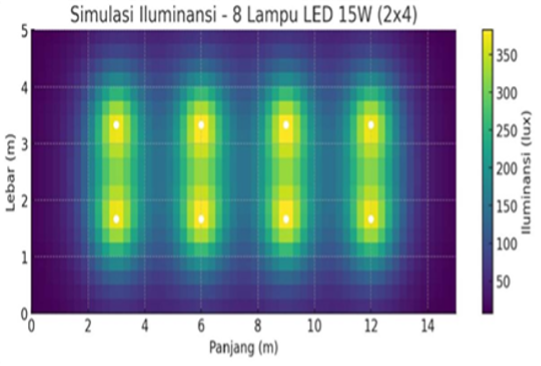
Energy efficiency in office buildings has become a critical issue due to increasing electricity consumption, particularly in lighting systems that operate continuously. Inefficient lighting design can lead to excessive energy use, higher operational costs, and reduced sustainability performance in commercial buildings. Objective: This study aims to analyze the implementation of Light Emitting Diode (LED) technology to improve energy efficiency in office lighting systems using DIALux simulation, while ensuring compliance with standard illumination requirements. Method: This research employs a quantitative descriptive approach supported by simulation modeling. Data were collected through field observation, illumination measurement using a lux meter, and documentation of room specifications. The analysis was conducted using DIALux software to evaluate illuminance levels, light distribution, and energy consumption based on office lighting standards. Findings: The results indicate that the LED lighting system achieves an average illuminance of 340 lux, which meets the SNI 6197:2011 standard (300–500 lux), with a uniformity ratio of 0.68 indicating adequate light distribution and visual comfort. The system consumes 36 kWh per month, which is more than 50% lower than conventional fluorescent (TL) lighting systems. Implications: The findings suggest that LED lighting systems can provide efficient and compliant lighting solutions while significantly reducing energy consumption and operational costs. This supports the implementation of energy-efficient and sustainable building practices. Originality: The originality of this study lies in its integrated approach that combines room characteristics, LED configuration, and DIALux simulation to evaluate lighting performance and energy efficiency simultaneously, offering a practical framework for office lighting design.
References
Afrizal, R. (2022). Analisis Tingkat Pemborosan Energi Listrik Ditinjau Dari Standar Sistem Penerangan Rumah Tangga di Desa Paya Dapur Aceh Selatan UIN Ar-Raniry].
Hasibuan, A., Siregar, W. V., & Fahri, I. (2020). Penggunaan Led Pada Lampu Penerangan Jalan Umum Untuk Meningkatkan Efisiensi Dan Penghematan Energi Listrik. Journal Of Electrical And System Control Engineering, 4(1), 18-32. https://doi.org/10.35134/jesce.v4i1.21
Husnayain, F., Himawan, D. S., Utomo, A. R., Ardita, I. M., & Sudiarto, B. (2023). Analisis Perbandingan Kinerja Lampu LED, CFL, dan Pijar pada Sistem Penerangan Kantor. CYCLOTRON, 6(1). https://doi.org/10.32497/cyclotron.v6i1.4943
Ningrum, D. R., & Yuliani, S. (2024). Strategi Efisiensi Energi Bangunan pada Kampus Fakultas Teknik Infrastruktur Institut Teknologi Bacharuddin Jusuf Habibie Menuju Kampus Berkelanjutan. Senthong, 7(2).
Nugroho, M. F., Pramudito, W. A., & Prayogi, S. (2024). Audit Energi Pada Gedung Universitas Pertamina Menggunakan Metode AHP (Analytical Hierarchy Process). I-Com: Indonesian Community Journal, 4(2), 761-772. https://doi.org/10.33379/icom.v4i2.4379
Pradanugraha, M. A., & Sudiarto, B. (2022). Pengaruh Sistem Peredupan terhadap Efisiensi Energi Penerangan Jalan Umum pada Universitas Indonesia Berdasarkan Metode Lumen. PROtek J. Ilm. Tek. Elektro, 9(1), 63. https://doi.org/10.33387/protk.v9i1.4638
Razu, M., Adelia, A. E., & Asmara, P. B. (2025). Evaluasi Efektivitas Alat Pelindung Diri (APD) dalam Mencegah Kecelakaan di Industri Listrik. Jurnal Ilmu Pengetahuan Naratif, 6(1).
Saputra, T., & Surapati, U. (2024). Analisis Efektivitas Sistem Kendali Otomatis PJU Berbasis IoT Menggunakan Mikrokontroler ESP32 dengan Metode Regresi Linier. Jurnal Indonesia: Manajemen Informatika dan Komunikasi, 5(3), 2582-2595. https://doi.org/10.35870/jimik.v5i3.932
Saputro, J. H., Sukmadi, T., & Karnoto, K. (2013). Analisa Penggunaan Lampu Led Pada Penerangan Dalam Rumah. Transmisi: Jurnal Ilmiah Teknik Elektro, 15(1), 19-27. https://doi.org/10.12777/transmisi.15.1.19-27
Widayati, E. (2021). Estimasi Potensi Penghematan Energi dengan Memperhitungkan Efek Interdependensi Studi Kasus Pada Gedung Perkantoran Bertingkat di Jakarta. Jurnal Inovasi Pendidikan dan Sains, 2(1). https://doi.org/10.51805/jips.v2i1.30
Wiraguna, S. A., & Purwanto, L. M. F. (2024). Integrasi Teknologi Digital Sensor dan Mekanik pada Fasad Bangunan Perkantoran. Journal of Architectural Design and Development (JAD), 5(1), 39-49. https://doi.org/10.37253/jad.v5i1.9124
Downloads
Published
How to Cite
Issue
Section
Citation Check
License
Copyright (c) 2026 Aat Januar Habibi, Erfiana Wahyuningsih

This work is licensed under a Creative Commons Attribution-ShareAlike 4.0 International License.