Circular Economy of Source-Separated Organic Waste in New York City
DOI:
https://doi.org/10.56127/ijst.v5i1.2618Keywords:
Circular Economy, Source-Separated Organic Waste, Composting, Anaerobic Digestion, New York City, Zero WasteAbstract
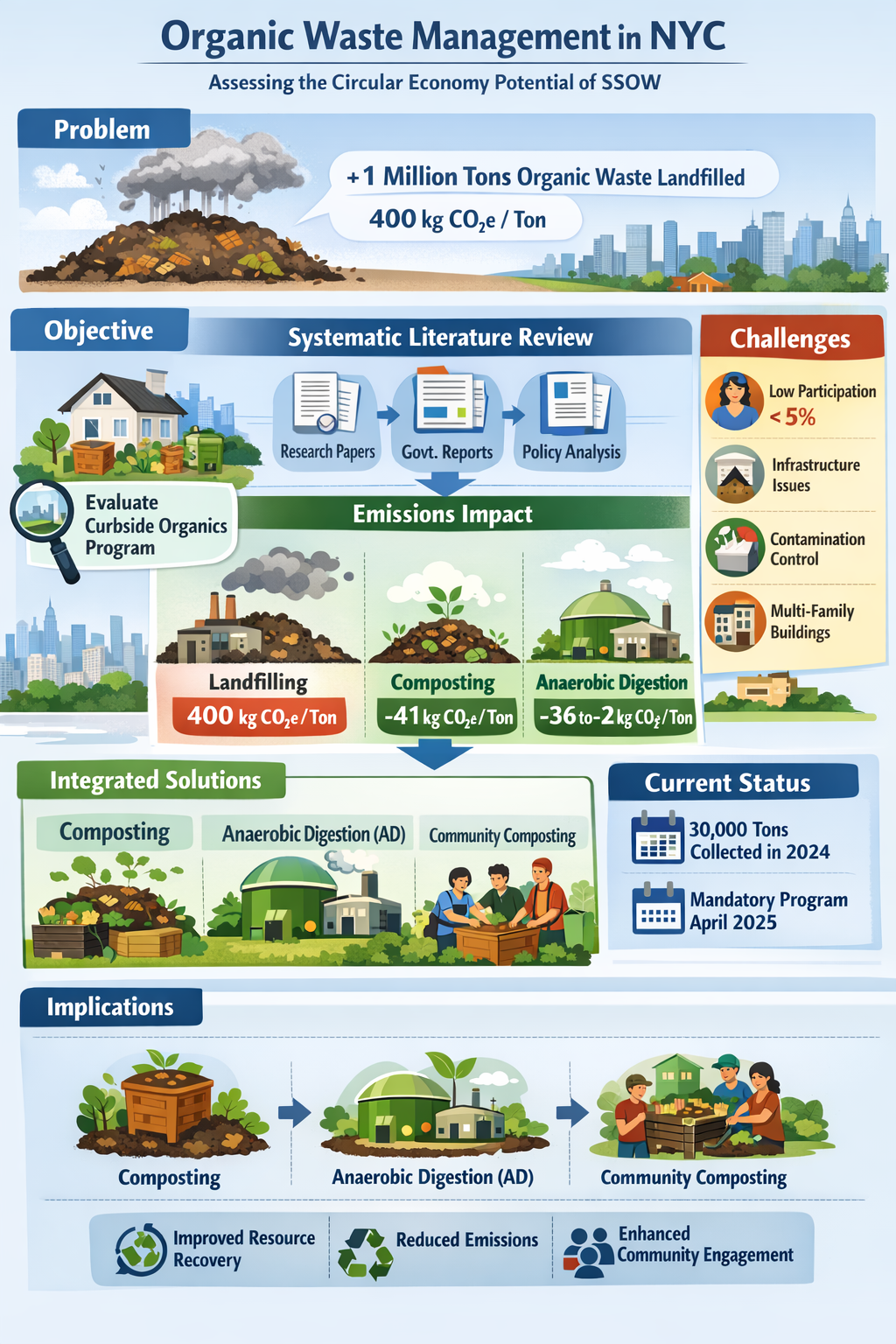
New York City (NYC) generates more than one million tons of compostable organic waste annually, most of which is still landfilled, contributing to greenhouse gas emissions and resource loss. Objective: This review aims to examine the circular economy potential of source-separated organic waste (SSOW) in NYC, with a primary focus on the residential curbside organics program. Method: This study uses a systematic literature review approach by synthesizing peer-reviewed articles, government reports, program documents, and policy records related to composting, anaerobic digestion (AD), community composting, life-cycle assessment (LCA), and NYC’s regulatory framework. Findings: The findings show that landfilling organic waste produces nearly 400 kg CO₂e per tonne, whereas composting generates net negative emissions of approximately −41 kg CO₂e per tonne and dry AD for renewable natural gas yields −36 to −2 kg CO₂e per tonne. Although NYC’s mandatory curbside composting program was fully enforced in April 2025 and collected more than 30,000 tons of organics in 2024, residential capture rates remain below 5%, indicating persistent challenges in infrastructure, public education, contamination control, and multi-family building compliance. Implications: These results imply that an integrated system combining composting, AD, and community composting can improve resource recovery, climate performance, and social participation. Originality: The originality of this review lies in its integrated analysis of technical, environmental, regulatory, and community dimensions of SSOW management within a single circular economy framework, providing a policy-relevant perspective for advancing zero-waste strategies in dense metropolitan contexts.
References
BioCycle. (2026). What NYC’s Organics Enforcement Reveals About Scaling Food Waste Diversion.
Chaudhary, S., Bhatia, T., & Sindhu, S. S. (2024). Sustainable approach for management of organic waste agri-residues in soils for food production and pollution mitigation. In Environmental Nexus Approach (pp. 355-386). CRC Press.
Ddiba, D., Andersson, K., Rosemarin, A., Schulte-Herbrüggen, B., Dickin, S., & Ekener, E. (2022). The Circular Economy Potential of Urban Organic Waste Streams in Low- and Middle-Income Countries. Environment, Development and Sustainability, 24, 1116-1144. https://doi.org/10.1007/s10668-021-01487-w
Ellacuriaga, M., García-Cascallana, J., & Gómez, X. (2021). Biogas Production from Organic Wastes: Integrating Concepts of Circular Economy. Fuels, 2(2), 144-167. https://doi.org/10.3390/fuels2020009
Ellen MacArthur, F. (2013). Towards the Circular Economy: Economic and Business Rationale for an Accelerated Transition.
Jalalipour, H., Jaafarzadeh, N., Morscheck, G., Narra, S., & Nelles, M. (2020). Potential of producing compost from source-separated municipal organic waste (A case study in Shiraz, Iran). Sustainability, 12(22), 9704.
Lelicińska-Serafin, K., Manczarski, P., & Rolewicz-Kalińska, A. (2023). An Insight into post-consumer food waste characteristics as the key to an organic recycling method selection in a circular economy. Energies, 16(4), 1735.
MacBride, S. (2024). New York City Residential Curbside Organics Program: FY2024 Quarterly Capture Rate Report. https://www.biocycle.net/wp-content/uploads/2024/10/FY24ResidentialCurbsideOrganicsQtlyReport.pdf
Morrow, O., & Davies, A. (2022). Creating careful circularities: community composting in New York City. Transactions of the Institute of British Geographers, 47(2), 529-546.
New York City Department of, S. (2023). 2023 NYC Waste Characterization Study. https://www.nyc.gov/assets/dsny/downloads/resources/reports/waste-characterization-studies/2023/wcs-2023.pdf
New York City Department of, S. (2024). Commercial Organics Requirements. https://www.nyc.gov/site/dsny/businesses/materials-handling/commercial-organics-requirements.page
New York City Department of, S. (2025). Curbside Composting Program. https://www.nyc.gov/site/dsny/collection/residents/curbside-composting.page
Nordahl, S. L., Devkota, J. P., Amirebrahimi, J., Smith, S. J., Breunig, H. M., Preble, C. V., Satchwell, A. J., Jin, L., Brown, N. J., Kirchstetter, T. W., & Scown, C. D. (2020). Life-Cycle Greenhouse Gas Emissions and Human Health Trade-Offs of Organic Waste Management Strategies. Environmental Science & Technology, 54(15), 9200-9209. https://doi.org/10.1021/acs.est.0c00364
Nordahl, S. L., Preble, C. V., Kirchstetter, T. W., & Scown, C. D. (2023). Greenhouse gas and air pollutant emissions from composting. Environmental Science & Technology, 57(6), 2235-2247.
Rabii, A., El Sayed, A., Ismail, A., Aldin, S., Dahman, Y., & Elbeshbishy, E. (2024). Optimizing the Mixing Ratios of Source-Separated Organic Waste and Thickened Waste Activated Sludge in Anaerobic Co-Digestion: A New Approach. Processes, 12(4), 794.
Sanciolo, P., Rivera, E., Navaratna, D., & Duke, M. C. (2022). Food waste diversion from landfills: a cost–benefit analysis of existing technological solutions based on greenhouse gas emissions. Sustainability, 14(11), 6753.
Tamasiga, P., Miri, T., Onyeaka, H., & Hart, A. (2022). Food Waste and Circular Economy: Challenges and Opportunities. Sustainability, 14(16), 9896. https://doi.org/10.3390/su14169896
Downloads
Published
How to Cite
Issue
Section
Citation Check
License
Copyright (c) 2026 Santunu Barua

This work is licensed under a Creative Commons Attribution-ShareAlike 4.0 International License.