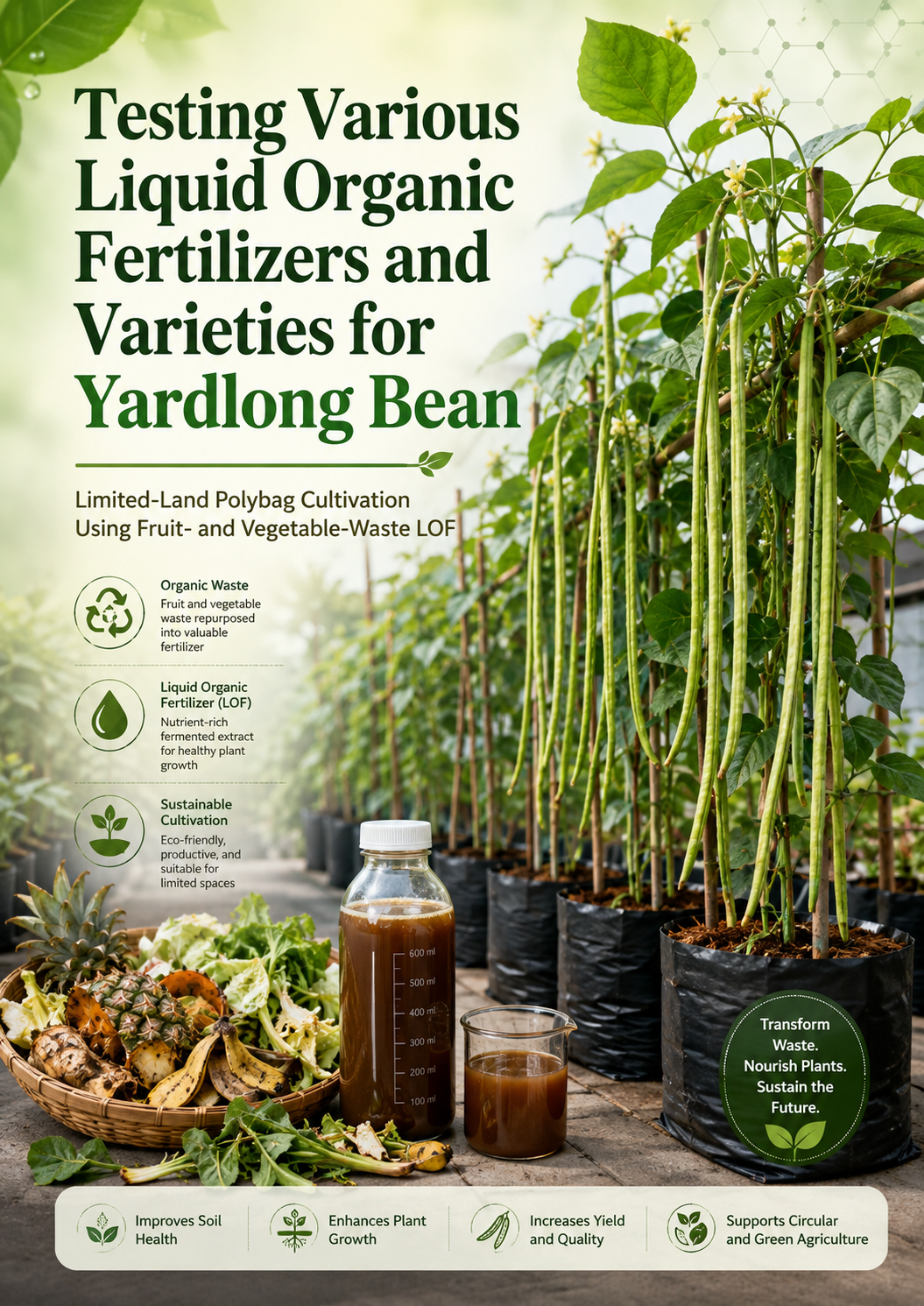
Testing Various Liquid Organic Fertilizers and Varieties for Yardlong Bean (Vigna unguiculata L.) on Limited Land in Pengempon Village, Sruweng, Kebumen
DOI:
https://doi.org/10.56127/ijst.v5i2.2930Keywords:
yardlong bean, liquid organic fertilizer, organic waste recycling, polybag cultivation, varietal responseAbstract
Limited agricultural land and the increasing volume of biodegradable household waste require cultivation technologies that are efficient, sustainable, and applicable to small-scale vegetable production. Liquid organic fertilizer (LOF) produced from fruit and vegetable waste has the potential to recycle organic materials while supplying nutrients for crop growth. Objective: This study aimed to evaluate the growth and yield responses of three yardlong bean varieties to different sources of waste-derived LOF under limited-land polybag cultivation. Methods: A quantitative experimental approach was employed using a 4 × 3 factorial Randomized Complete Block Design with three replications. The first factor consisted of four LOF treatments: no LOF, fruit-waste LOF, vegetable-waste LOF, and mixed fruit–vegetable waste LOF. The second factor comprised the Parade, Fantastik, and Komet varieties. Plant height, leaf number, pod number, and pod weight were measured directly. The data were analyzed using factorial analysis of variance, followed by Duncan’s Multiple Range Test at the 5% significance level when significant differences were detected. Results: LOF application significantly supported early vegetative growth, particularly by increasing the number of leaves at two weeks after planting. Fruit-waste LOF produced the numerically highest leaf number, although its effect was statistically comparable to vegetable-waste and mixed fruit–vegetable waste LOFs. No marked differences were detected among the three varieties, while plant height and yield components showed relatively uniform responses during the first three harvests. Implications: Household fruit and vegetable waste can potentially be processed into an alternative fertilizer input to support the early establishment of yardlong bean in limited-land cultivation. Optimization of LOF concentration, application frequency, and nutrient composition is required to improve its contribution to pod production. Originality: The originality of this study lies in the simultaneous comparison of three waste-derived LOF sources and three yardlong bean varieties within a factorial polybag experiment under limited-land conditions.
References
Amir, M., Sari, D., & Dewi, P. (2022). Peran pupuk organik cair sebagai biofertilizer dalam memperbaiki struktur tanah dan meningkatkan kesuburan lahan. Jurnal Pertanian Berkelanjutan, 5(2), 125-134.
Aprilia, R. L., & Sukur, S. (2022). Kajian sifat fisik, kimia, dan biologi pada tanah berpasir di beberapa wilayah Indonesia. Jurnal Agroteknologi, 1(02), 71-79. https://doi.org/10.53863/agronu.v1i02.475
Ardiyanti, D., Fahriah, S. Y., & Chodijah, M. (2021). Pemanfaatan limbah sayur sebagai pupuk organik cair tanaman di RW 12 Kelurahan Babakan Surabaya. Proceedings UIN Sunan Gunung Djati Bandung,
Badan Pusat, S. (2018). Statistik tanaman pangan Indonesia 2017-2018.
Baon Yosep, M. (2017). Kacang panjang sebagai kuliner nusantara. Majalah Agroindonesia, 12(3), 30-37.
Chand, J., Reza, R., Chowdhury, M., Hager, J. V., Dash, P. K., Akter, N., & Cammarisano, L. (2026). Liquid organic fertilizers in soilless cultivation: A systematic review of production, performance, challenges, and future prospects. Frontiers in Sustainability, 7, 1775182. https://doi.org/10.3389/frsus.2026.1775182
Danga, J. R. Y., Bulu, S. I., Riti, D. N., Saghu, Y. S., Nduka, R., Wohangara, M. G. L., & Lika, R. R. (2026). Pengaruh pupuk organik cair terhadap pertumbuhan dan jumlah daun tanaman kacang panjang (Vigna sesquipedalis). Jurnal Agroteknologi, 5(1), 38-44. https://doi.org/10.53863/agronu.v5i01.2161
Ibrahim, A. (2022). Respon pemberian pupuk kandang kambing dan pupuk organik cair (POC) kulit nanas terhadap pertumbuhan dan produksi tanaman mentimun (Cucumis sativus L.) [Doctoral dissertation, Universitas Medan Area]. Medan, Indonesia.
Nur, T., Noor, A. R., & Elma, M. (2018). Pembuatan pupuk organik cair dari sampah organik rumah tangga dengan bioaktivator EM4. Konversi, 5(2), 44-51.
Refaldi, A. D., Soedomo, P., Muharam, M., & Rahayu, Y. S. (2021). Pengaruh konsentrasi pupuk organik cair serta varietas dan galur terhadap pertumbuhan dan produksi benih tanaman kacang panjang (Vigna sinensis L.). ZIRAA'AH Majalah Ilmiah Pertanian, 46(3), 330-340. https://doi.org/10.31602/zmip.v46i3.4578
Rukmana, D. (1997). Pertumbuhan dan perkembangan tanaman kacang panjang. Jurnal Hortikultura Indonesia, 6(1), 14-20.
Wang, Y., Maltais-Landry, G., Rathinasabapathi, B., Sargent, S. A., & Liu, G. (2021). Growth and yield responses of pot-grown long bean and luffa to nitrogen rates. Agriculture, 11(11), 1145. https://doi.org/10.3390/agriculture11111145
Zahanis, Z., Fatimah, F., & Anggraini, Y. (2022). Growth and production of long bean plants (Vigna sinensis L.) on concentration level of liquid organic fertilizer banana weevil and chitosan. Eksakta, 23(1), 18-29. https://doi.org/10.24036/eksakta/vol23-iss01/302
Downloads
Published
How to Cite
Issue
Section
Citation Check
License
Copyright (c) 2026 Fauziyatul Fitri, Rennanti Lunnadiyah Aprilia

This work is licensed under a Creative Commons Attribution-ShareAlike 4.0 International License.