Design and Development of a Press Machine for Biobriquettes Made from Patchouli Distillation Waste and Rice Husk
DOI:
https://doi.org/10.56127/ijst.v5i1.2378Keywords:
Hydraulic Briquette Press, Patchouli Waste, Rice Husk, Pneumatic Cleaning, Safety SystemAbstract
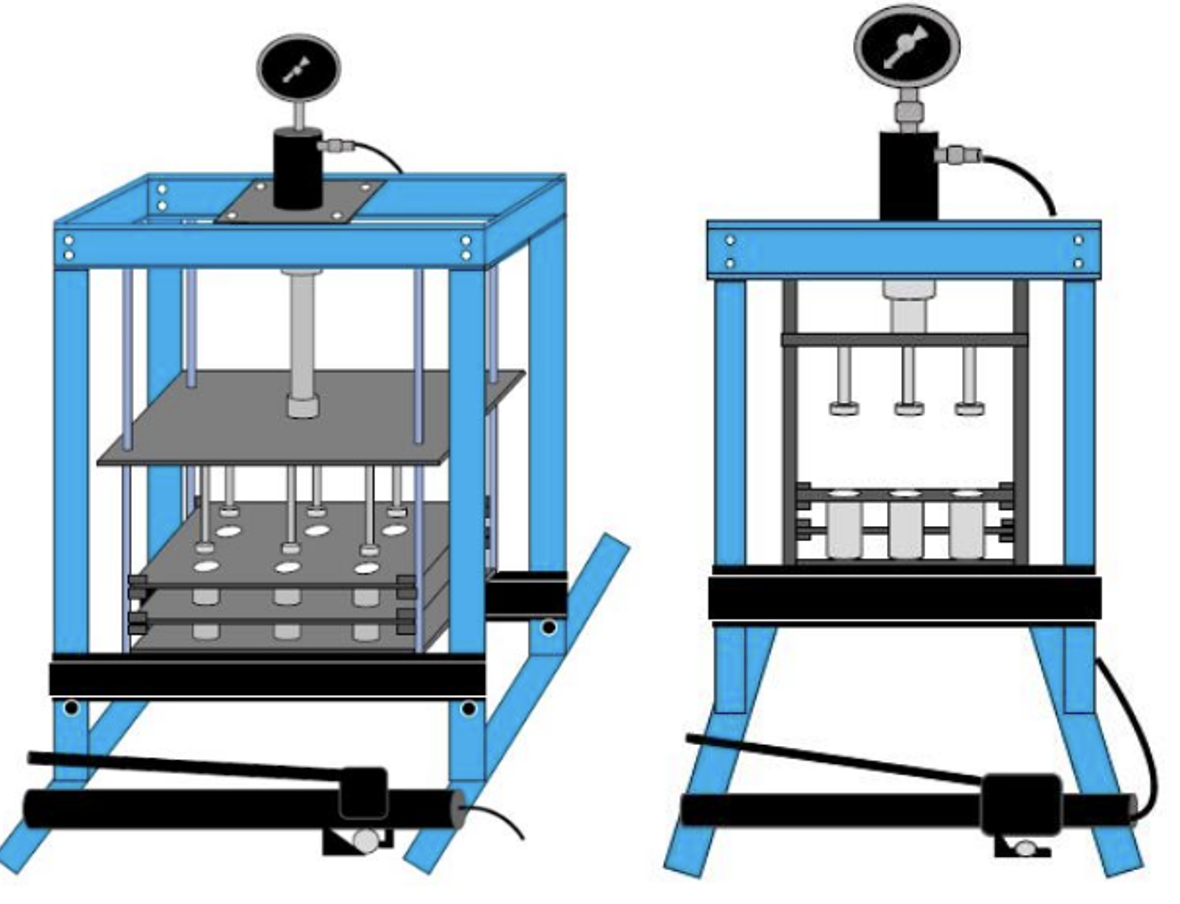
The increasing availability of biomass residues such as patchouli distillation waste and rice husk presents an opportunity for renewable energy production; however, their utilization remains limited due to the lack of efficient and safe small-scale processing equipment. Developing practical briquette production systems is therefore essential to support sustainable energy use at household and MSME levels. Objective: This study aims to develop and evaluate a hydraulic briquette press capable of producing biomass briquettes from patchouli distillation waste and rice husk while enhancing operational safety, maintenance efficiency, and usability for small-scale production. Method: The research employed an engineering research-and-development approach involving machine design, prototype fabrication, and functional testing. Data were collected through technical observation and performance monitoring of pressing cycles, followed by descriptive analysis to evaluate operational functionality, safety response, and cleaning effectiveness. Findings: The developed press integrates a pressure-sensor-based safety system and an automatic pneumatic cleaning mechanism. The machine is capable of forming six briquettes per cycle at an operating pressure of approximately 50 kg/cm². The integrated systems functioned as intended, supporting stable operation, reducing manual cleaning needs, and improving operational safety. Implications: The proposed design demonstrates potential for improving briquette production efficiency and reliability in small-scale applications. By reducing downtime and enhancing safety, the system can support wider adoption of biomass briquette technology and contribute to community-level renewable energy utilization. Originality/Value: This study offers a novel integration of hydraulic pressing, automatic pneumatic cleaning, and pressure-based safety monitoring within a single multi-cavity briquette press, providing a practical and user-oriented solution for transforming agricultural waste into renewable energy products.
References
Abdel Aal, A. M. K. (2023). Impact of biomass moisture content on the physical properties of briquettes produced from recycled Ficus nitida pruning residuals. Sustainability, 15(15), 11762. https://doi.org/10.3390/su151511762
Carnaje, N. P. et al. (2018). Development and characterisation of charcoal briquettes from water hyacinth (Eichhornia crassipes)-molasses blend. PLOS ONE, 13(11), e0207135. https://doi.org/10.1371/journal.pone.0207135
Ginting, Z. (2022). Thermal and Physical Properties of Patchouli Essential Oil Industry Residue as Renewable Feedstock for Bioenergy. Journal of Renewable Energy, Electrical, and Computer Engineering, 2(1), 14–20. https://doi.org/10.29103/jreece.v2i1.6644
Ginting, Z. (2025). Optimization of the production of grade A liquid smoke from Patchouli solid residue using a distillation-adsorption process. AIMS Environmental Science, 12(1), 106–119. https://doi.org/10.3934/environsci.2025005
Irzandy, A. et al. (2024). Pengembangan Alat Pencetak Briket Arang Dengan Sistem Otomatis Pneumatic Single Acting. Jurnal Ilmiah Nusantara, 1(6), 61–71. https://doi.org/https://doi.org/10.61722/jinu.v1i6.2770
Jekayinfa, S. O. et al. (2024). Effects of binders and die geometry on quality of densified rice bran using a screw-type laboratory scale pelleting machine. Results in Engineering. https://doi.org/10.1016/j.nexus.2024.100275
Kim, J., & Park, S. (2022). Monitoring and safety control strategies for industrial hydraulic press systems. Journal of Manufacturing Systems, 64, 412–421. https://doi.org/10.1016/j.jmsy.2022.05.018
Kpalo, S. Y. et al. (2020). A review of technical and economic aspects of biomass briquetting. Sustainability, 12(11), 4609. https://doi.org/10.3390/su12114609
Lisowski, A. et al. (2019). Effects of compaction pressure and particle size on quality of biomass briquettes. Renewable Energy, 138, 706–715. https://doi.org/10.1016/j.renene.2019.01.112
Nunes, L. J. R. et al. (2020). Biomass densification systems for energy production: A review. Renewable and Sustainable Energy Reviews, 129, 109923. https://doi.org/10.1016/j.rser.2020.109923
Rahman, M. M. et al. (2020). Design and performance evaluation of a hydraulic briquetting machine for biomass densification. Energy Reports, 6, 144–151. https://doi.org/10.1016/j.egyr.2019.11.047
Sarker, S. et al. (2021). Biomass briquette production: A review of raw materials and technological approaches. Journal of Cleaner Production, 294, 126287. https://doi.org/10.1016/j.jclepro.2021.126287
Subekti, M. I. (2023). Desain sistem kontrol mesin presser briket limbah bambu–serbuk kayu menggunakan PLC Mitsubishi FX1N-60MR-D. Jurnal Rekayasa Mesin, 18(3), 483. https://doi.org/10.32497/jrm.v18i3.5083
Tumuluru, J. S. (2020). Biomass densification: Fundamentals, technologies, and applications. Biofuels, Bioproducts and Biorefining, 14(5), 1087–1108. https://doi.org/10.1002/bbb.2125
Wang, L. et al. (2022). Influence of moisture content and pressure on the physical properties of biomass briquettes. Fuel, 310, 122386. https://doi.org/10.1016/j.fuel.2021.122386
Downloads
Published
How to Cite
Issue
Section
Citation Check
License
Copyright (c) 2026 Vincen Tandiapa, Rifan Pantow, Simon Simanjuntak, Friani Manoppo, Josephine Raphaela, Tineke Saroinsong, Alfred Noufie Mekel, Firmansyah Reskal Motulo, Estrela Bellia Muaja

This work is licensed under a Creative Commons Attribution-ShareAlike 4.0 International License.