Development of a Web-Based Computer-Based Test System Using Exact Matching and Fuzzy Text Matching for Automated Scoring
DOI:
https://doi.org/10.56127/juit.v5i3.3105Keywords:
Automated Scoring, Computer-Based Test, Educational Assessment, Exact Matching, Fuzzy Text MatchingAbstract
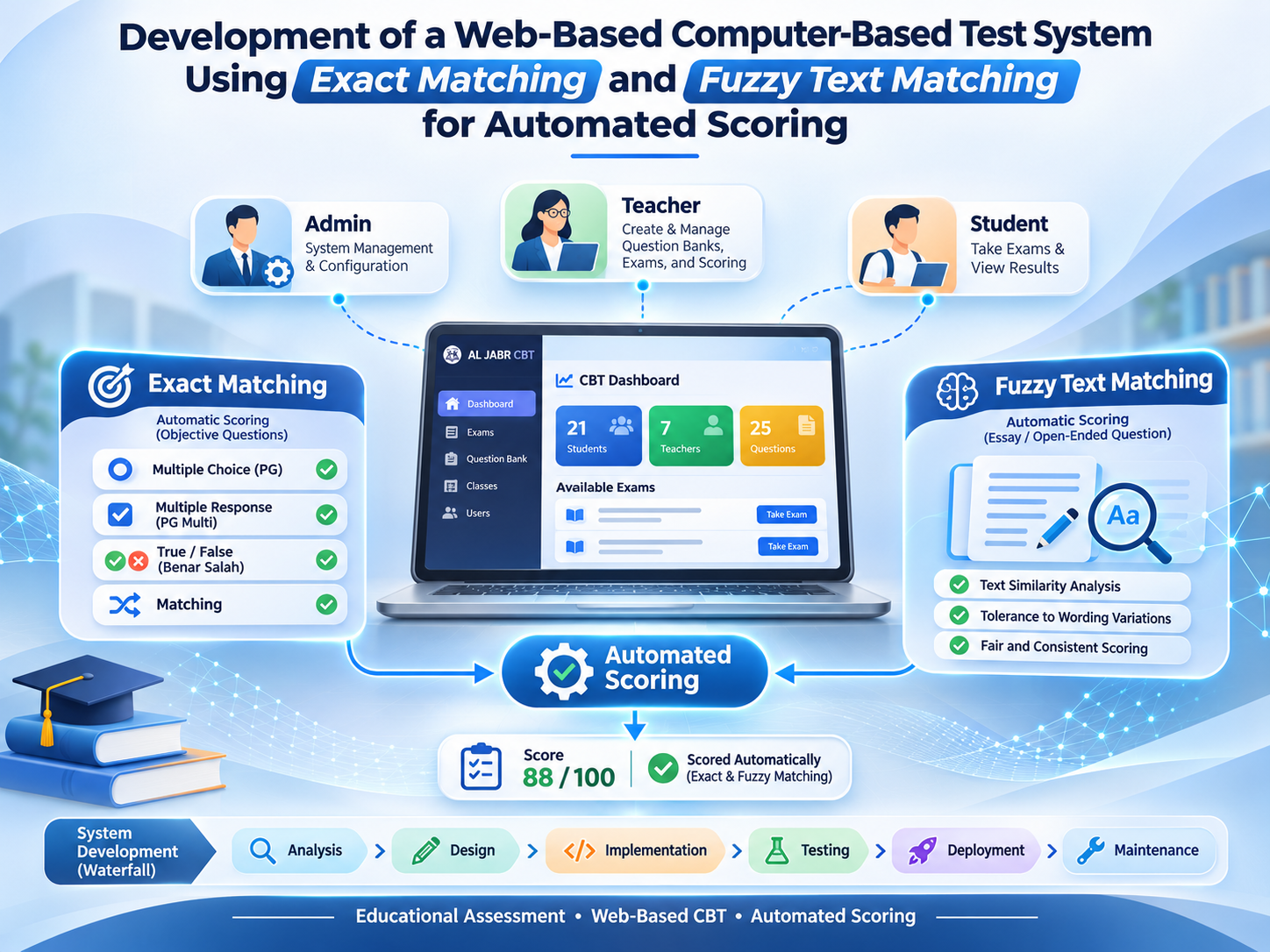
Conventional paper-based examinations present operational challenges, including time-consuming grading procedures, increased administrative workloads, and potential errors in examination result processing. Objective: This study aims to develop a web-based Computer-Based Test (CBT) system integrating Exact Matching and Fuzzy Text Matching to support examination administration and automated scoring at SMP Al Jabr Islamic School. Methodology: This study adopts a software development research design using the Waterfall methodology, combining qualitative descriptive analysis of user requirements with quantitative descriptive evaluation of system functionality. Data were collected through observations, interviews, and literature reviews. The system was implemented using Laravel and MySQL and evaluated through Black Box Testing. Findings: The developed system accommodates three user roles and five question types, applying Exact Matching to four objective question types and Fuzzy Text Matching to essay responses. The reported functional testing results achieved a 100% success rate, indicating conformity with the evaluated system requirements. Implications: The proposed system provides a technological foundation for digital examination management, automated scoring, and structured academic data processing. However, scoring accuracy and operational efficiency require further quantitative validation. Originality: This study contributes an integrated assessment approach that combines deterministic and similarity-based scoring mechanisms within a unified web-based CBT platform tailored to the operational requirements of junior secondary education.
References
Aidah, A., Arifudin, O., Kartika, I., & Ibrahim, T. (2024). Pengembangan sistem informasi manajemen dalam dunia pendidikan. Jurnal Tahsinia, 5(6), 966-977. https://doi.org/10.57171/jt.v5i6.604
Amalia, A., Hamidah, S. W. P., & Kristanto, T. (2021). Pengujian black box menggunakan teknik equivalence partitions pada aplikasi e-learning berbasis web. Building of Informatics, Technology and Science (BITS), 3(3), 269-274. https://doi.org/10.47065/bits.v3i3.1062
Boevé, A. J., Meijer, R. R., Albers, C. J., Beetsma, Y., & Bosker, R. J. (2015). Introducing computer-based testing in high-stakes exams in higher education: Results of a field experiment. PLOS ONE, 10(12), e0143616. https://doi.org/10.1371/journal.pone.0143616
Burrows, S., Gurevych, I., & Stein, B. (2015). The eras and trends of automatic short answer grading. International Journal of Artificial Intelligence in Education, 25(1), 60-117. https://doi.org/10.1007/s40593-014-0026-8
del Gobbo, E., Guarino, A., Cafarelli, B., & Grilli, L. (2023). GradeAid: A framework for automatic short answers grading in educational contexts—Design, implementation and evaluation. Knowledge and Information Systems, 65, 4295-4334. https://doi.org/10.1007/s10115-023-01892-9
Hidayat, R., Septian, A., Lattu, A., Permana, M. A., Verianti, G., & Sukmawan, D. (2024). Pengembangan aplikasi ujian online berbasis komputer (CBT) di SMP Terpadu Al-Ghifari Kabupaten Sukabumi. Jurnal Sistem Informasi dan Teknologi Informasi, 6(1), 332-337. https://doi.org/10.52005/jursistekni.v6i1.246
Iman, F. N., & Farida, I. (2025). Pengembangan aplikasi CBT menggunakan framework Laravel dan Electron JS. JIKA (Jurnal Informatika), 9(4), 446-454. https://doi.org/10.31000/jika.v9i4.14795
Kementerian Pendidikan Dasar dan, M. (2025a). Asesmen Nasional Berbasis Komputer (ANBK). https://anbk.kemendikdasmen.go.id/
Kementerian Pendidikan Dasar dan, M. (2025b). Tanya jawab seputar Tes Kemampuan Akademik (TKA). https://www.kemendikdasmen.go.id/download/file/1201
Kurniadi, D., Gernowo, R., Surarso, B., Wibowo, A., & Warsito, B. (2023). Sistem penilaian jawaban singkat otomatis pada ujian online berbasis komputer menggunakan algoritma cosine similarity. JEPIN (Jurnal Edukasi dan Penelitian Informatika), 9(2). https://doi.org/10.26418/jp.v9i2.66934
Mushthofa, Z., Rusilowati, A., Sulhadi, S., Marwoto, P., & Mindiyarto, B. N. (2021). Analisis perilaku kecurangan akademik siswa dalam pelaksanaan ujian di sekolah. Jurnal Kependidikan: Jurnal Hasil Penelitian dan Kajian Kepustakaan di Bidang Pendidikan, Pengajaran dan Pembelajaran, 7(2), 446-452. https://doi.org/10.33394/jk.v7i2.3302
Nur, A. M., Piarsa, I. N., & Sukarsa, I. M. (2022). Rancang bangun sistem ujian online berbasis web. JITTER: Jurnal Ilmiah Teknologi dan Komputer, 3(3), 1257-1269. https://doi.org/10.24843/JTRTI.2022.v03.i03.p01
Perry, K., Meissel, K., & Hill, M. F. (2022). Rebooting assessment: Exploring the challenges and benefits of shifting from pen-and-paper to computer in summative assessment. Educational Research Review, 36, 100451. https://doi.org/10.1016/j.edurev.2022.100451
Pressman, R. S., & Maxim, B. R. (2020). Software engineering: A practitioner's approach (9 ed.). McGraw-Hill Education.
Ramesh, D., & Sanampudi, S. K. (2022). An automated essay scoring systems: A systematic literature review. Artificial Intelligence Review, 55(3), 2495-2527. https://doi.org/10.1007/s10462-021-10068-2
Saptono, M. P., & Widjasena, H. (2019). Perancangan dan implementasi aplikasi ujian sekolah berbasis komputer atau Computer Based Test (CBT) di SMK Negeri 1 Kabupaten Sorong. Electro Luceat, 5(2), 5-13. https://doi.org/10.32531/jelekn.v5i2.148
Weirich, S., Sachse, K. A., Henschel, S., & Schnitzler, C. (2024). Comparing test-taking effort between paper-based and computer-based tests. Applied Psychological Measurement, 48(1–2), 3-17. https://doi.org/10.1177/01466216241227535
Yudhistira, J. (2024). Perancangan sistem informasi ujian online menggunakan metode Extreme Programming. Journal of Artificial Intelligence and Technology Information, 2(2), 87-95. https://doi.org/10.58602/jaiti.v2i2.122
Zhang, L., Huang, Y., Yang, X., Yu, S., & Zhuang, F. (2022). An automatic short-answer grading model for semi-open-ended questions. Interactive Learning Environments, 30(1), 177-190. https://doi.org/10.1080/10494820.2019.1648300
Downloads
Published
How to Cite
Issue
Section
Citation Check
License
Copyright (c) 2026 Adi Priyatna, Juwari Juwari, Abdur Rohman, Ahmad Soderi, Karno Diantoro

This work is licensed under a Creative Commons Attribution-ShareAlike 4.0 International License.